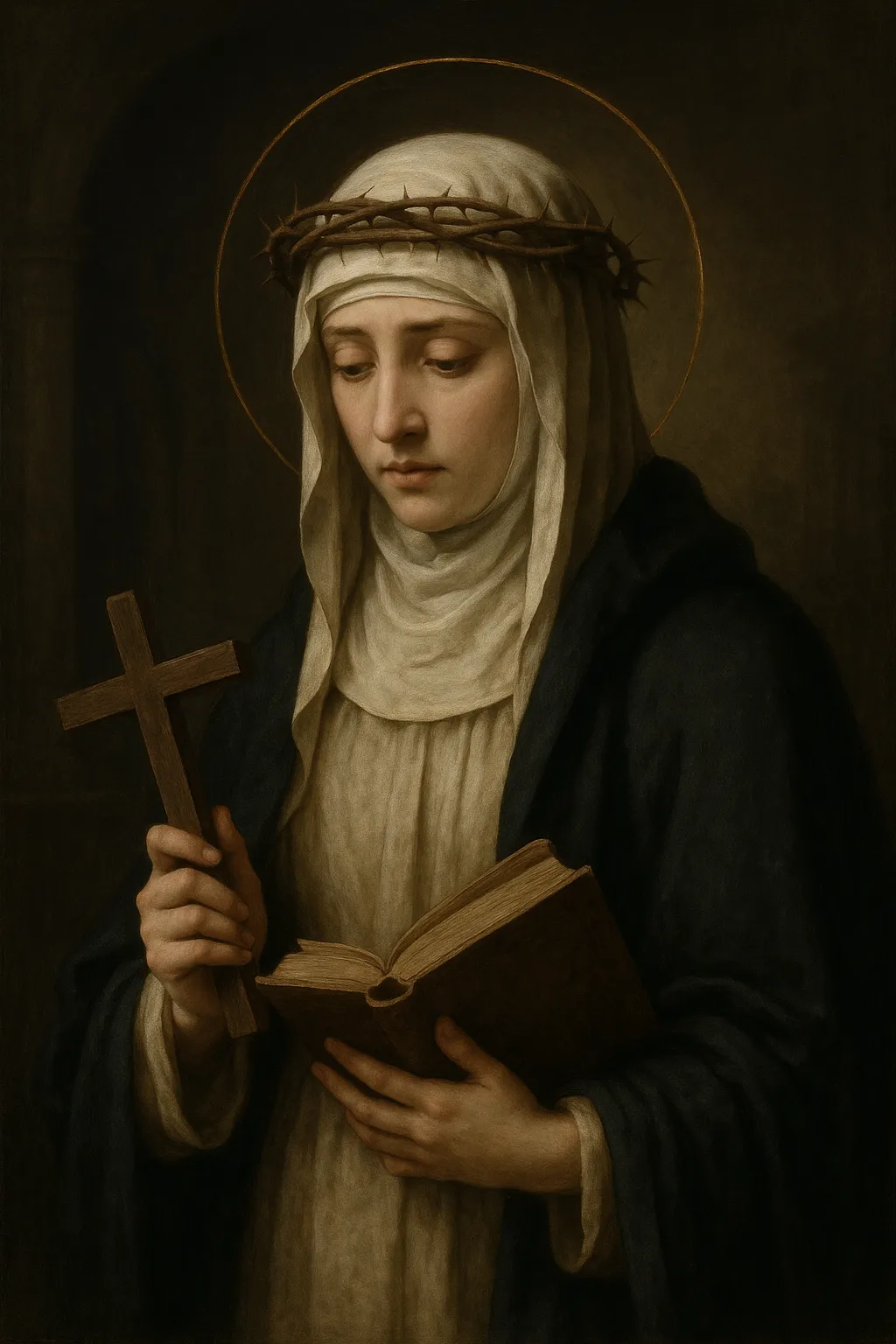
Apostolic tombs, martyr roads, imperial basilicas, and the parishes of later saints, in the city where the Church has never stopped burying and building.
Rome is not one sacred site enlarged to the scale of a capital. Its meaning accumulated. Peter and Paul were buried here, and the roads out of the city filled with the graves of martyrs. When Constantine made building legal, the basilicas went up over those graves. Later saints arrived and took rooms in ordinary neighborhoods. Agnes and Cecilia keep the whole thing from turning abstract: each has a burial place, a church, and a street you can still walk. The city becomes intelligible when you follow one of these lines instead of trying to see everything at once.
Each thread is a finished path with one organizing idea, an honest rhythm, and a reason the stops belong together. Carry one into My Journey whole, or read it and go your own way.
Wilfredor / Wikimedia Commons (CC0 1.0)
Follow the thread
Apostolic Rome
A full day, or two unhurried half days
Peter and Paul give Rome its apostolic axis: two tomb basilicas, one shared feast, and the cathedral of the bishop whose office the Church traces to Peter.
Visit rhythmGive this a full day, or divide it into two unhurried half days. Begin at one apostolic tomb, cross the city to the other, and keep the Lateran as the ecclesial conclusion rather than a hurried third monument.
The four papal basilicas hold Rome's apostolic, cathedral, and Marian memory in a single pilgrimage through the city.
Visit rhythmTreat the four as a full pilgrimage day only with deliberate transit and pauses. A gentler rhythm pairs Peter with Paul, then keeps the Lateran and Santa Maria Maggiore for a second half day.
4 ordered stops · nothing is added until you choose
Raboe001 / Wikimedia Commons (CC BY-SA 3.0)
Follow the thread
Rome of the Early Martyrs
Two half days
Agnes and Cecilia make the early Church visible across tombs, house-church memory, and the catacomb roads beyond the center.
Visit rhythmUse two half days. Keep Agnes's two churches together despite the distance between them; on another morning, descend at San Callisto before returning to Cecilia's basilica in Trastevere.
The apostolic shrine of Rome, built over the tomb of Saint Peter. Pilgrims visit the Confessio above the tomb, the Vatican Grottoes, Bernini's Baldachin, and Michelangelo's Pietà.
Raised over the tomb venerated as Saint Paul's, two kilometres beyond the walls on the Ostian Way. Fire gutted it in 1823; the apse mosaic and Cosmati cloister survived.
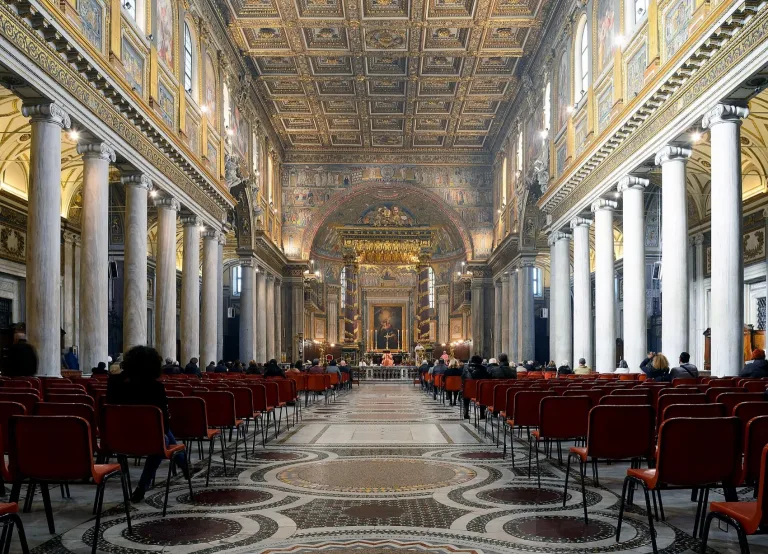
The great Marian basilica of Rome, with early 5th-century mosaics, the venerated icon Salus Populi Romani, and the relics traditionally venerated as fragments of the manger of Bethlehem in the Confessio beneath the altar.
The official cemetery of the early Roman Church, cut into tufa along the Via Appia. The Crypt of the Popes holds the third-century bishops of Rome. Guided visits only.
Rome's only Gothic church interior, with Catherine of Siena's body beneath the altar and Fra Angelico's tomb. The only place in Rome where Gothic vaulting opens overhead.
The Archbasilica of St. John Lateran is the cathedral of the Diocese of Rome and the seat of the Pope as Bishop of Rome. The oldest of the four major papal basilicas and the first public basilica of the city, it is honoured as the mother and head of all the churches of Rome and of the world.
On the summit of the Esquiline Hill, the Basilica of Santa Maria Maggiore is the largest of Rome's churches dedicated to the Blessed Virgin Mary and one of the four major papal basilicas of the city.
Two kilometres south of the Aurelian Walls along the ancient Ostian Way, the Basilica of St. Paul Outside the Walls is the papal basilica raised over the tomb traditionally venerated as the burial place of the Apostle Paul.
On the Via Appia Antica south of the Aurelian Walls, the Catacombs of San Callisto are the largest and most historically central of the Roman catacombs. They preserve the official cemetery of the Church of Rome from the late second century, the Crypt of the Popes where most of the third-century bishops of Rome were buried, the early burial place traditionally associated with Saint Cecilia, and some of the earliest Christian fresco programs in Rome.
The basilica on the Via Nomentana raised over the catacomb where Saint Agnes was buried, two miles beyond the ancient walls. Her body relics rest beneath the high altar, under a seventh-century apse mosaic that is among the oldest images of the saint in Rome.
The Baroque church on Piazza Navona, its concave Borromini facade set over the arches of the ancient Stadium of Domitian, on the spot Roman tradition associates with the public witness of Saint Agnes.
Built directly on the site of Saint Cecilia's family home where she lived and was martyred, this ancient church is a pilgrimage destination for musicians.
The Dominican basilica beside the Pantheon, the one Gothic church interior in Rome, where the body of Saint Catherine of Siena rests beneath the high altar.
The spiritual center of the Catholic Church, housing masterpieces of Renaissance art and architecture beneath Michelangelo's magnificent dome.
Sacred map
Rome Sacred Places Map
6 Essential Places shown.
Switch collections above to fit the active places. Select a marker to visit or save that place.
Each entry named and sourced
Tombs, relics & sacred objects
Rome's relics are remarkable less for their number than for their setting: most rest in the churches built to hold them, on the ground where the saint died or was buried. The entries below are in public churches and open for veneration during visiting hours. Most churches close around midday and reopen in the afternoon, and a modest dress code applies throughout.
Tomb of Saint Peter
ST. PETER'S BASILICA, VATICAN
Documented
Beneath the high altar of St. Peter's Basilica. The primary pilgrimage goal of Rome since the earliest centuries; the Confessio above the tomb is accessible during basilica hours, and Scavi excavations beneath the floor require advance booking.
The marble sarcophagus beneath the altar at San Paolo fuori le Mura bears the ancient inscription PAULO APOSTOLO MART. The basilica identifies this as the tomb of the Apostle, and pilgrims venerate it as the quieter companion to Peter's tomb.
Catherine of Siena died in Rome in 1380 and was buried in the church of the Dominican Order. Her body rests beneath the high altar; her head was later translated to Siena.
Traditionally venerated asRelics of the PassionSanta Croce in Gerusalemme
Traditionally venerated asChains of Saint PeterSan Pietro in Vincoli
Pilgrims venerateBody of Saint CeciliaSanta Cecilia in Trastevere→
Pilgrims venerateRelics of Saint AgnesSant'Agnese fuori le Mura, Via Nomentana→
Traditionally venerated asRelics of the Holy MangerSanta Maria Maggiore→
Traditionally identified withColumn of the FlagellationSanta Prassede
Shape your pilgrimage
Or shape a journey of your own.
Save the places that hold your attention, then let Journey Studio draft a realistic Rome itinerary around your days, your pace, and the times you are already committed to.
Works without an account. Nothing is scheduled until you ask.
Practical, not booking
Before you go
When to go
Spring and autumn are best for walking pilgrimages. August is hot enough to shorten any plan. Liturgies, closures, and reservations change through the year, so check the official site before you go.
Getting around
The churches of the center are walkable in clusters. The four major basilicas are not: each leg between them is a metro or bus ride, and San Paolo and the Via Appia catacombs lie outside the Aurelian Walls.
Reservations
The Scavi beneath St. Peter's tomb must be booked weeks ahead by email. We link the official office. We do not sell tickets.
A word of pace
Two churches a day, prayed, beats seven rushed. These pages are built to slow you down, not to speed you up.
Liturgy
Sunday Masses are celebrated throughout the city in the morning. The Wednesday papal audience at St. Peter's Square requires free tickets from the Vatican. Major feast days bring special celebrations and sometimes restricted access.
Dress code
Shoulders and knees must be covered in all major basilicas and churches. Carry a scarf or light layer. St. Peter's and San Giovanni enforce this strictly at the door.
Walkability
The centro storico is walkable, and the churches inside it sit in tight clusters. The four major basilicas do not: St. Peter's, Santa Maria Maggiore, San Giovanni in Laterano, and San Paolo fuori le Mura stand far apart across the city. San Paolo and the Via Appia catacombs are beyond the Aurelian Walls and need transit.
Transit
Metro Line A runs from Ottaviano near the Vatican through Termini to San Giovanni. Line B reaches San Paolo fuori le Mura. Buses serve the Via Appia catacombs. Walking remains the best way to move between the churches of the center.
Rome keeps its saints where they lived and died rather than in a museum. The apostles lie under their basilicas, the early martyrs in the catacombs, the teachers and founders in the churches where they worked. Each can still be visited where the story happened.
Rome rarely ends a pilgrimage. It sends the traveler north toward Francis and Clare, east into the valleys where Benedict began, and out to Orvieto for the relic that gave the Church the feast of Corpus Christi.
Francis was born here in 1181 and buried here in 1226, and the town has been shaped by that fact ever since. The Basilica of San Francesco holds his tomb and Giotto's cycle of his life; Santa Chiara holds Clare.
Benedict came here as a young man to live alone in a cave. The Sacro Speco was later built into the cliff around it, one chapel stacked on another.
ThePhotografer / Wikimedia Commons (CC BY-SA 4.0)
Monte Cassino
~1.5 hours by train to Cassino, then taxi
The abbey Benedict founded in 529 and where he wrote the Rule. Allied bombing levelled it in 1944; it was rebuilt as it had been. The crypt holds his relics and Scholastica's.
A day in Umbria
Marcok / it.wikipedia.org / Wikimedia Commons (CC BY 2.5)
Orvieto
~1 hour by train
The cathedral was raised to house the corporal of the Bolsena miracle, the relic behind the feast of Corpus Christi. Its mosaic facade is among the finest in Italy.
Farther out
Cascia
~2.5 hours by bus
Rita of Cascia, patron of impossible causes, lies in the basilica above the town. Pilgrims have come since the fifteenth century.
Feedback
Use this for corrections, broken links, missing places, and planning ideas.