Skull relic of Saint Agnes
Head relicYes, at the shrine within the church
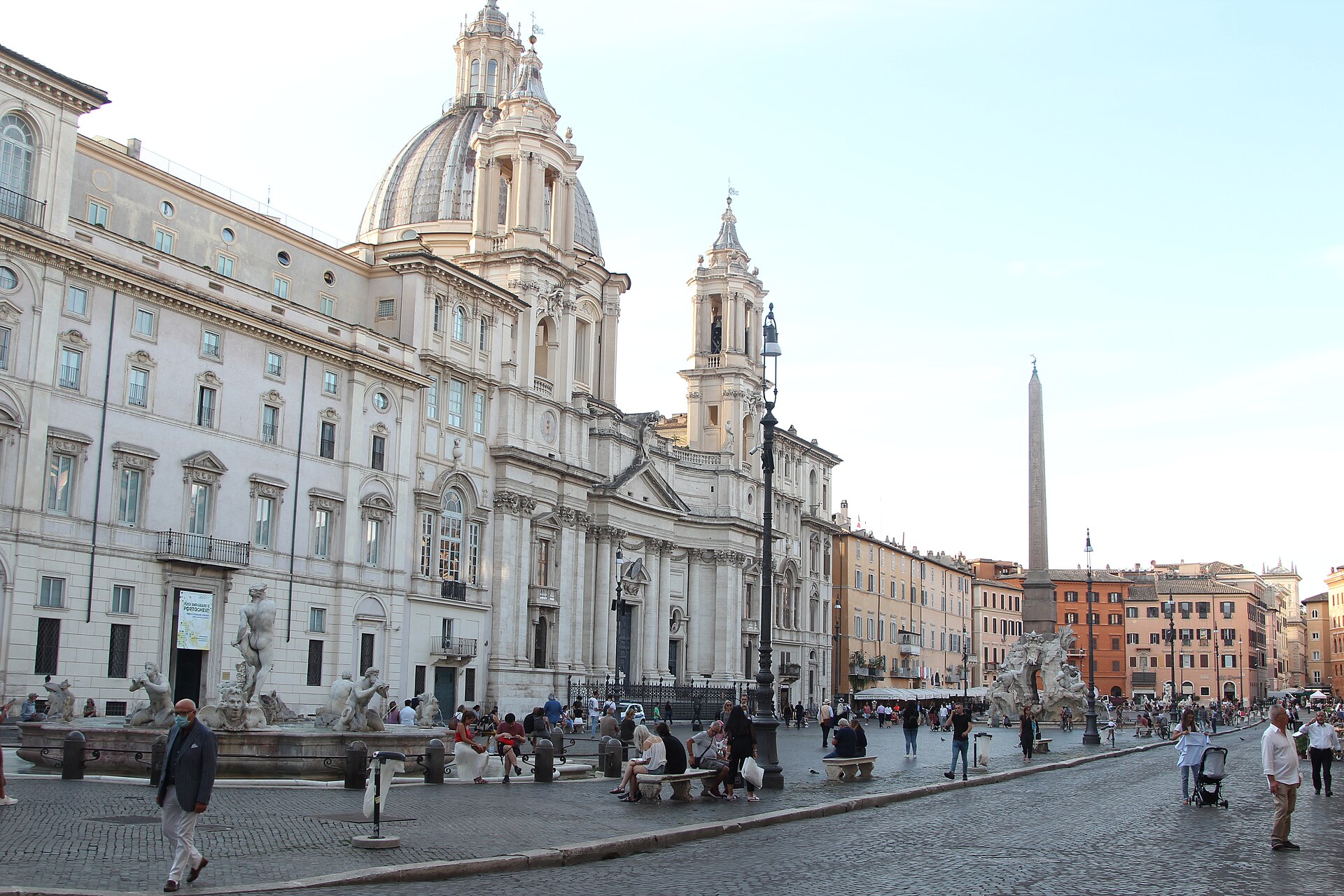
Church of Sant'Agnese in AgoneSant'Agnese in Agone is the Baroque church on Piazza Navona, its concave Borromini facade raised over the arches of the ancient Stadium of Domitian, on the spot Roman tradition associates with the public witness of Saint Agnes. A shrine within preserves the reliquary venerated as her skull.
Come here to meet Agnes where Rome actually walks. This church marks the place tradition links to her public trial and martyrdom, in the middle of one of the city's great squares, and keeps the reliquary venerated as her skull. It is the visible, urban half of her story, the counterpart to her quiet tomb beyond the walls.
Piazza Navona follows the shape of the Stadium of Domitian, where the ancient city held its athletic contests, the agones that gave the church its name. Roman tradition places the public exposure and witness of Agnes on this ground, in the arches of the stadium. A medieval church already marked the spot; in 1652 the Pamphilj family, the family of Pope Innocent X whose palace stood on the square, began the present church. Francesco Borromini took over the facade in 1653 and gave it the concave front that defines the piazza. The body of Agnes rests across the city at Sant'Agnese fuori le Mura; here, where she bore witness, a shrine preserves the reliquary venerated as her skull.
Borromini's facade curves inward between its bell towers so that the dome rises close behind it, a design that shaped Baroque churches well beyond Rome. Inside, the Greek-cross plan is faced in colored marble and Baroque sculpture, and the cupola carries the Apotheosis of Saint Agnes, frescoed from 1670 by Ciro Ferri and finished after his death.
The reliquary venerated as the skull of Saint Agnes, in the heart of Rome
Borromini's facade on Piazza Navona
The site of the ancient Stadium of Domitian, linked by tradition to her public witness
A natural city-center counterpart to her tomb beyond the walls
For all its Baroque grandeur, the reason to enter is devotional: the shrine of Agnes and the memory of her courage held in the busiest part of the city. It is an easy, meaningful stop for families and pilgrims who want her to feel present in the Rome they are walking through.
A side shrine preserves the reliquary traditionally venerated as the skull of Saint Agnes, with Alessandro Algardi's marble relief of the young martyr. Cautious tradition, carefully kept: her body relics are venerated separately, beyond the walls.
The facade curves inward between its towers to let the dome rise behind it, one of the most influential designs of the Roman Baroque. Borromini took it over in 1653 and gave Piazza Navona its defining church front.
The cupola is frescoed with Agnes carried into glory, begun by Ciro Ferri in 1670 and completed after his death. Stand beneath it and look up before leaving.
Piazza Navona keeps the long oval shape of the ancient stadium whose arches once stood here. Tradition places Agnes's public exposure and witness on this ground, which is why a church was raised on it.
Step in from the square to the shrine of Saint Agnes, with the reliquary venerated as her skull and Algardi's relief, then stand beneath the cupola to see the Apotheosis of Saint Agnes before returning to the piazza.
Add Borromini's concave facade seen from the square and the long oval of the Stadium of Domitian that Piazza Navona still traces. The church and the piazza were shaped together.
Pair this church, which marks her public witness in the heart of the city, with Sant'Agnese fuori le Mura beyond the walls, over her tomb and catacomb. The two together hold the whole of her story.
This is the easy half of Agnes to reach and the harder half to slow down for. Let the shrine, not the square, be the reason you came in.
Enter from Piazza Navona and find the shrine of Saint Agnes, with the reliquary venerated as her skull and Algardi's marble relief, then stand beneath the dome to see the Apotheosis frescoed above. Read the visit alongside Sant'Agnese fuori le Mura, which holds her tomb and body relics. Confirm current opening hours before building a visit around the church.
Yes, at the shrine within the church
Church of Sant'Agnese in AgoneThe church marks the site
Roman traditionSource note Traditional attributions are presented as tradition, with documentation named where it exists.
This is Agnes's church in the heart of the city, marking her public witness. It belongs with her tomb beyond the walls and with the other young martyrs of Rome.
This church marks the tradition of Agnes's martyrdom. Continue beyond the walls to the basilica raised over her tomb.
Leave the crowded square for the Via Nomentana, where the basilica descends toward Agnes's grave and catacomb.
Agnes and Cecilia make the early Church visible across tombs, house-church memory, and the catacomb roads beyond the center.
Traditional attributions are identified in context.
The church's own source. The name 'in Agone' refers to the ancient athletic contests of the stadium beneath the piazza, not to the martyr's suffering. Relic language is deliberately cautious: a reliquary traditionally venerated as the skull of Saint Agnes.
June 23, 2026
Use this for corrections, broken links, missing places, and planning ideas.