
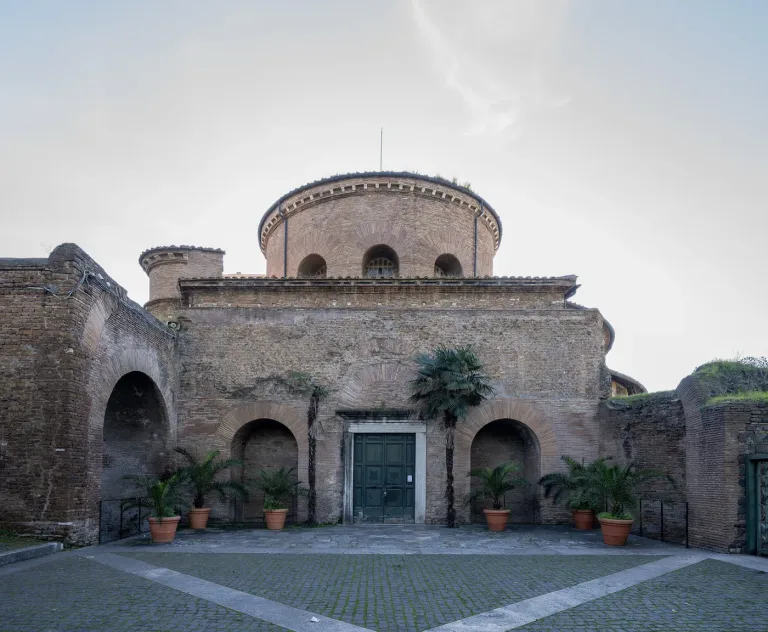
Mausoleum of Santa Costanza, Rome
A round mausoleum built by Constantine's daughter next to the grave of a martyred girl, with the oldest monumental Christian mosaics in Rome still on its vault.
- Location
- Rome, Italy 41.9234° N · 12.5199° E
- Type
- Fourth-century mausoleum, later a church A circular imperial mausoleum of the fourth century, with a domed center ringed by a barrel-vaulted ambulatory
- Dedication
- Santa Costanza, from the medieval identification of Constantina as a saint The ambulatory mosaics
- Time Needed
- 1 hour to half a day
The emperor's daughter beside the martyr
Come for the vault. Rome has older Christian painting in the catacombs, but nothing older on this scale and in this material: the ambulatory mosaics here are the earliest monumental Christian mosaics surviving in the city, older than the apse at Santa Pudenziana and two centuries older than the work at Santa Prassede. Come also for what the building says by standing where it stands. Constantina could have been buried anywhere in the empire. She chose the ground beside a girl the empire had executed.
Constantina, her devotion, and a name the Church never granted
Constantina, called Costanza in Italian, was a daughter of the emperor Constantine. She had the mausoleum built in the fourth century against the flank of the great covered cemetery basilica her family had raised near the burial place of Saint Agnes. The parish records that she was devoted to the martyr and attributed her own healing to Agnes's intercession, which is the tradition's explanation for why an imperial tomb stands on this particular piece of ground.
The name of the building needs care. From the early Middle Ages Constantina was arbitrarily identified as a martyr, and the mausoleum came to be called Santa Costanza. In 1254 Alexander IV made it an autonomous church under that title. The Church has kept the building's name; it has never canonized the woman buried in it. A visitor should read the dedication as the survival of a medieval mistake rather than as a judgment about her, and the honest version is more interesting: the imperial burial matters here because of where it is, not because of who she was.
Her sarcophagus of red porphyry, a stone reserved to the imperial house, was removed to the Vatican Museums at the end of the eighteenth century. What stands in its place is a plaster copy.
The mosaics divide into two campaigns and the difference matters. The barrel vault of the ambulatory is fourth-century work and is what makes this building important: a vintage with putti treading grapes, birds, branches, vessels, and heads in roundels, one pair of which may be Constantina and her first husband. The two mosaics in the side niches, the Traditio Legis and the Traditio Clavium, are another matter. Scholarship dates them anywhere from the fourth century to the seventh, and they were heavily restored between 1834 and 1843 under Camuccini, who remade the heads of Christ and Peter outright. They are worth seeing and they are not evidence of anything at the date the vault is.
A circular building: twelve pairs of granite columns carry a drum and dome at the center, and a barrel-vaulted ambulatory rings it. The external ambulatory is one of the earliest applications in Christian architecture of a form that would be repeated for centuries. The vault of that ring is the mosaic surface.
The double ring of paired granite columns carrying the dome
The vintage mosaics, which a visitor can read as a harvest or as the wine of the Eucharist, and which were probably meant to be read both ways
The quiet, which is unlike anything else on this scale in Rome
An emperor's daughter chose to be buried beside a girl the empire had killed.
Almost nobody is here. The basilica next door receives the pilgrims and the mausoleum receives the few who walk the extra hundred meters. It is a burial place before it is a church, and it reads that way: cool, circular, and centered on an absence where the sarcophagus used to be.
Do Not Miss
-
The ambulatory vault
Fourth century, the oldest monumental Christian mosaics surviving in Rome. Walk the full ring slowly; the design is meant to unfold as you move.
-
The vintage panels
Putti treading grapes among vine scrolls. A harvest, and to Christian eyes the wine of the Eucharist. Both readings were available to the people who made it.
-
The two niche mosaics
Traditio Legis and Traditio Clavium. Impressive, disputed in date, and substantially repainted in the nineteenth century.
-
The sarcophagus copy
A plaster cast standing where the red porphyry original stood. The original went to the Vatican Museums in the late eighteenth century.
-
The paired columns
Twelve pairs of granite carrying the dome. The center is imperial architecture put to Christian use without alteration.
- That the building is a ring, and that the mosaics are only on the ring
- How much of the decoration is not obviously Christian at first glance, and how little that mattered
- The empty center where the sarcophagus stood
- That the basilica of Agnes is visible from the door, which is the whole explanation for the site
- How different the niche mosaics look from the vault, once you know to compare them
Visit Plans
-
The mausoleum unhurried, with the full ambulatory walked twice.
-
With the ruins of the Constantinian basilica beside it.
-
The whole Sant'Agnese complex: basilica, catacomb, ruins and mausoleum.
Visit with the basilica, and after it. Opening hours are narrower than the basilica's and the building is often used for weddings.
How to Visit
Visit after the basilica and the catacomb, not before. The order matters: the martyr's grave first, then the imperial tomb that wanted to be near it. Walk the ambulatory the whole way round rather than standing in the center, because the vault is designed to be read while moving.
- Used for the liturgy occasionally rather than as a parish; the parish life of the complex belongs to the basilica
- Visited as part of the Sant'Agnese complex
- The feast of Saint Agnes on January 21 draws pilgrims to the whole site
Relics, Tombs, Sacred Objects
Tomb and Burial
- Constantina, daughter of the emperor Constantine, for whom the mausoleum was built. She is not a canonized saint. From the early Middle Ages she was identified as a martyr, and the building's name preserves that identification rather than a judgment of the Church.
- The building was raised beside the cemetery in which Saint Agnes was buried, which is the reason it stands here at all.
Relics and Sacred Tradition
- The mausoleum is not a relic shrine. The relics of the complex are those of Saint Agnes, in the basilica a few steps away.
Sacred Objects
- The mosaics of the ambulatory vault, of the fourth century: geometric fields, a vintage with putti treading grapes, birds, vessels, and portrait heads set in roundels
- The two mosaics in the lateral niches, showing the Traditio Legis and the Traditio Clavium, Christ giving the law and the keys to Peter and Paul
- The plaster copy of Constantina's porphyry sarcophagus, standing where the original stood
Continue Your Pilgrimage
-
City hub
Rome
Where this church sits within the wider Catholic geography of Rome.
-
Basilica
Basilica of Sant'Agnese fuori le Mura
The martyr's basilica over her tomb and catacomb. This mausoleum exists because that grave is there, and the two should be visited in that order.
-
Archaeological site
Basilica of Constantina (ruins)
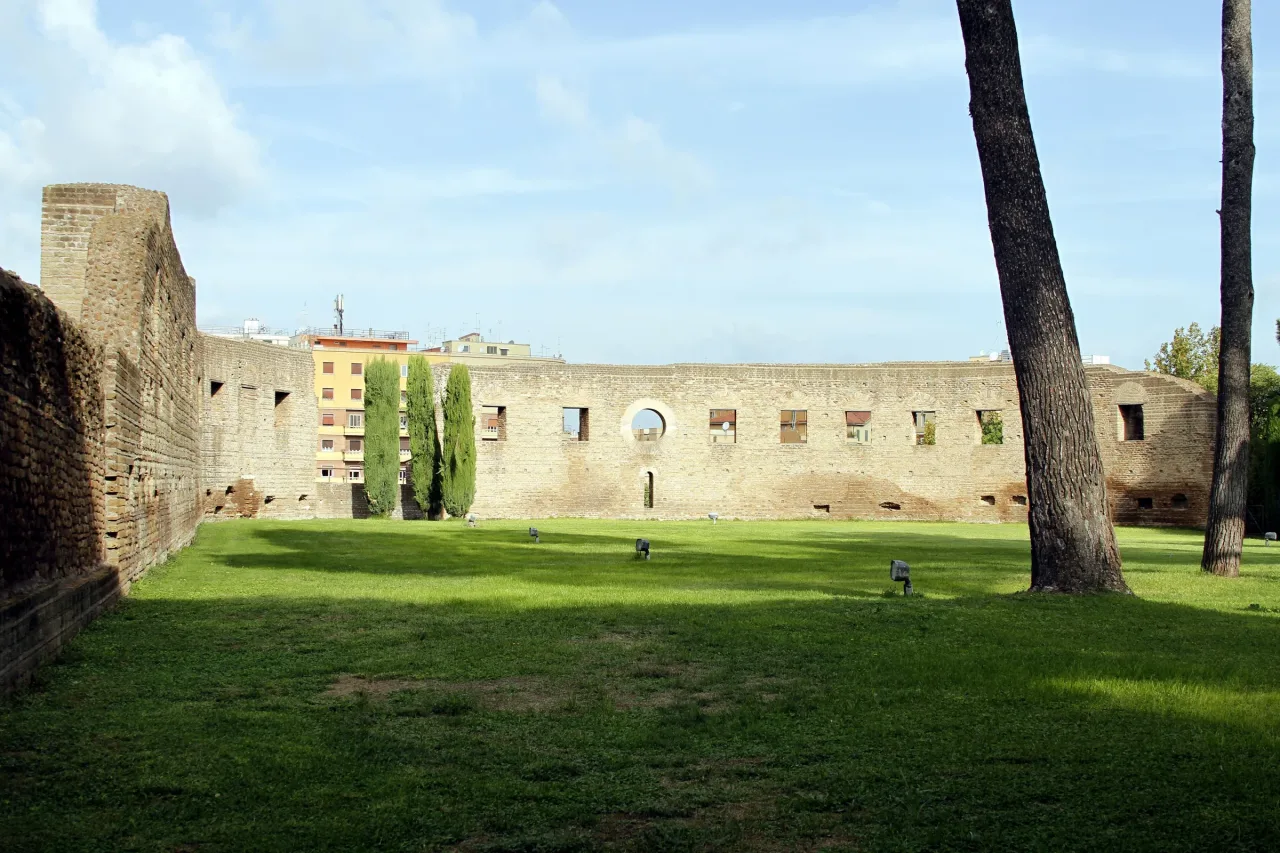
The great covered cemetery basilica the same imperial family raised here. The mausoleum was built against its flank, and the ruins explain the mausoleum's orientation.
-
Basilica
Basilica of Santa Pudenziana
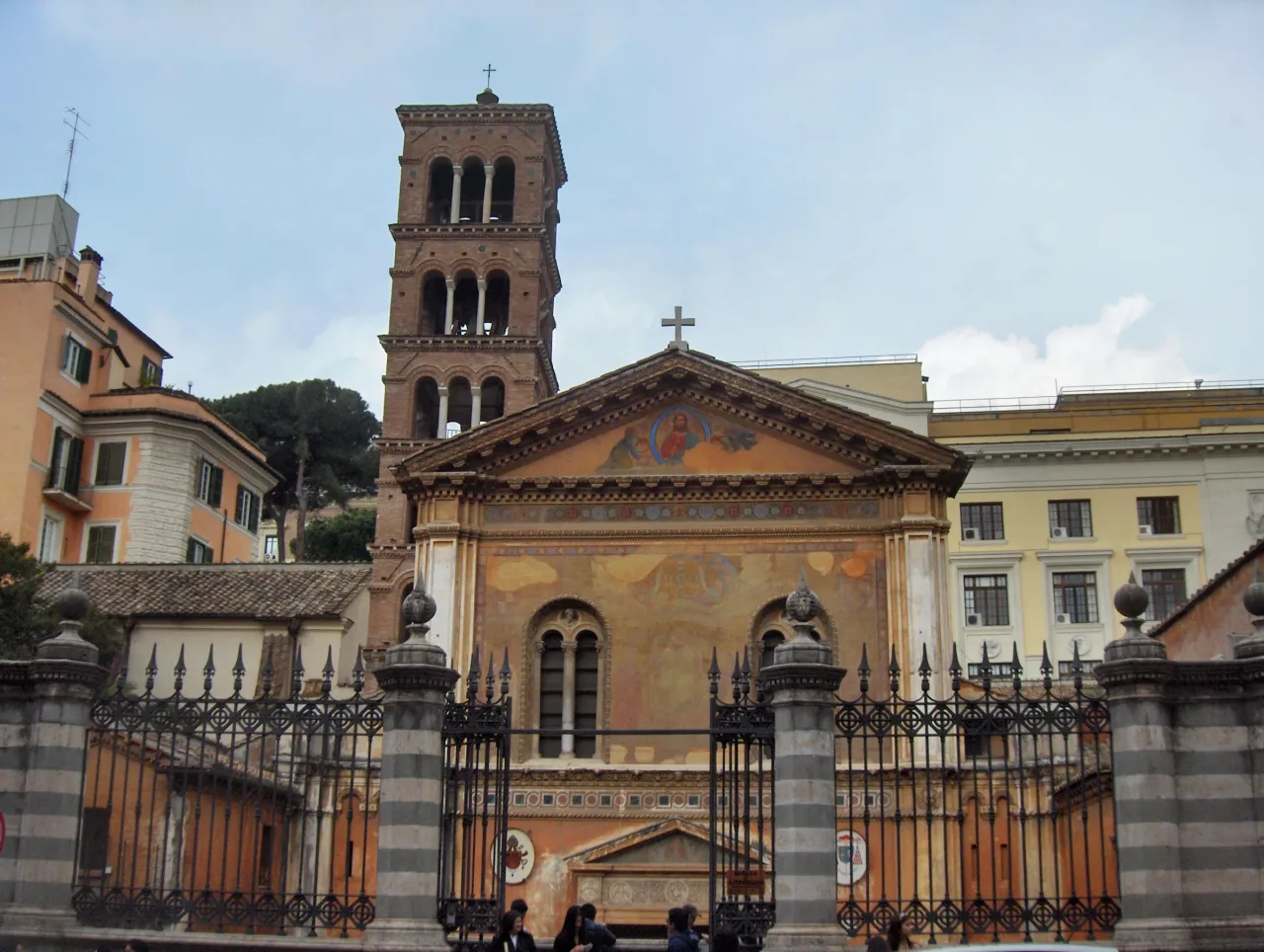
The apse mosaic there, of about 390, is the next step after this vault in the story of monumental Christian mosaic in Rome, and its own page names these mosaics as the older ones.
Map
The Sant'Agnese complex's parish account of the mausoleum.
September 13, 2026