
- Location
- Rome, Italy 41.8836° N · 12.4788° E
- Type
- Minor basilica and religious house An early thirteenth-century monastic church heavily remodeled in the eighteenth century, keeping its Romanesque campanile and a Cosmatesque fragment or two
- Dedication
- Saint Boniface of Tarsus and Saint Alexis The chapel of Saint Alexis and the staircase venerated there
- Time Needed
- 1 hour to half a day
Why Go
The Hill That Sent People Away
The Aventine is where Rome goes to be quiet, and most visitors take it as three churches and a view. This is the one in the middle, and it is the one with the longest reach. In the tenth century the monastery here held Greek and Latin monks in the same house, at a moment when the two halves of Christendom were drifting apart, and it functioned as a school for missionaries. Adalbert of Prague lived here. He left for Prussia and was killed there in 997, and the first account of his life was written by a monk of this house.
Alexis Under the Stairs, Adalbert Out the Door
The dedication is double. Boniface of Tarsus is the older patron; Alexis was joined to him in the tenth century, when the Greek monks who had come west brought his story with them.
That story is one of the most widely told in medieval Europe. Alexis, a Roman of a wealthy house on this hill, left on his wedding day for the East and lived as a beggar. Returning years later, he was not recognized by his own family and was given shelter as a poor man in a space under the outside staircase of the house, where he lived unknown until he died. The chapel in the left aisle keeps a wooden staircase venerated as that stair.
The monastery itself became something else. Under Otto III the house on the Aventine was a center of the Western missionary effort toward the Slavs and the Baltic. Adalbert, bishop of Prague, was a monk here. He went north to preach in Prussia and was martyred in 997, and a monk of this community, John Canaparius, is long credited with writing his life two years later. The Somaschi Fathers have served the church since 1846.
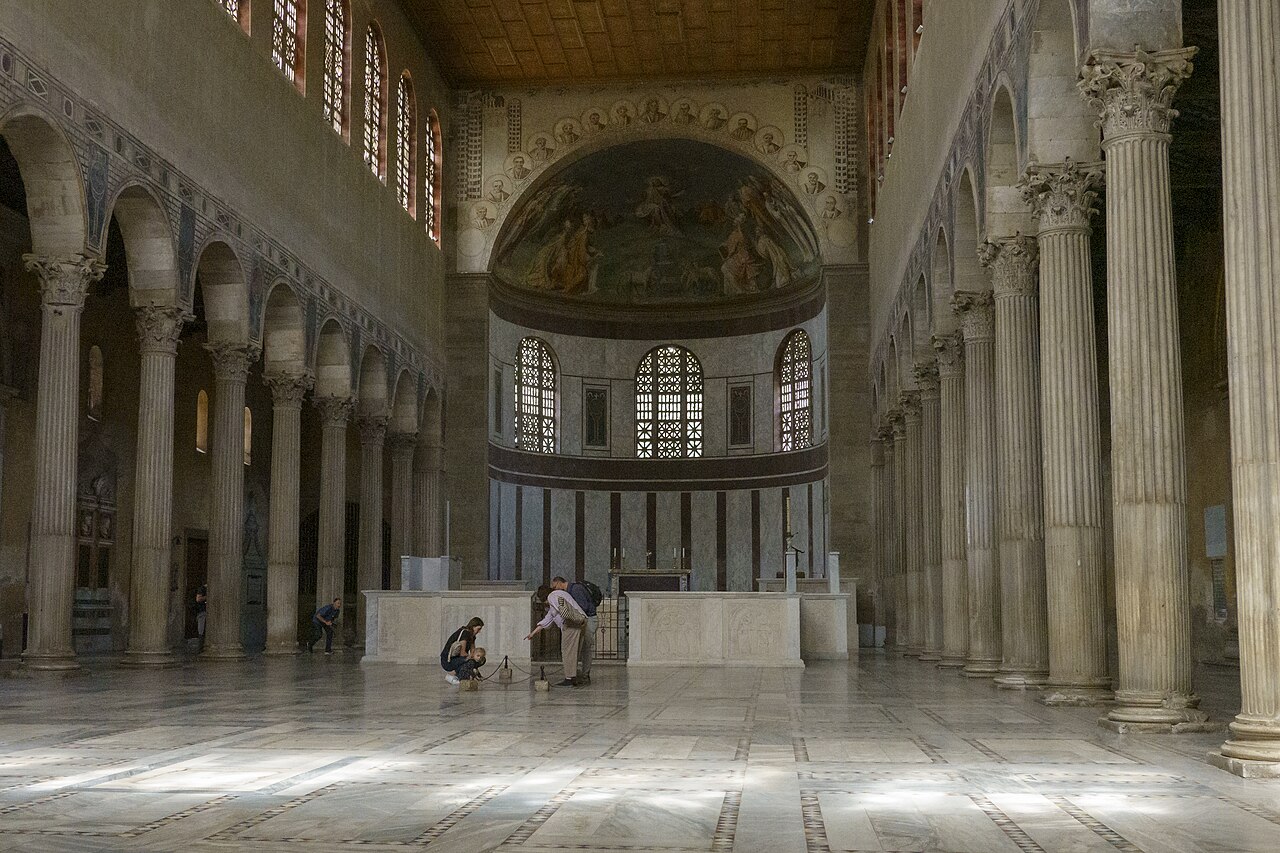
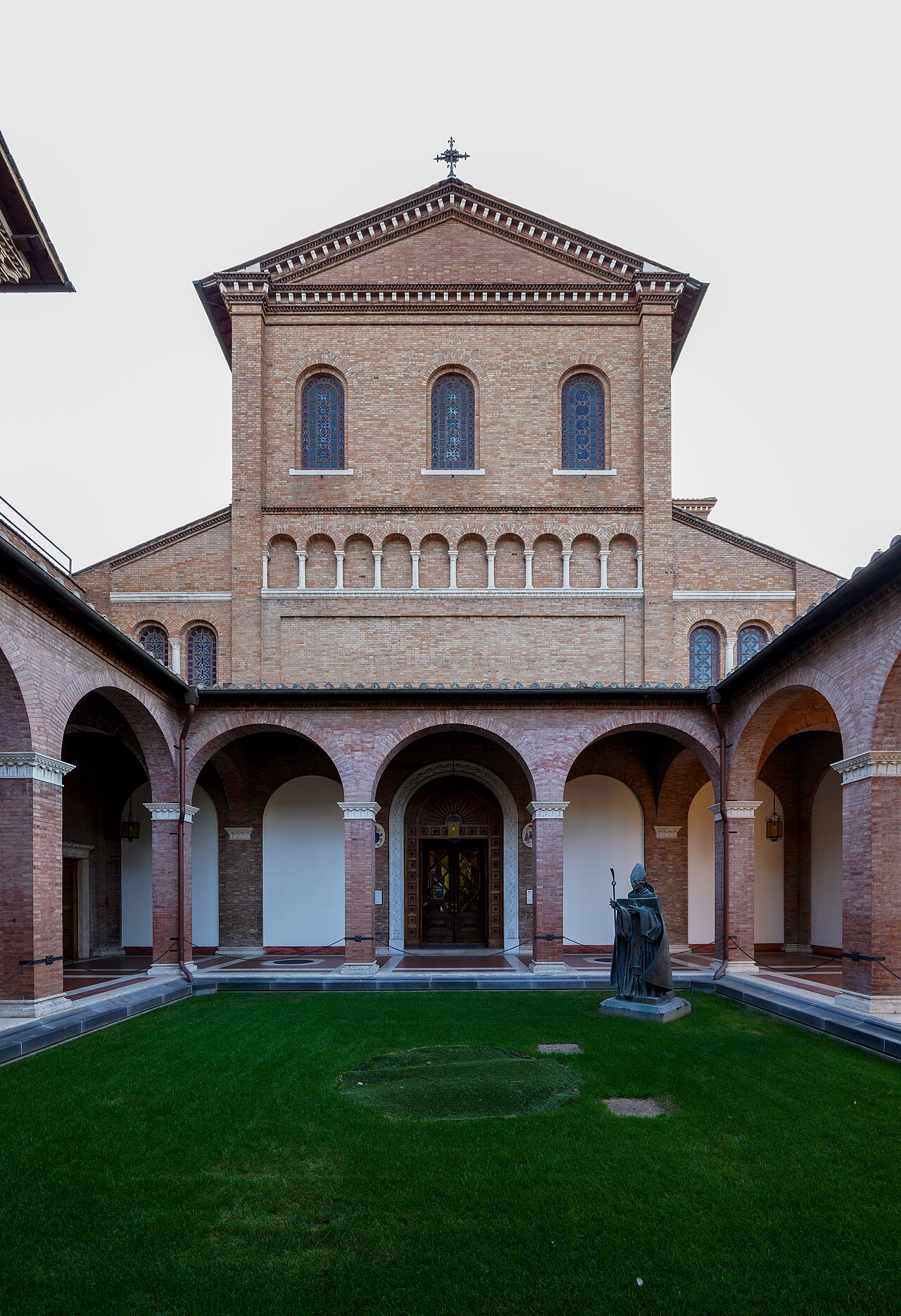
The church is early thirteenth century underneath and eighteenth century on the surface, which is a common Roman condition and not worth regretting. The campanile is the honest survivor, Romanesque and plain. Come in through the courtyard rather than straight off the street: the approach is the best-composed thing about the building, and it prepares the scale of a church that turns out to be small inside.
The chapel of Saint Alexis, at the near end of the left aisle
The orange garden, the Giardino degli Aranci, immediately beside the church
The position between Santa Sabina and Sant'Anselmo, which makes this the middle of the Aventine walk
Spiritual Significance
Greek and Latin monks lived here together, and from this hill men went north and east into countries that had not yet been baptized.
This is a neighborhood church with a religious community attached, on a hill where nobody hurries. It receives very few visitors compared with Santa Sabina a hundred meters away, and the difference in atmosphere between the two is worth noticing rather than correcting.
The orange garden is next door, which means most people who pass the door are going to look at the view. Going in instead takes ten minutes and changes the walk.
Do Not Miss
-
The chapel of Saint Alexis
At the near end of the left aisle. The wooden staircase venerated as the one he lived and died beneath is raised in a reliquary of glass and gilded wood, beside the recumbent statue of the saint. The devotional center of the church.
-
The courtyard approach
Come in through the court rather than off the street. It is the best-composed part of the building and it sets the scale.
-
The campanile
Romanesque, surviving from the medieval church under the eighteenth-century surface. Visible from the piazza.
-
The Madonna di Sant'Alessio
The venerated icon of the church, brought west in the medieval centuries and kept here since.
-
The orange garden next door
The Giardino degli Aranci, between this church and Santa Sabina, with the city laid out below. Two minutes, and the natural pause in the Aventine walk.
What to notice
- The staircase is venerated as the stair of Saint Alexis. The basilica presents it as a relic of the tradition; it is not documented in the way a dated foundation is.
- The life of Saint Alexis is a devotional narrative of great antiquity and enormous medieval reach. It should be read as the Church has always read it, as a story about hiddenness and poverty, rather than as a biography with dates.
- Saint Adalbert of Prague was a monk of this house and is buried at Gniezno in Poland. Nothing of him is kept here, and the church makes no claim otherwise.
- Boniface of Tarsus, the older of the two patrons, is a martyr of the Eastern tradition. The double dedication is a record of the Greek presence on the Aventine in the tenth century rather than an accident of naming.
Visit Plans
-
The courtyard, the church, the chapel of Saint Alexis, and the orange garden next door.
-
As above, taken with Santa Sabina a hundred meters along the wall.
-
The whole Aventine: Sant'Anselmo, here, Santa Sabina, and down the far side to Santa Prisca.
Take this as the middle of a walk rather than as a destination. It is a hundred meters from Santa Sabina and ten minutes from Sant'Anselmo, and the hill only makes sense taken as one hour on foot.
How to Visit
How to Visit
Go straight to the chapel at the near end of the left aisle. The staircase is there, under glass, venerated as the stair Alexis lived and died beneath. Stand with it for a moment before deciding what you think about it. The devotion is a thousand years old and the object is a piece of wood; both of those are true at once, and the Aventine has held them together for a very long time.
Then find the campanile from the courtyard, and give a minute to Adalbert. There is nothing here that marks him, because he is buried at Gniezno in Poland, and the absence is the point: this was a house people left from. In the tenth century a monk on this hill could expect to be sent somewhere that would kill him.
Come out into the orange garden and take the view, and then walk on to Santa Sabina, which is a hundred meters along the wall.
- Ordinary parish and community Mass under the Somaschi Fathers
- The feast of Saint Alexis on July 17
- Veneration at the chapel of Saint Alexis in the left aisle
- A quiet church on a quiet hill, used more by the neighborhood than by visitors
Relics, Tombs, Sacred Objects
Tomb and Burial
- Honorius III placed the bodies of both patrons beneath the high altar when he rebuilt the church in the thirteenth century, and they remained there until 1680.
- No tomb of Saint Adalbert is here. He was killed in Prussia in 997 and is buried at Gniezno in Poland.
Relics and Sacred Tradition
- The wooden staircase venerated as the stair Alexis lived and died beneath, raised in a reliquary of glass and gilded wood in his chapel in the left aisle
- The relics of both patrons, placed beneath the high altar by Honorius III and kept there until 1680
Sacred Objects
- The icon known as the Madonna di Sant'Alessio, venerated in the church
- The Romanesque campanile, surviving from the medieval church
- The well associated in the tradition with the saint's household
Connected Saints
Continue Your Pilgrimage
-
City hub
Rome
Where this church sits within the wider Catholic geography of Rome.
-
Minor basilica
Basilica of Santa Sabina all'Aventino
The mother church of the Dominicans and the best-preserved fifth-century basilica in Rome. The orange garden lies between the two.
-
Benedictine abbey
Sant'Anselmo all'Aventino
The Benedictine house at the far end of the Aventine, where Vespers is sung in Gregorian chant and the Ash Wednesday procession begins.
-
Titular church
Santa Prisca
The oldest Christian ground on the Aventine, held by tradition to stand on the house of Aquila and Prisca.
Map
Editorial sources
The documented history of the Aventine monastery and the medieval Alexis tradition.
Official
Awaiting source.
Last reviewed
September 13, 2026