
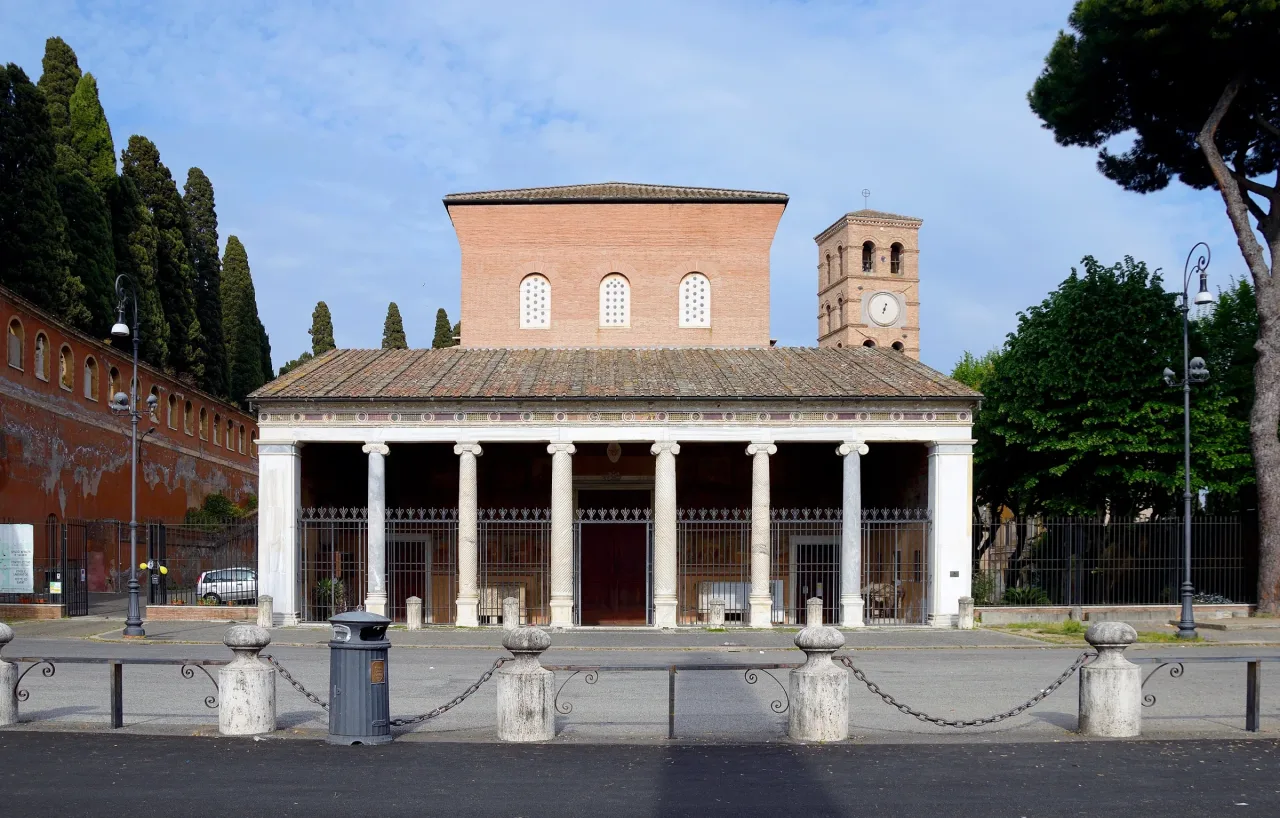
Basilica of San Lorenzo fuori le Mura, Rome
Two basilicas joined end to end over a martyr's grave, beside Rome's cemetery, rebuilt after the only bombing that struck one of the Seven Churches.
- Location
- Rome, Italy 41.9015° N · 12.5180° E
- Type
- Papal basilica and parish church Two basilicas joined end to end: a sixth-century church of Pelagius II, now the raised chancel, and a thirteenth-century nave added in front of it under Honorius III, with a Cosmatesque floor, two ambones, and a twelfth-century campanile
- Dedication
- Saint Lawrence, deacon and martyr The confessio holding the relics venerated as Lawrence's and Stephen's
- Time Needed
- 1 hour to half a day
Why Go
The Deacon Who Gave It Away
Valerian's edict of 258 ordered the killing of the bishops, priests and deacons of the Church.
Lawrence was a deacon of Rome, which meant the care of its poor and its funds. The tradition records that he was ordered to hand over the treasure of the Church and that he brought the poor instead, and that he was killed on a gridiron for it. The basilica stands on the hillside where he was buried, and nothing about the building lets you forget that it is a burial place. Rome's largest cemetery begins at the far wall.
Two Churches, Facing Each Other
Constantine built over the grave first. Then Pelagius II rebuilt between 579 and 590, a tall basilica raised directly above the tomb with galleries over the aisles. That church still exists, and you can walk into it, but not as a church: in the thirteenth century Honorius III demolished its apse and built an entirely new nave onto the front of it, reversing the direction of the whole building. What had been the sixth-century church became the chancel of the thirteenth-century one.
The two do not quite line up. Walk up the nave and the axis shifts slightly under you. Honorius also gave the basilica its portico, with frescoes of the lives of Lawrence and Stephen, and the Cosmati workshops laid the floor and cut the two ambones.
On the morning of July 19, 1943, Allied bombers attacked the freight yards beside the basilica in the first air raid on Rome. A bomb fell just outside the portico and destroyed most of it; a smaller one came through the roof and burst on the Cosmatesque floor. The nineteenth-century decoration of the nave was wrecked and the district around the church was devastated. Pius XII came out from the Vatican that day and stood among the dead in the street. The restoration ran into the late nineteen-forties, and it took the opportunity to strip away the nineteenth-century work rather than repaint it, which is why the interior now reads as medieval again.
You come in under a portico that was rebuilt from rubble, past frescoes that survived because the blast went the other way. The nave is wide, low and severe, with a floor of cut stone and no color in it. At the far end the ground rises: the chancel is the old Pelagian basilica, lifted above the nave, with columns of a different century and a triumphal arch that no longer aligns with the room you walked through. Beneath that, in the confessio, is the grave. The whole building is arranged so that the last part of the walk is upward and the last movement is down.
The junction where the thirteenth-century nave meets the sixth-century church, visibly out of alignment
The tomb of Blessed Pius IX, who asked to be buried here rather than at Saint Peter's
The tomb of Alcide De Gasperi, near the entrance, carved by Giacomo Manzù
The twelfth-century cloister, and the campanile of the same century standing clear of the church
Spiritual Significance
Lawrence was killed for refusing to surrender the treasure of the Church. He had already given it away, to the poor, and said so.
San Lorenzo is a papal basilica, one of the five, and it does not behave like one. There are no queues, no barriers, and often no other visitors. What there is instead is the cemetery: the Campo Verano begins immediately behind the apse, and the basilica has been Rome's funeral church since the nineteenth century. Hearses come and go. Families gather in the portico. On November 2 the city's attention turns here rather than to the center. A pilgrim who arrives expecting a monument will find a parish in the middle of burying someone, which is closer to what the building has always been.
Do Not Miss
-
The confessio
Beneath the high altar, holding the relics venerated as Saint Lawrence's and Saint Stephen's together. The reason the basilica exists and the place to pray in it.
-
The join between the two churches
Where the thirteenth-century nave meets the sixth-century chancel. The axis shifts, the columns change century, and the triumphal arch no longer lines up with the room in front of it.
-
The portico frescoes
About 1220, the lives of Lawrence and Stephen told in sequence across the entrance. Most of the portico around them was rebuilt after the bomb of July 1943.
-
The tomb of Blessed Pius IX
He asked to be buried here rather than at Saint Peter's. Beatified in 2000, and still the reason a certain kind of pilgrim comes out to the Tiburtina.
-
The Cosmatesque floor and the ambones
Thirteenth century, cut and inlaid by the Cosmati workshops, with a twisted paschal candlestick beside the ambo. The bomb that came through the roof burst on this floor.
What to notice
- Lawrence's martyrdom on a gridiron is the tradition the Church has carried since the fourth century and is how he is universally depicted. The bare historical record establishes that he was a deacon of Rome killed in the persecution of 258; the manner of his death is tradition rather than documentation.
- The relics venerated as Saint Stephen's were brought here, the tradition records, from Constantinople and laid beside Lawrence. The pairing of the two deacons is ancient and is the devotional logic of the confessio.
- The Vatican Jubilee page states that the basilica was completely destroyed in the war. That overstates it. The portico took the worst of the blast and the roof was pierced, the nineteenth-century decoration was wrecked, and the restoration finished in the late nineteen-forties. The medieval fabric largely survived.
- Pius IX is Blessed, not canonized. He was beatified in 2000.
- The basilica is one of the five papal basilicas of Rome, alongside Saint Peter's, Saint John Lateran, Santa Maria Maggiore, and Saint Paul Outside the Walls. It is by far the least visited of them.
Visit Plans
-
From the nave to Lawrence’s grave
3 ordered stopsEnter as a worshipper in a working parish church. Walk the nave toward the confessio, then pray at the place of Lawrence’s burial.
- Begin in the nave; leave room for parish worship and funerals.
- Approach the confessio and the relics venerated as Lawrence’s and Stephen’s.
- Pray for deacons and those who serve the poor; then read the basilica’s cemetery setting.
Do not rush the nave. The building is arranged as a single long approach that rises at the end and then drops to the grave, and taken at speed it reads as an empty church with a crypt.
How to Visit
How to Visit
Stand in the portico before you go in. The frescoes above you are from about 1220 and tell Lawrence and Stephen in sequence, and the stonework around them was reassembled after 1943. Both facts are worth holding at once.
Walk the nave slowly and let the axis shift. When you reach the steps, you are leaving the thirteenth century for the sixth. Go up into the chancel, look at the columns, and then go down to the confessio, where the relics venerated as Lawrence's and Stephen's are kept together. This is the devotional center and everything else in the building is arranged around it.
Find the tomb of Blessed Pius IX, who chose to be buried out here rather than at Saint Peter's, and the tomb of Alcide De Gasperi near the entrance. Then go out the back and stand at the edge of the Campo Verano for a few minutes. The basilica does not make sense without the cemetery, and the cemetery is the reason the church has never become a museum.
- Daily parish life under the Capuchins, in a basilica that also serves the cemetery beside it
- The feast of Saint Lawrence on August 10, kept with particular solemnity here
- Funerals and requiems, continuously, because the Campo Verano is next door
- The sixth station of the Seven Churches pilgrimage
A working basilica beside the Verano cemetery
San Lorenzo fuori le Mura is a parish church as well as a martyr shrine. Funerals and worship can affect access to the chancel and confessio; check current parish notices before visiting.
- Place
- Piazzale del Verano 3, Rome
- Prayer
- The confessio and the grave of Saint Lawrence
- Access
- Check the parish before travel; services and funerals take priority
Visiting with the parish
Enter quietly
This is an active church. A funeral or Mass may limit access to part of the basilica.
Relics, Tombs, Sacred Objects
Tomb and Burial
- Saint Lawrence, deacon of Rome, martyred in 258 and buried in the cemetery on this hillside. The basilica stands over the grave.
- Saint Stephen the Protomartyr, whose relics the tradition records as brought here from Constantinople and laid beside Lawrence's
- A Saint Justin is named with them in the confessio, though which Justin the tradition means has never been settled
Relics and Sacred Tradition
- The relics venerated as Saint Lawrence's, in the confessio beneath the high altar
- The relics venerated as Saint Stephen's, in the same confessio
- A slab venerated as the stone on which the body of Lawrence was laid after his martyrdom
Sacred Objects
- The Cosmatesque pavement and the two ambones of the thirteenth-century nave
- The Romanesque paschal candlestick, twisted and inlaid, beside the ambo
- The portico frescoes of about 1220, telling the lives of Lawrence and Stephen
Connected Saints
Saint Lawrence of Rome
Tomb and basilica
The basilica preserves the Roman pilgrimage to Lawrence's burial place on the Via Tiburtina.
Saint Philip Neri
The Seven Churches · he made this the sixth station
Philip Neri's sixteenth-century pilgrimage of the seven major basilicas reaches San Lorenzo sixth, after Santa Croce, with only Santa Maria Maggiore left. By this point in the walk the route has covered most of twenty-five kilometers.
Saint Stephen
Venerated here · laid beside Lawrence in the confessio
The first martyr, and the first of the seven deacons of the Church at Jerusalem. The tradition records that his relics were brought to Rome from Constantinople and placed in this confessio beside Lawrence, pairing the two deacons in one grave.
Continue Your Pilgrimage
-
City hub
Rome
Where this church sits within the wider Catholic geography of Rome.
-
Basilica
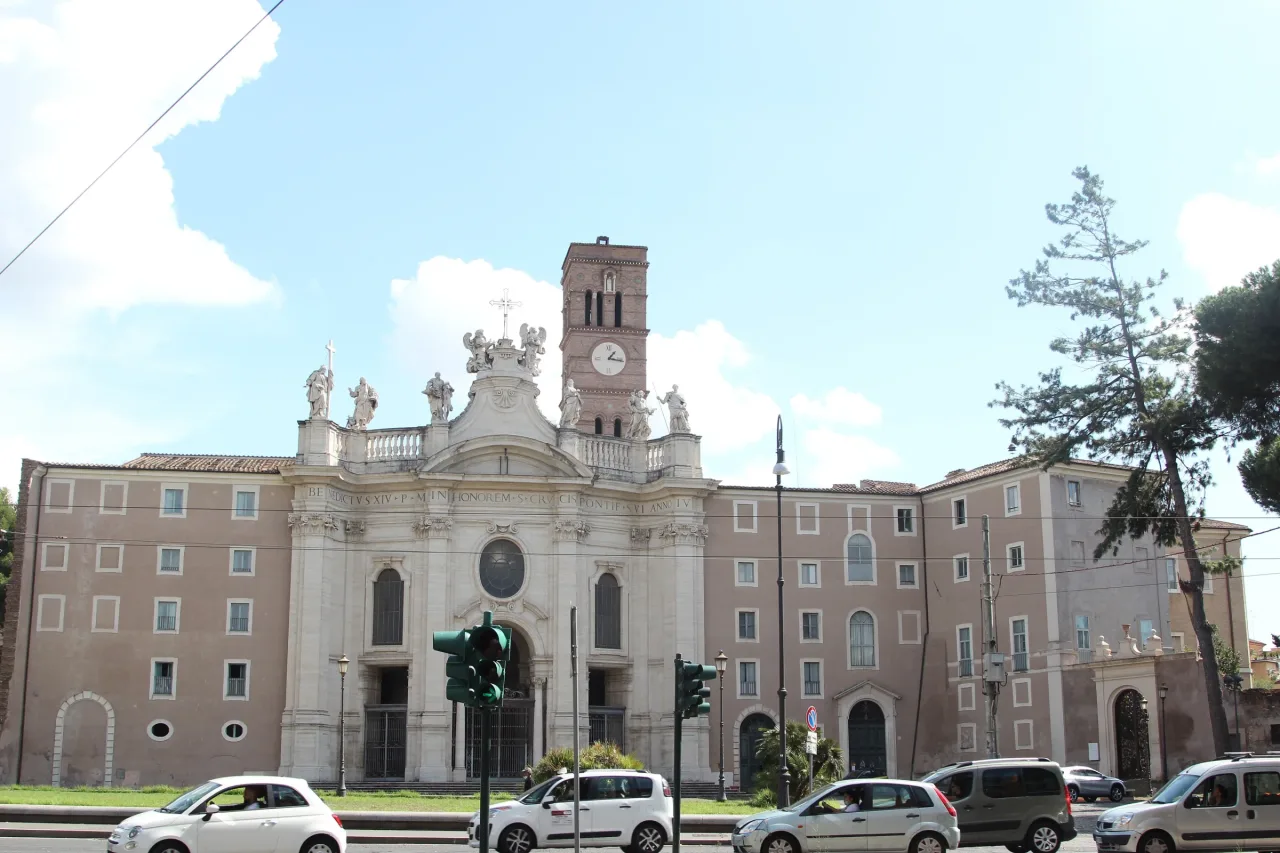
Basilica of Santa Croce in Gerusalemme
The relics of the Passion, held in Helena's palace. The walk between the two crosses the eastern edge of the ancient city.
-
Papal basilica
Basilica of Santa Maria Maggiore
Where the route ends. The final stretch from San Lorenzo runs back in through the Esquiline, and the contrast between this austere nave and that one is the closing note of the pilgrimage.
-
Basilica
Basilica of Sant'Agnese fuori le Mura
Agnes was buried in a cemetery on the Via Nomentana as Lawrence was on the Tiburtina, and her basilica was built over the grave in the same way. The two read as a pair.

Map
Editorial sources
The Holy See's Jubilee 2025 guidance for the Seven Churches, with the documented building history.
Official
Last reviewed
September 13, 2026
Photo credits
- Hero. Livioandronico2013, CC BY-SA 4.0, via Wikimedia Commons. Source. CC BY-SA 4.0.