
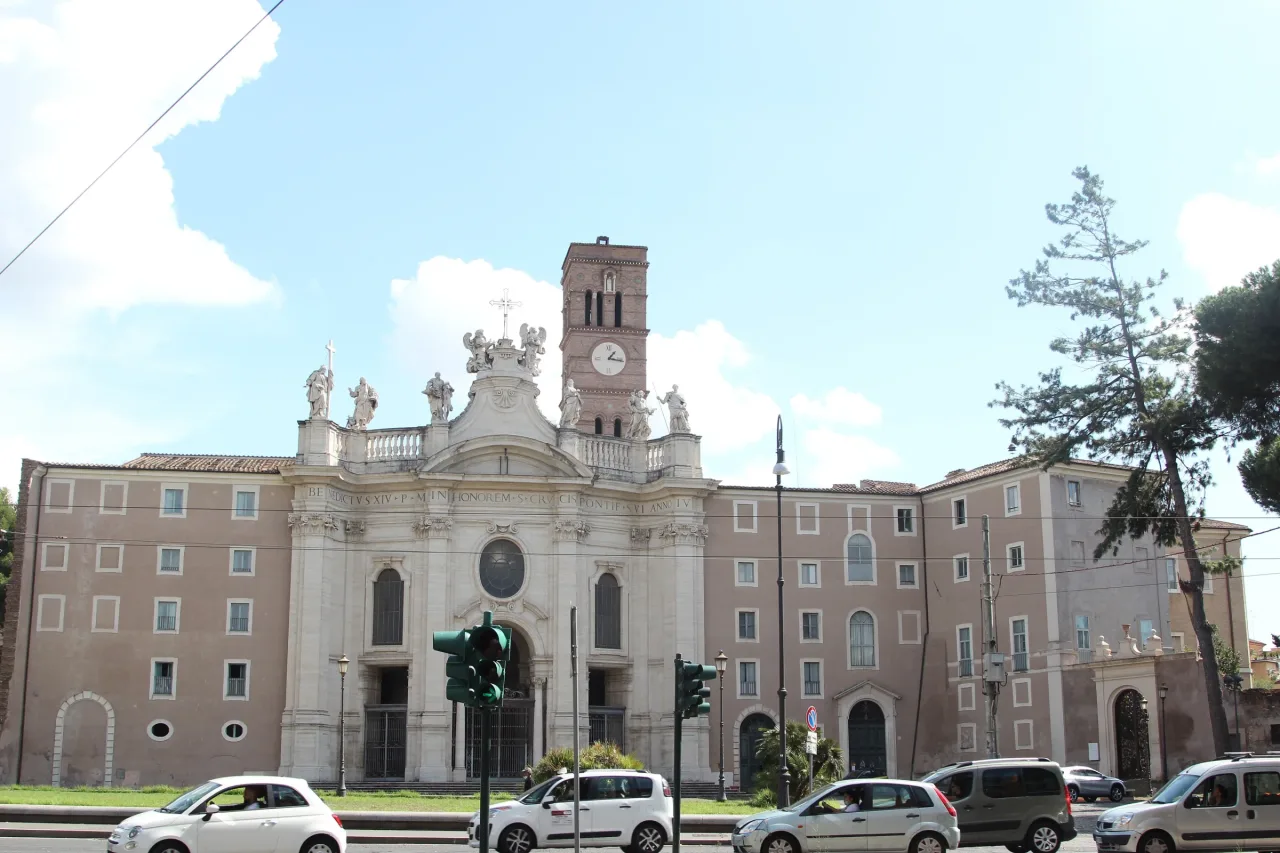
Basilica of Santa Croce in Gerusalemme, Rome
A hall of Helena's palace, turned into a reliquary for what she brought back from Jerusalem, standing on Jerusalem earth.
- Location
- Rome, Italy 41.8877° N · 12.5157° E
- Type
- Minor basilica and titular church A fourth-century hall of the imperial Sessorian palace, rebuilt in the seventeen-forties under Benedict XIV with a curved travertine facade and an oval vestibule
- Dedication
- The Holy Cross The relics of the Passion and the chapel of Saint Helena
- Time Needed
- 1 hour to half a day
A Room Kept Back From a Palace
The other churches on the Seven Churches route were built over graves.
This one was built over a decision. Helena, the mother of Constantine, kept the Sessorian palace when her son moved the capital east, and she gave up part of it to hold the relics of the Cross she had brought from the Holy Land. Earth from Calvary was laid beneath the chapel floor. The basilica is called in Gerusalemme not because it looks toward Jerusalem but because a piece of Jerusalem is physically underneath it.
What Helena Brought Back
The site was imperial ground long before it was a church. A third-century residence stood here against the Aurelian wall, beside the small amphitheater the court used, and in the fourth century it belonged to Helena. She went to the Holy Land around 325, and the tradition of the Church holds that she found there the wood of the Cross. What she sent or carried back to Rome was housed in a hall of her own palace, with soil from Calvary placed beneath it.
The hall became a basilica, and the basilica became, in the Vatican's phrase for it, a great reliquary. Fragments accumulated over the centuries in the way relic collections do. In February 1492, during work on a mosaic, masons found a box sealed behind a brick marked Titulus Crucis. Inside was a walnut board with an inscription cut in three lines, the Greek and Latin written right to left. Cardinal Mendoza, then titular of the church, encouraged its veneration, and it has been venerated here ever since.
Cistercians served the basilica from 1561 until their community was suppressed in 2011. It is now in the care of the Diocese of Rome. The building you walk into is not Helena's: it was rebuilt in the seventeen-forties under Benedict XIV, which gave it the curved facade and the oval vestibule.
The facade bends outward at you, and then the vestibule is oval, so you are turned twice before the nave releases in a straight line toward the apse. That is the eighteenth century talking. Underneath it the hall is still fourth century, and the granite columns of the nave are older than the church around them. The important movement is downward: the chapel of Saint Helena is below the level of the nave, reached by steps, and its floor was left alone in the rebuilding because of what is under it.
The chapel of Saint Helena, reached by going down, with a floor that the eighteenth-century rebuilding deliberately left untouched
The oval vestibule of the seventeen-forties, which turns you twice before it lets you into the nave
The Amphitheatrum Castrense and the Aurelian wall immediately behind the basilica
The kitchen garden the Cistercians kept along the flank of the church
Helena did not build a church and then fill it. She gave up a wing of her house so that a piece of Jerusalem could stay in Rome.
Santa Croce is the Good Friday station of Rome, which tells you what it is for. It is a place to be quiet in front of specific objects, and it is not a place with a body to pray beside. That absence gives the church a different feel from the Lateran ten minutes away, and it explains why pilgrims on the Seven Churches route often find this the stop where the walking stops mattering. The building is also, at the moment, incomplete as an experience: the chapel that holds the relics is closed for structural work.
Do Not Miss
-
The chapel of Saint Helena
Below the level of the nave, on earth brought from Jerusalem. The eighteenth-century rebuilding left this floor untouched, which is the single most deliberate decision in the building.
-
The relics of the Passion
Three fragments venerated as the True Cross, a nail, two thorns, and a fragment of the cross of the Good Thief, shown together in the chapel of the relics. Check first: the basilica's notice of April 16, 2026 has that chapel closed for building works.
-
The Titulus Crucis
A walnut board venerated as the title fixed above the Cross, found walled up behind a brick in 1492. The Greek and Latin lines run right to left.
-
The apse fresco
The finding of the Cross, filling the half-dome, which is the whole reason for the building told in one image.
-
The wall behind the basilica
Step out and look. The Aurelian wall and the ruin of the imperial amphitheater are immediately behind the apse, and they explain the odd shape of the site.
- The basilica presents these as relics venerated as the Passion's.
- The Titulus was radiocarbon dated at Roma Tre in 2002 to between 980 and 1146, and the result was published in the journal Radiocarbon. Scholars remain divided over whether the board is a medieval copy of an older original or a medieval object entirely. The Church has made no pronouncement on it, and the basilica venerates it without settling the question.
- The finding of the Cross by Helena is Catholic tradition of great antiquity, attested within decades of the event in the writing of the fourth-century Fathers. It is not a modern legend, and it is also not a documented excavation report.
- The Shroud displayed here is a photographic copy, presented as such. The Shroud itself is at Turin.
- The Cistercian community was suppressed in 2011 and the basilica passed to the Diocese of Rome. Anything written before then that describes a monastic community in residence is out of date.
Visit Plans
-
The chapel of Saint Helena, the nave, and the relics if the chapel holding them is open.
-
As above, without hurrying, plus the apse fresco and the walk around the outside to the Aurelian wall and the amphitheater.
-
Paired with San Giovanni in Laterano and the Scala Sancta, which are about fifteen minutes away on foot and form the eastern half of the Seven Churches route.
Go down before you go up. The chapel of Saint Helena is the foundation of the place in both senses, and the relics read differently once you have stood on the earth that gave the basilica its name.
How to Visit
Begin by going down to the chapel of Saint Helena rather than straight up the nave. The floor is the oldest thing you will stand on here, and the earth beneath it is the reason the church has the name it has. Sit there first.
Then come up for the relics, if the chapel is open. It is reached by a ramped corridor rather than stairs, which is generally read as an ascent toward Calvary, and the objects are displayed together in a small space. Take them one at a time. The Titulus is the one most visitors come for; the fragments of the Cross are the reason the church exists.
End in the nave, which is nearly empty most afternoons. Behind the apse is the Aurelian wall and the shell of the imperial amphitheater, and the whole basilica makes more sense once you have seen that it is wedged into the back of a palace at the edge of the ancient city.
- The station church of Good Friday and of Laetare Sunday in the Roman stational tradition
- Veneration of the relics of the Passion, when the chapel that holds them is open
- The fifth station of the Seven Churches pilgrimage
- A parish and titular basilica in ordinary use, quieter than its neighbors at the Lateran
Relics, Tombs, Sacred Objects
Tomb and Burial
- No saint is buried here. The basilica is a reliquary of the Passion rather than a tomb, which is unusual among the Seven Churches.
Relics and Sacred Tradition
- Three fragments of wood venerated as relics of the True Cross
- A nail venerated as one of those of the Crucifixion
- Two thorns venerated as from the Crown of Thorns
- The Titulus Crucis, the inscribed board venerated as the title fixed to the Cross, found walled up in the basilica in 1492
- A fragment venerated as part of the cross of the Good Thief
- A bone venerated as the finger of Saint Thomas, with fragments associated with the grotto of Bethlehem, the Holy Sepulchre, and the column of the scourging
Sacred Objects
- Earth carried from Jerusalem and laid beneath the chapel of Saint Helena, which is why the basilica is called in Gerusalemme
- A full-size photographic copy of the Shroud of Turin, displayed for veneration
- The eighteenth-century apse fresco of the finding of the Cross
Connected Saints
Continue Your Pilgrimage
-
City hub
Rome
Where this church sits within the wider Catholic geography of Rome.
-
Papal archbasilica
Basilica of Saint John Lateran
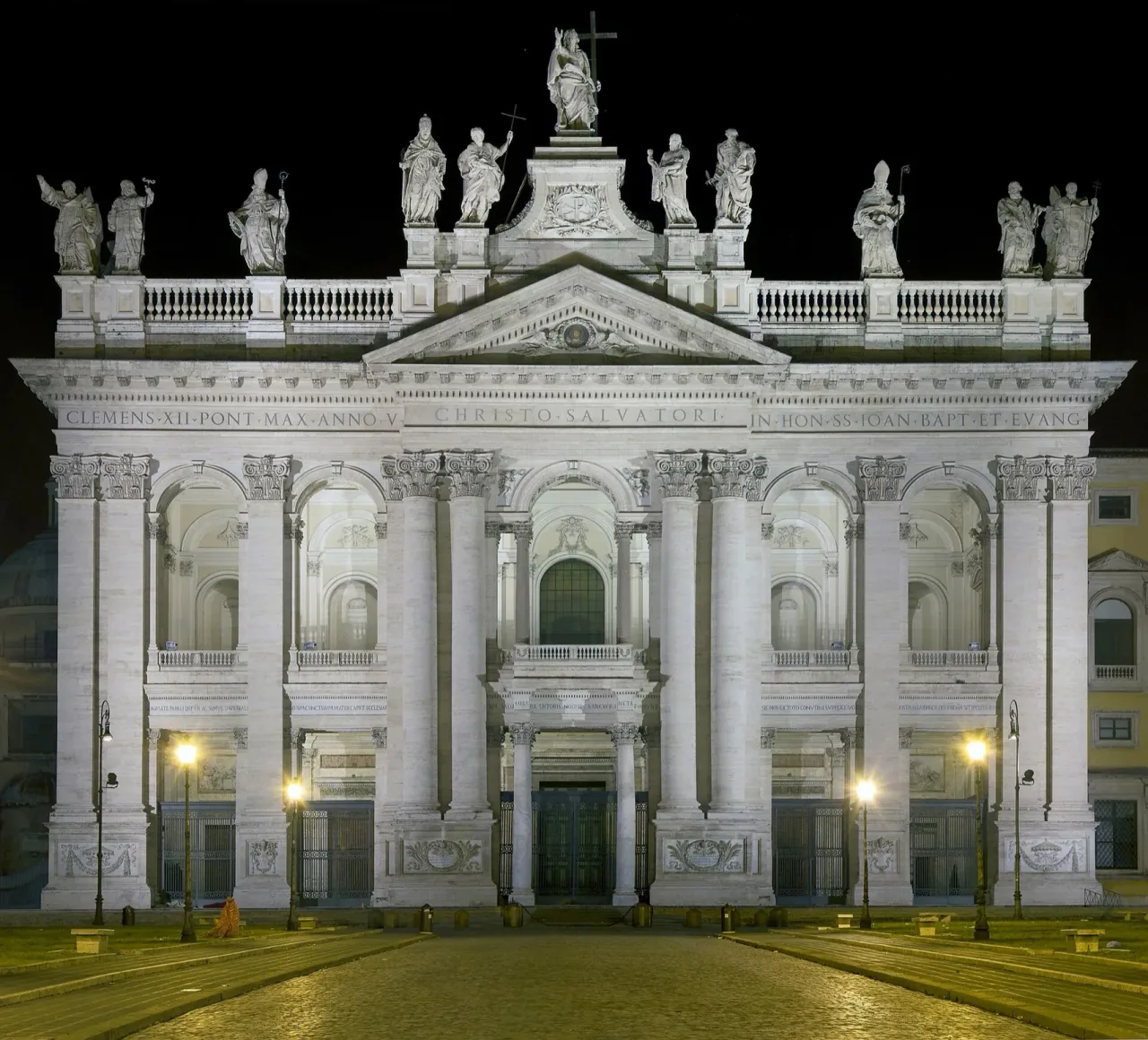
The cathedral of Rome and the previous station of the Seven Churches. The two were built on the same imperial ground and are usually walked together.
-
Papal basilica
Basilica of Santa Maria Maggiore
Where the route ends. Santa Maria Maggiore keeps relics venerated as wood of the crib of Bethlehem, which reads as a deliberate answer to the relics of the Passion held here.
-
Basilica
Basilica of San Clemente al Laterano
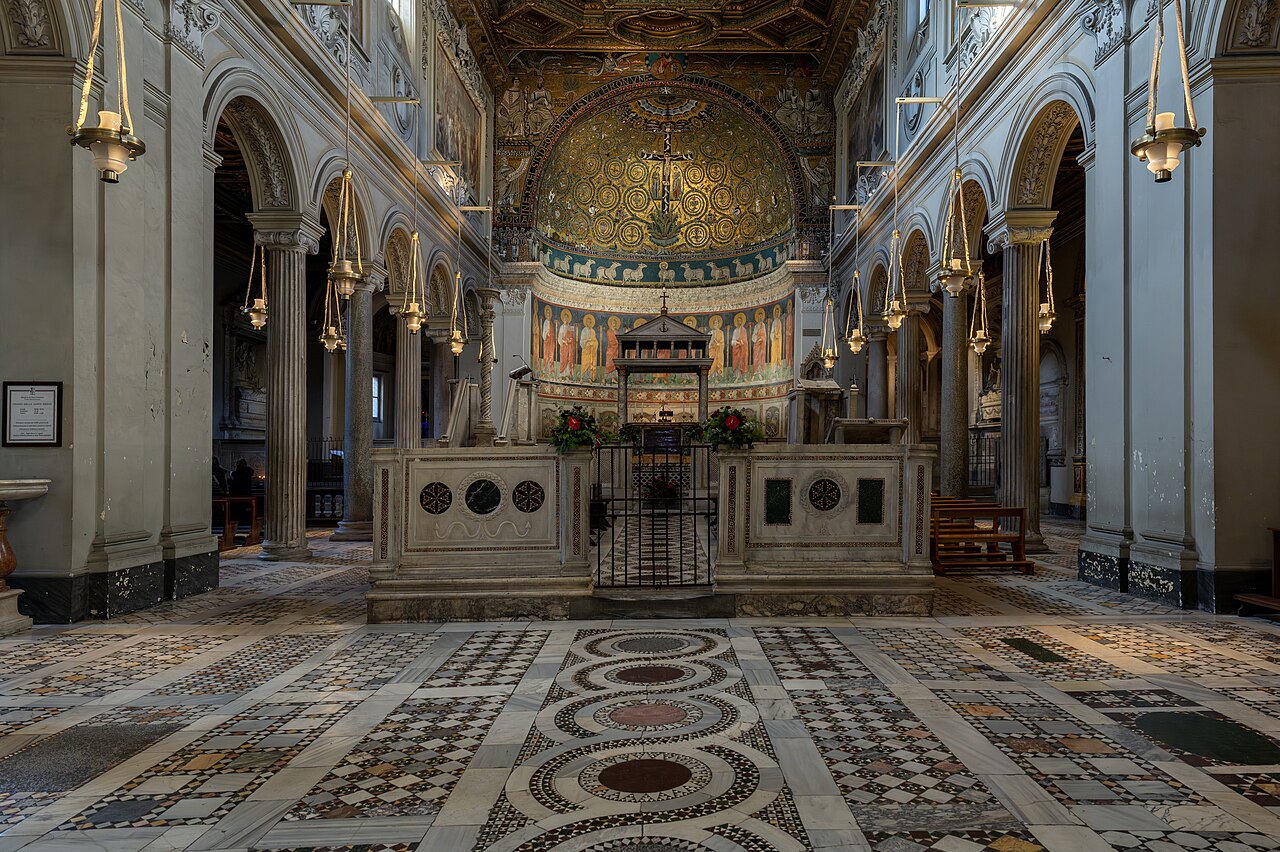
Three levels of Christian Rome stacked vertically. A natural continuation if the Lateran corner has been walked and there is still afternoon left.

Map
The basilica (santacroceroma.it) and the Holy See's Jubilee 2025 guidance for the Seven Churches.
September 13, 2026
Photo credits
- Hero. Fallaner, CC BY-SA 4.0, via Wikimedia Commons. Source. CC BY-SA 4.0.