
Basilica of Santa Pudenziana, Rome
A church sunk below the modern street on the Viminale, holding the oldest monumental image of Christ enthroned in Rome. Five minutes from Santa Maria Maggiore and almost always empty.
- Location
- Rome, Italy 41.8971° N · 12.4954° E
- Type
- Ancient titulus and minor basilica A fourth-century basilica built into a Roman bath hall, heavily altered in the sixteenth century and restored in the nineteenth
- Dedication
- Saint Pudentiana, virgin The apse mosaic
- Time Needed
- 1 hour to half a day
The oldest Christ in Rome
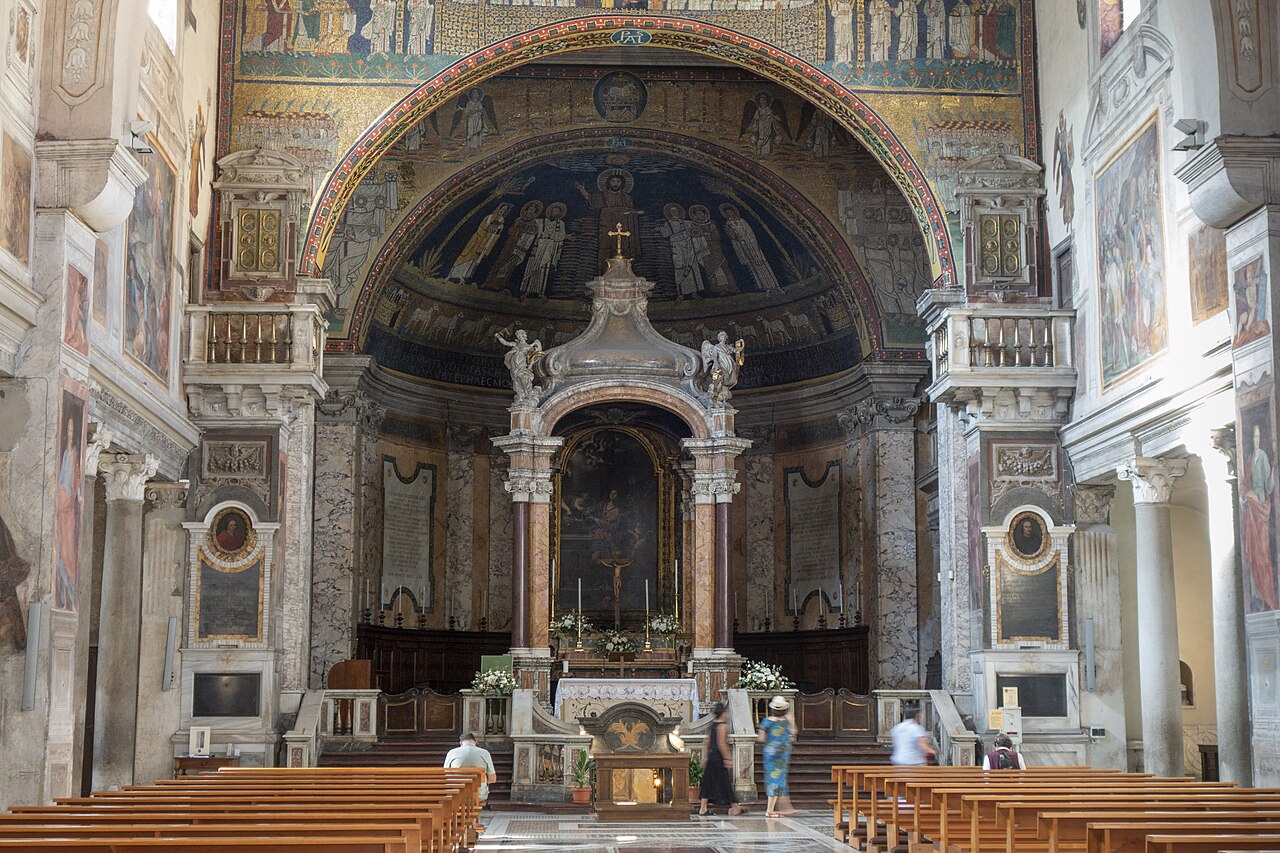
Come for the apse. Around 390, before the imperial city had finished becoming Christian, someone set Christ in the apse of this church seated and reigning, in gold, with the apostles in senatorial dress on either side and the buildings of Jerusalem behind him. It is among the oldest Christian mosaics in the city, and it is the moment the Church stopped depicting Christ chiefly as a teacher or shepherd and began depicting him as Lord. Everything later in Roman apse decoration, including the ninth-century work at Santa Prassede around the corner, is downstream of this room.
A titulus, a bath hall, and a tradition to handle carefully
The church stands on the site of a Roman bath hall of the second century, and the basilica was fitted into that structure in the fourth. It is recorded among the oldest tituli of Rome, and its ancient name, titulus Pudentis, is the origin of everything else said about it.
That name is where care is needed. Roman tradition understands Pudens as a senator of the first century who received the apostle Peter into his house, and Pudentiana and Praxedes as his daughters. The tradition is ancient, the two churches preserve it, and the New Testament does name a Pudens in the second letter to Timothy. What the sources do not allow is the next step: turning that into a continuous first-century biography, or identifying the titulus Pudentis securely with a specific household of the apostolic generation. A titulus took its name from the person who gave the property, and the distance between that and the senator of the legend is exactly the distance modern scholarship cannot close. The Church keeps the feast and the dedication; it has never asked anyone to treat the legend as history.
The relics venerated as Pudentiana's are not here. Paschal I took them, with those of Praxedes, to the church he was rebuilding a few minutes away in the ninth century, in the same campaign that emptied the catacombs. What remains here is the title, the mosaic, and the ground.
The sixteenth century treated the building roughly, shortening the apse and cutting figures out of the mosaic, and the nineteenth restored it. The mosaic a visitor sees is therefore incomplete: ten apostles remain of twelve, and the lower part of the composition is gone.
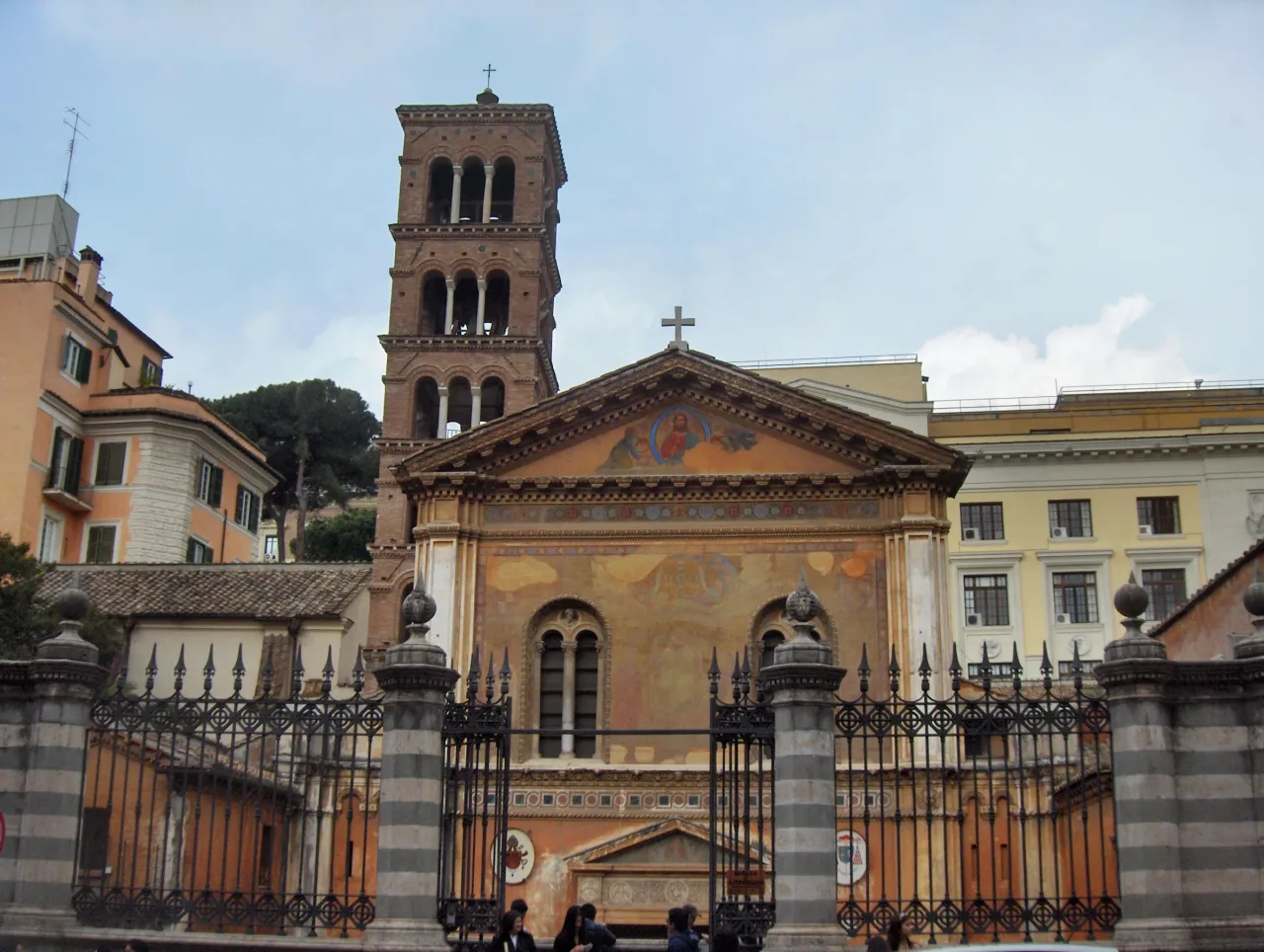
A basilica fitted into the hall of a Roman bath, which is why the plan is broad and the entrance now sits well below the street. Sixteenth-century remodelling reduced the apse and the nave; the campanile is medieval and survived it. Below the church the Roman structures can be seen, and they are the reason the building is where it is.
The two women in the mosaic holding crowns, whose identity has never been settled
The city of Jerusalem behind Christ, with the cross of Golgotha on the hill
The four living creatures of the evangelists, here among the earliest in Roman apse decoration
The sunken entrance, several steps below the modern street, which shows how far Rome has risen
The earliest surviving image in Rome of Christ reigning, and it is still above an altar.
Almost empty on a weekday, and entirely different on Sunday, when the Filipino community fills it. Both are worth meeting. The mosaic needs a quiet church and good light; the parish needs neither, and seeing an ancient titulus still functioning as somebody's parish is its own argument.
Do Not Miss
-
The apse mosaic
About 390. Christ enthroned, the apostles in senatorial dress, Jerusalem behind, the cross on Golgotha. The reason to come.
-
The two crowned women
Holding wreaths over Peter and Paul. Either the sisters, or the Church from the Jews and from the Gentiles. Unresolved, and better left so.
-
The four living creatures
Around the cross, among the earliest appearances of the evangelist symbols in a Roman apse.
-
The descent from the street
The entrance is well below Via Urbana. That drop is fifteen centuries of Rome accumulating.
-
The campanile
Medieval, and a survivor of the sixteenth-century remodelling that damaged so much else here.
- That Christ is seated and robed like an emperor, not standing like a teacher
- The apostles' dress, which is Roman senatorial and deliberately so
- Where the mosaic has been cut: the composition does not end, it stops
- How far below the street the floor is
- The difference between this church on a Tuesday and on a Sunday
Visit Plans
-
The apse mosaic, unhurried, with time in the nave.
-
With the Roman structures below, if they are open.
-
With Santa Maria Maggiore and Santa Prassede, which is the Esquiline in one walk.
Weekday mornings for the mosaic; Sunday for the parish. Pair with Santa Maria Maggiore and Santa Prassede.
How to Visit
Walk down from Santa Maria Maggiore; it takes about five minutes and puts the two in the right relation. Sit in the nave and look at the apse for longer than feels necessary. Then go on to Santa Prassede, where the relics went.
- The Filipino community of Rome, whose Sunday liturgy fills a church that would otherwise be quiet
- The feast of Saint Pudentiana on May 19
- A station church in Lent
- An ancient cardinal title
Relics, Tombs, Sacred Objects
Tomb and Burial
- The relics of Pudentiana venerated here were translated to Santa Prassede by Paschal I in the ninth century, together with her sister's. The church keeps her name and her title rather than her body.
Relics and Sacred Tradition
- The church is not a relic shrine. The tradition of the well, in which the sisters are said to have gathered the blood of martyrs, belongs to Santa Prassede.
Sacred Objects
- The apse mosaic of Christ enthroned among the apostles, of about 390
- The remains of the Roman bath hall the basilica was built into, visible in the fabric and below
- The medieval campanile, among the older bell towers of the city
Continue Your Pilgrimage
-
City hub
Rome
Where this church sits within the wider Catholic geography of Rome.
-
Papal basilica
Basilica of Santa Maria Maggiore
The patriarchal basilica up the hill. This church is one of the two ancient tituli it has always been read alongside.
-
Basilica
Basilica of Santa Prassede
Her sister's church, and where the relics venerated as hers were taken by Paschal I in the ninth century. The two are one visit.
-
Basilica
Basilica of San Clemente
Another Roman church built down into its own older layers, toward the Lateran.

Map
The ancient record of the titulus Pudentis and standard accounts of the apse mosaic.
September 13, 2026