The relic of the Holy Crib
Relic of traditionYes, at the Confessio beneath the high altar
Papal Basilica of Saint Mary MajorRome's church of the Mother of God, on the summit of the Esquiline. Under its altar is the relic of the Holy Crib; in its chapel, the icon Romans call the Salus Populi Romani.
Pope Sixtus III built this church in the 430s, soon after the Council of Ephesus proclaimed Mary the Mother of God.
Under the papal altar the basilica keeps the relic of the Holy Crib, five pieces of sycamore wood venerated as part of the manger where Christ was laid. Since the seventh century the church has also been called Saint Mary at the Crib. In the Pauline Chapel is the Salus Populi Romani, the icon that, by Roman tradition, Gregory the Great carried through the city to pray for an end to the plague. Pope Francis came to pray before it as he set out on each apostolic journey and again on his return, and he is buried a few steps away.
Roman tradition tells that in the time of Pope Liberius the Virgin asked for a church in her honor and marked its site with snow on the Esquiline on August 5. The feast of the Dedication on that day still remembers it: during the Gloria of the morning Mass, white rose petals fall from a compartment in the ceiling.
The church itself is the one Sixtus III raised between 432 and 440. His mosaicists covered the nave with scenes from the Old Testament and the triumphal arch with the childhood of Christ. Nicholas IV, the first Franciscan pope, had Jacopo Torriti make the apse mosaic in the 1290s. Sixtus V built the Sistine Chapel in 1585 to 1587, Paul V built the Pauline Chapel opposite it as a home for the icon, and Ferdinando Fuga gave the church its present front in 1743. Pius IX had the Confessio built in front of the papal altar in 1861 to 1864. Pope Francis was buried in the left aisle on April 26, 2025.
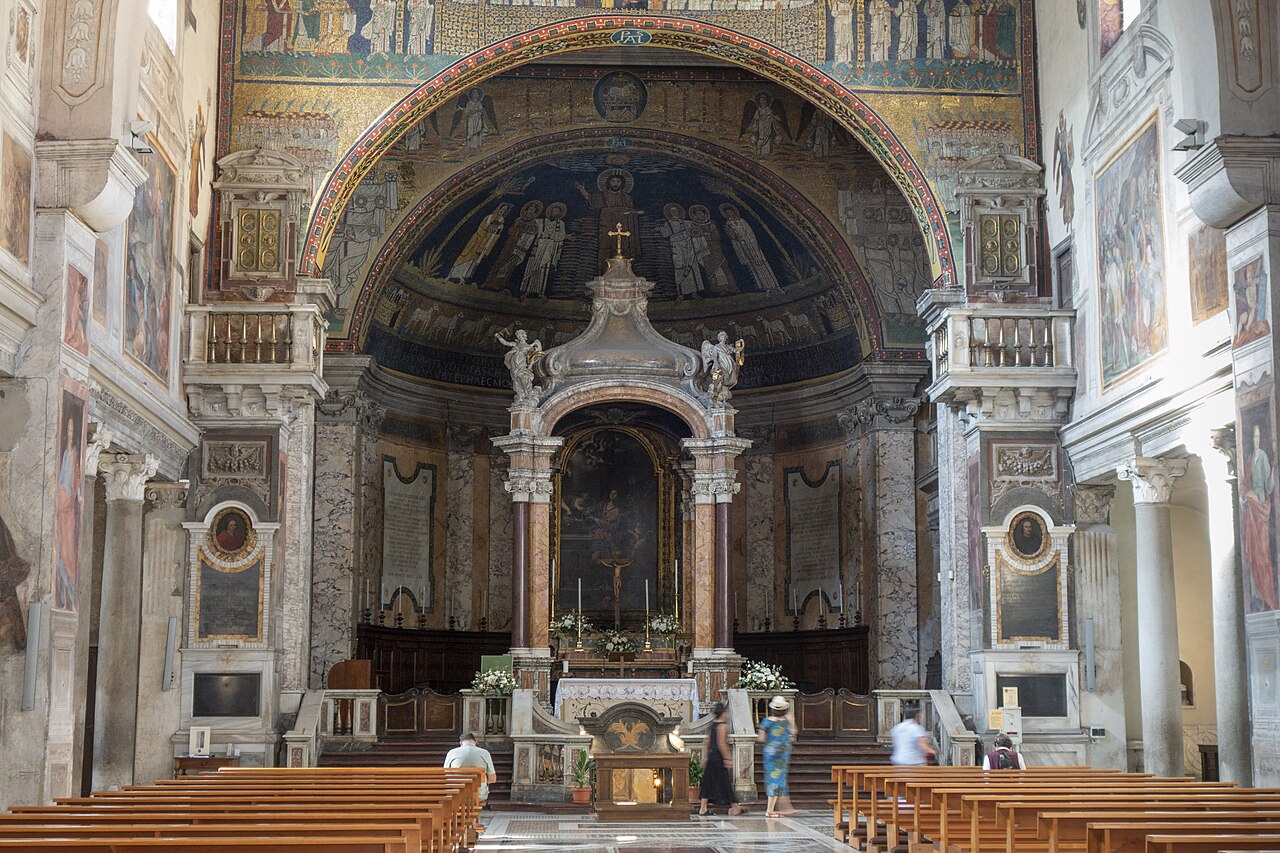
Of Rome's four major basilicas, this is the one whose fifth-century church still stands. Behind Fuga's front the old basilica is all there: the long nave on its two rows of columns, the mosaic panels above them, the arch at the far end. The Cosmatesque floor is medieval, and the coffered ceiling was designed by Giuliano and Antonio da Sangallo and gilded, by tradition, with the first gold brought from the Americas.
Near the head of the nave, the Sistine Chapel opens on the right and the Pauline Chapel on the left. One is built around the birth of Christ, the other around his Mother. The Crib lies between them, under the papal altar.
Sixtus V built his chapel over the medieval Oratory of the Nativity, a likeness of the grotto at Bethlehem, which lies below it at the foot of a double stair. Pope Saint Pius V and Sixtus V are buried on either side.
Steps go down in front of the papal altar to the Confessio, where the relic of the Crib is kept.
Paul V's chapel holds the Salus Populi Romani above its altar, framed in lapis lazuli. Pope Francis lies just outside, in the left aisle, under a plain slab cut FRANCISCVS.
Eight popes are buried in the basilica, among them Saint Pius V and Francis. The sculptor Gian Lorenzo Bernini lies in the right aisle, in his family's tomb under a plain inscription.
The basilica counts the relics of Saint Jerome and Saint Matthew among its treasures. Jerome translated the Scriptures at Bethlehem, beside the cave of the Nativity.
Santa Maria Maggiore honors Mary for the reason Ephesus gave: her Son is God. The church was built to say so, and its oldest mosaics, on the triumphal arch, tell the childhood of Christ. The Crib carries the same thought into devotion. The basilica holds that the first Christmas night Mass was celebrated here, popes have kept the custom for centuries, and Rome has long called the church the Bethlehem of the West.
The icon gives the basilica its other life. For centuries Romans have brought the needs of the city to the Salus Populi Romani. Popes have crowned it, Pius XII in 1954, and the Jesuits carried copies of it around the world.
In the Confessio before the papal altar, five pieces of sycamore wood rest in a crib-shaped crystal reliquary designed by Giuseppe Valadier in 1802. The basilica reports that recent scientific study dates the wood to the time of Christ's birth. The marble figure kneeling before it is Pius IX.
A cedar panel, 117 by 79 centimeters, showing Mary half-length with the Child in her arms. Tradition attributes it to Saint Luke. The Pauline Chapel is kept for prayer.
In the left aisle between the Pauline and Sforza chapels, near the altar of Saint Francis of Assisi. On the wall behind the slab is an enlarged copy of the pectoral cross he wore. A plaque in the Pauline Chapel, unveiled on April 21, 2026, records his 126 visits to the icon.
Look above the columns for the Old Testament panels, then at the triumphal arch, where the Annunciation and the coming of the Magi open the childhood of Christ. They have been in place since the 430s.
In Jacopo Torriti's apse mosaic, Christ sets the crown on his Mother inside a circle of stars on a gold ground.
The nave under the fifth-century mosaics and the coffered ceiling, the triumphal arch and apse mosaic, the Confessio with the relics of the Crib, and the Salus Populi Romani in the Pauline Chapel.
As above, with an unhurried turn through the Sistine Chapel of Sixtus V and the tomb of Pope Saint Pius V, the Cosmatesque pavement, and time for prayer before the icon.
Pair the basilica with the nearby mosaic churches of Santa Prassede and Santa Pudenziana, or walk Via Merulana to Saint John Lateran, about twenty-five minutes on foot.
Walk the nave first, as far as the arch. Go down to the Crib, then cross to the Pauline Chapel to pray before the icon; Francis's tomb is a few steps away in the left aisle. Finish in the Sistine Chapel at the tomb of Pius V. On weekday mornings a Mass begins in the Pauline Chapel every hour until noon, so there is nearly always one to join.
The basilica is free and open every day. Tickets for the museum, the Loggia of Blessings with Filippo Rusuti's facade mosaics, the Hall of Popes, Bernini's staircase and the excavations beneath the church are sold at the desk under the portico or reserved by email. Groups of eight or more must use the basilica's own radio headsets.
Prayer and liturgy
Visiting and access
Yes, at the Confessio beneath the high altar
Papal Basilica of Saint Mary MajorYes, in the Pauline Chapel
Papal Basilica of Saint Mary MajorVisible along the nave and at the head of the nave
Basilica documentationVisible in the apse above the high altar
Basilica documentationYes, in the Sistine Chapel
Basilica documentationSource note Traditional attributions are presented as tradition, with documentation named where it exists.
The basilica is dedicated to the Blessed Virgin Mary. Saint Jerome's relics are kept here, Pope Saint Pius V is buried in the Sistine Chapel, and Pope Saint Sixtus III built the church.
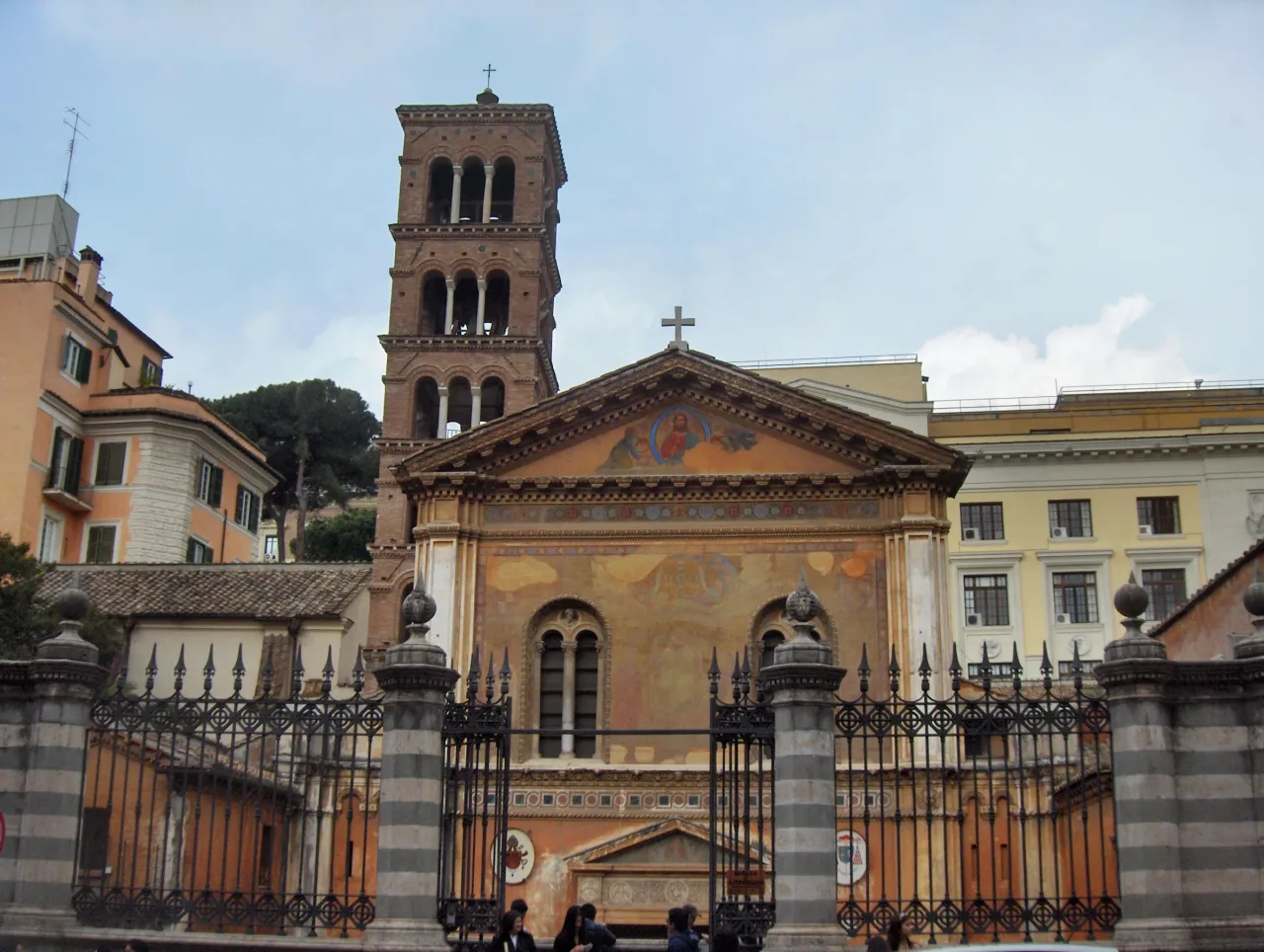
A short walk down the Esquiline, the ninth-century basilica of Santa Prassede preserves some of the most luminous Byzantine-style mosaics in Rome in the Chapel of Saint Zeno.
One of the oldest churches in Rome, preserving a fourth-century apse mosaic of Christ enthroned among the Apostles. A natural companion to Santa Maria Maggiore for pilgrims reading the early mosaic churches of the Esquiline.
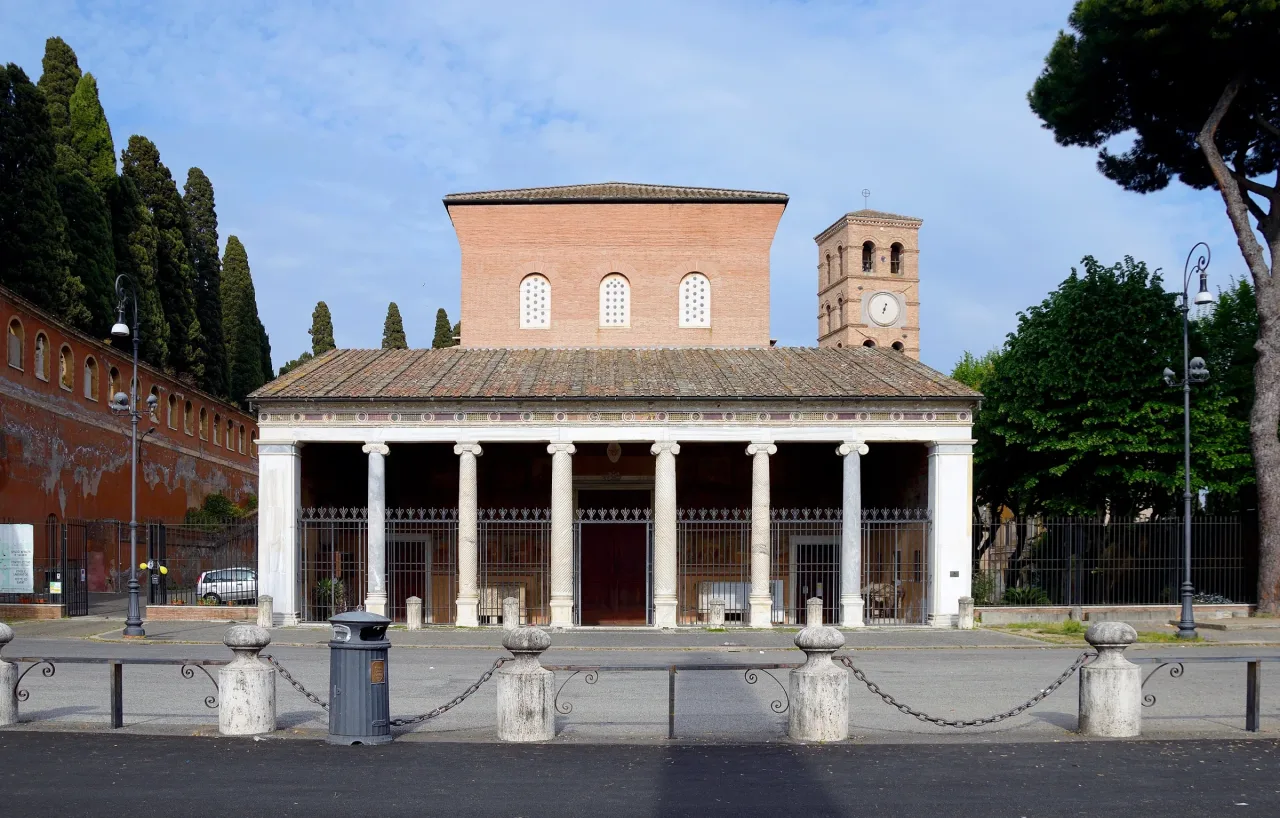
Pilgrims walking the Seven Churches arrive at Santa Maria Maggiore from San Lorenzo, out beyond the walls beside the Campo Verano. The austerity of that nave is what the mosaics here are answering.
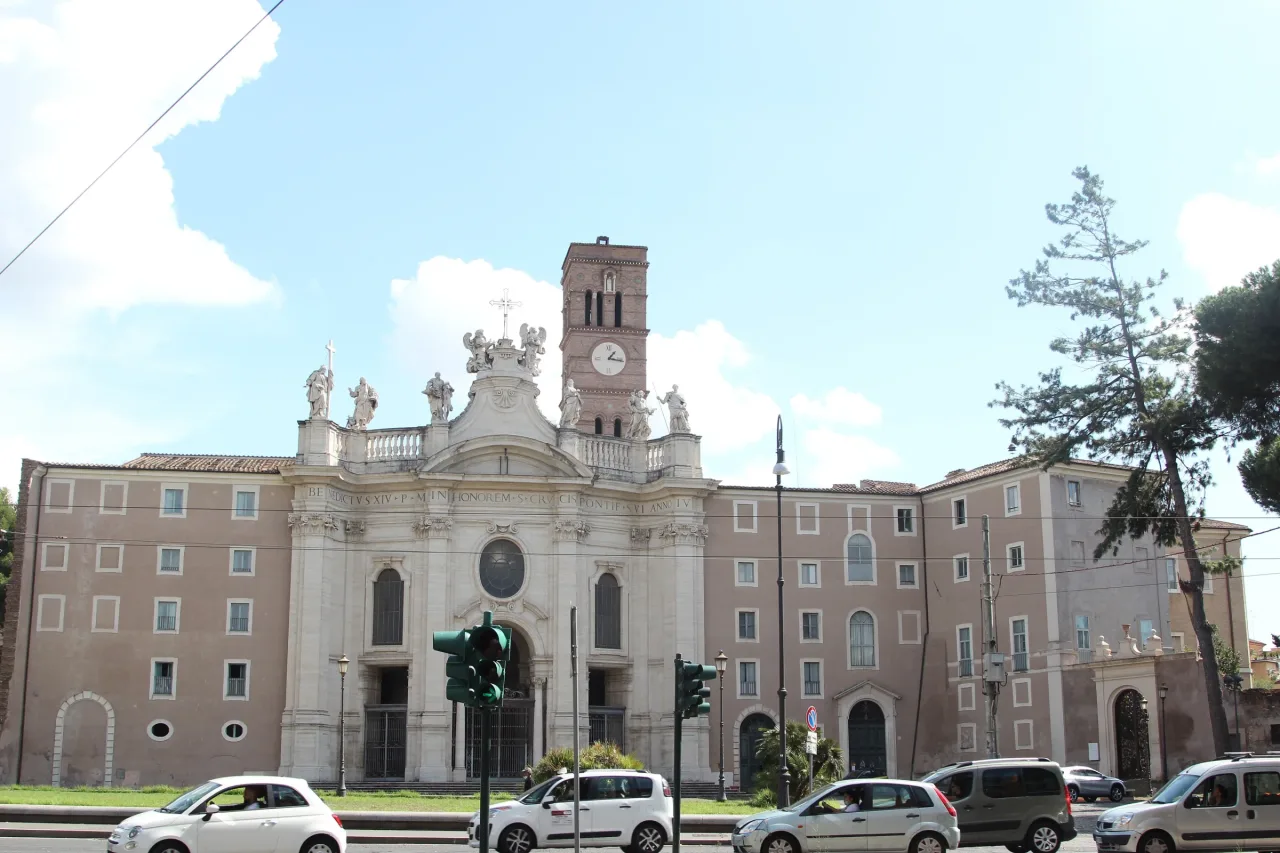
Santa Croce holds relics venerated as the Passion's; Santa Maria Maggiore holds relics venerated as wood of the crib of Bethlehem. Read together, the two basilicas hold the beginning and the end of the same life.
Rome's great Marian basilica belongs to the pilgrimage of the four papal basilicas that gather the memory of the city.
Move south toward the Lateran, the cathedral of the Bishop of Rome and the mother church of the churches of the city.
The four papal basilicas hold Rome's apostolic, cathedral, and Marian memory in a single pilgrimage through the city.
Traditional attributions are identified in context.
Hours, Masses, confession times and tickets come from the basilica's official site. The relic of the Holy Crib and the attribution of the Salus Populi Romani to Saint Luke are the basilica's tradition, and the dating of the Crib wood is the basilica's own report. The snowfall of August 5 is the Roman tradition behind the feast of the Dedication; the church itself is the work of Sixtus III.
July 9, 2026
Use this for corrections, broken links, missing places, and planning ideas.