
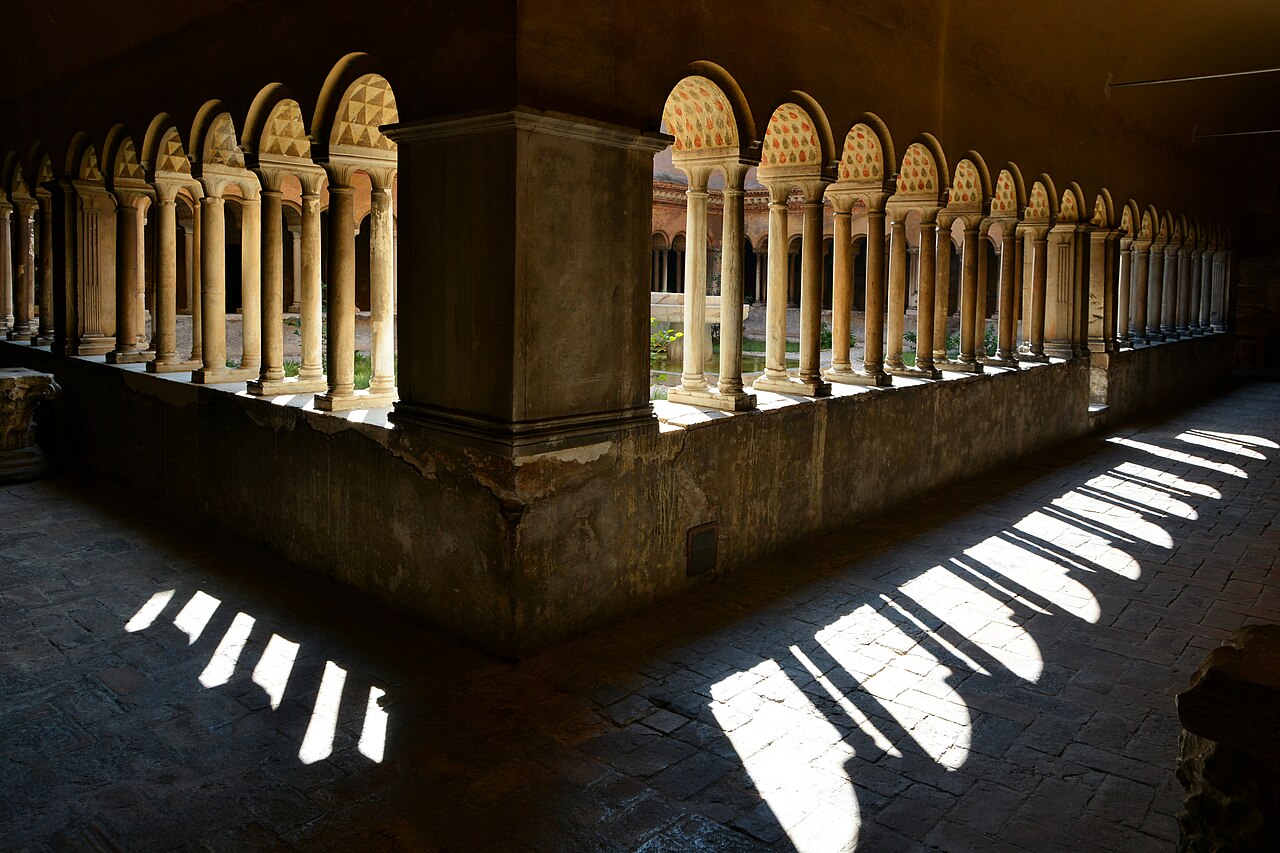
Basilica of Santi Quattro Coronati, Rome
A fortified church with an enclosed monastery inside it, halfway between the Colosseum and the Lateran, holding a cloister most visitors never find and a fresco cycle painted to argue a papal case.
- Location
- Rome, Italy 41.8879° N · 12.5013° E
- Type
- Titular basilica and enclosed monastery A fortified medieval complex, rebuilt after the Norman sack of 1084 within the walls of a much larger earlier basilica
- Dedication
- The Four Crowned Martyrs The cloister and the Oratory of San Silvestro
- Time Needed
- 1 hour to half a day
Why Go
The fortress church on the Caelian
Come for the quiet, which is unlike anything else in central Rome, and for the fact that the quiet is kept by a living community rather than by emptiness. The Augustinian nuns have been here since 1564 and the enclosure is real. Come also because the Oratory of San Silvestro is one of the most historically revealing rooms in the city: a thirteenth-century fresco cycle painted to assert, in pictures, a claim about the relationship of the papacy to the empire.
Four martyrs, a Norman sack, and a painted argument
The church is named for the Four Crowned Martyrs, and the tradition about who they were reaches us in more than one form. One account names four soldiers who refused to offer worship before a statue of Asclepius. Another names a group of stonemasons from Pannonia, martyred under Diocletian, whose bodies were later brought to Rome. The martyrologies, the sacramentaries and the medieval itineraries do not agree, and the old Roman Martyrology commemorated both groups together on the same day. The Church has kept the feast without resolving the confusion, and there is no reason for a pilgrim to resolve it either. What is certain is that martyrs are venerated here and have been for a very long time. The stonemasons' account is why the Four Crowned are patrons of stoneworkers.
The complex was far larger before 1084, when the Norman army of Robert Guiscard burned this quarter on its way through Rome. The present church was rebuilt inside the nave of the older one, which is why a visitor crosses two courtyards to reach a building that sits oddly within its own footprint, and why the whole is walled and towered like a small castle. It stood on the road between the Lateran and the rest of the city, and it was fortified because that mattered.
In 1246 Cardinal Stefano Conti built the Oratory of San Silvestro beside it and had it frescoed with the story of Constantine and Pope Sylvester: the emperor's leprosy, his baptism by the pope, and his handing of authority to the Church. That last scene depicts the Donation of Constantine, a document that Lorenzo Valla demonstrated in the fifteenth century to be a forgery. The frescoes are not evidence for the Donation. They are evidence of how forcefully the thirteenth-century papacy wished to assert it, painted at the moment the argument was live, and they are worth far more as that.
A medieval fortress in everything but name: high walls, a tower over the gate, two successive courtyards, and a church rebuilt after 1084 inside the shell of a much larger ninth-century basilica. The cloister of the early thirteenth century is reached from the left aisle. The Aula Gotica, part of the cardinal's palace, holds a fresco programme of the months, the liberal arts and the virtues that was only rediscovered in 1996.
The two courtyards that must be crossed before reaching the church, which are what remain of the earlier, much larger basilica
The tower over the entrance, which is why the building reads as a fortress
The turntable at which a visitor asks the enclosed community for the key to the oratory
Spiritual Significance
A church built like a fortress, kept by nuns, on the road between the Colosseum and the Lateran.
This is an enclosed house first and a monument second, and the difference is felt immediately. Voices drop in the cloister without anyone asking. Access to the cloister and the oratory depends on the community's rhythm, not the visitor's, and being turned away at the wrong hour is a normal outcome rather than a failure of planning.
Do Not Miss
-
The cloister
Early thirteenth century, with a fountain at the center. Among the quietest places in the city. Reached from the left aisle.
-
The Oratory of San Silvestro
Frescoed from 1246 with Constantine and Pope Sylvester, including the Donation. Ask at the turntable. A small room and a large argument.
-
The Aula Gotica
The months, the liberal arts and the virtues, painted in the early thirteenth century and rediscovered in 1996. Opened rarely and on its own schedule.
-
The two courtyards
What is left of the far larger basilica burned in 1084. You are walking through the old nave to reach the new church.
-
The crypt
Beneath the raised sanctuary, where the relics of the martyrs are kept.
What to notice
- That the church sits inside the outline of a bigger one, and how obvious that becomes in the courtyards
- How the noise of Rome stops at the gate
- The fountain in the cloister, and how much of the sound in that space it accounts for
- That the community is present and unseen, which is the point of an enclosure
- The tower, which belongs to a fortification rather than to a bell
Visit Plans
-
The church, the crypt, and the cloister.
-
With the Oratory of San Silvestro, if the hours allow.
-
On the walk from the Colosseum to the Lateran, with San Clemente between them.
Opening for the cloister and the oratory is limited and set by the community. Morning is the safer half of the day. Combine with San Clemente and the Lateran.
How to Visit
How to Visit
Approach on foot from the Colosseum toward the Lateran; the climb is part of it. Ask at the turntable for the oratory. Keep the cloister for last and sit down in it.
- The enclosed life of the Augustinian community, who have kept the house since 1564
- The feast of the Four Crowned Martyrs on November 8
- A station church in Lent
- The cloister and the oratory are shown by the nuns, on their terms and their hours
Relics, Tombs, Sacred Objects
Tomb and Burial
- The relics venerated as those of the Four Crowned Martyrs are kept in the crypt beneath the raised sanctuary
Relics and Sacred Tradition
- The relics of the martyrs who give the church its name, whose identity the tradition itself transmits in more than one form
Sacred Objects
- The cloister, built in the early thirteenth century, with a small fountain at its center
- The Oratory of San Silvestro, frescoed from 1246 with the story of Constantine and Pope Sylvester
- The Aula Gotica, with an early thirteenth-century cycle of the months, the liberal arts and the virtues, rediscovered in 1996
- The Chapel of Saint Barbara, among the oldest parts of the surviving complex
Connected Saints
Continue Your Pilgrimage
-
City hub
Rome
Where this church sits within the wider Catholic geography of Rome.
-
Basilica
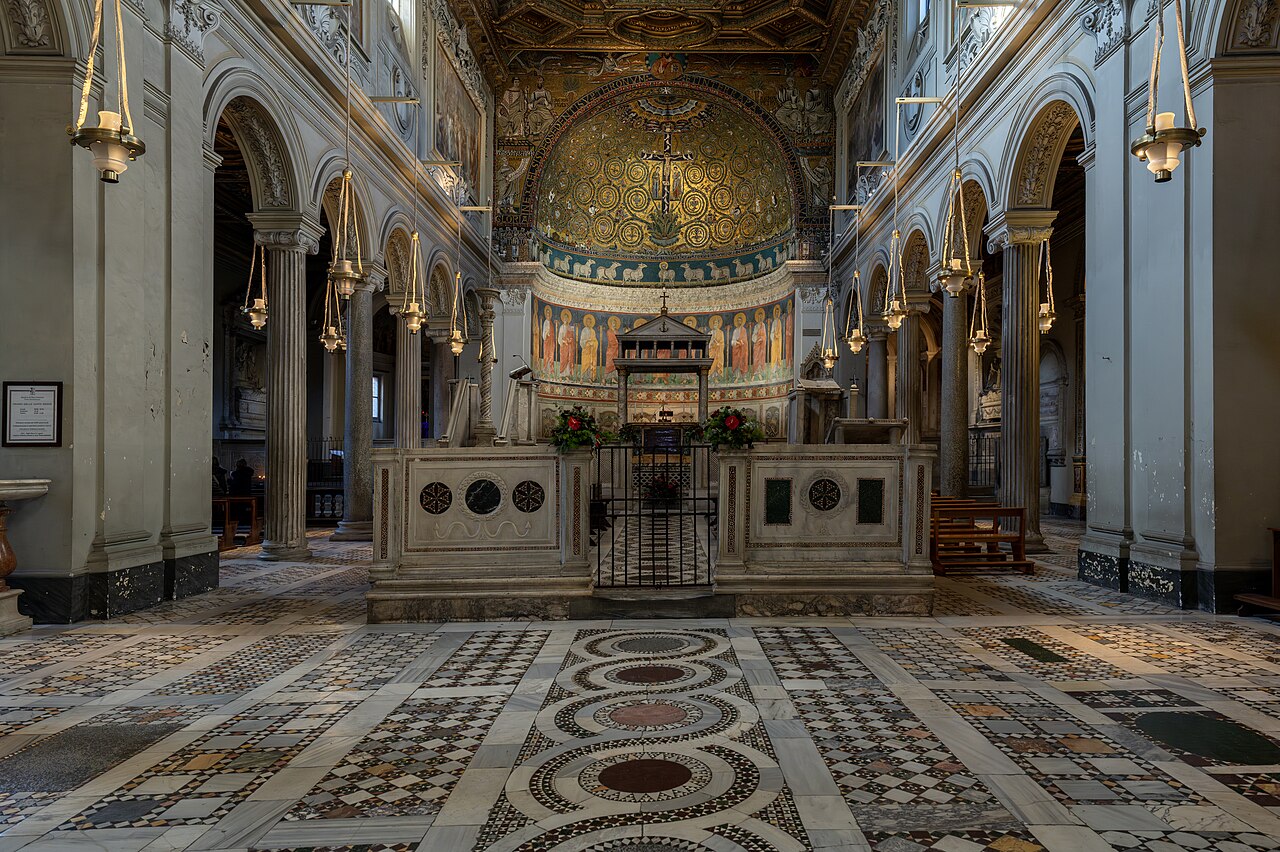
Basilica of San Clemente
Downhill toward the Colosseum, the three-layered church. The natural pairing on this stretch of road.
-
Papal archbasilica
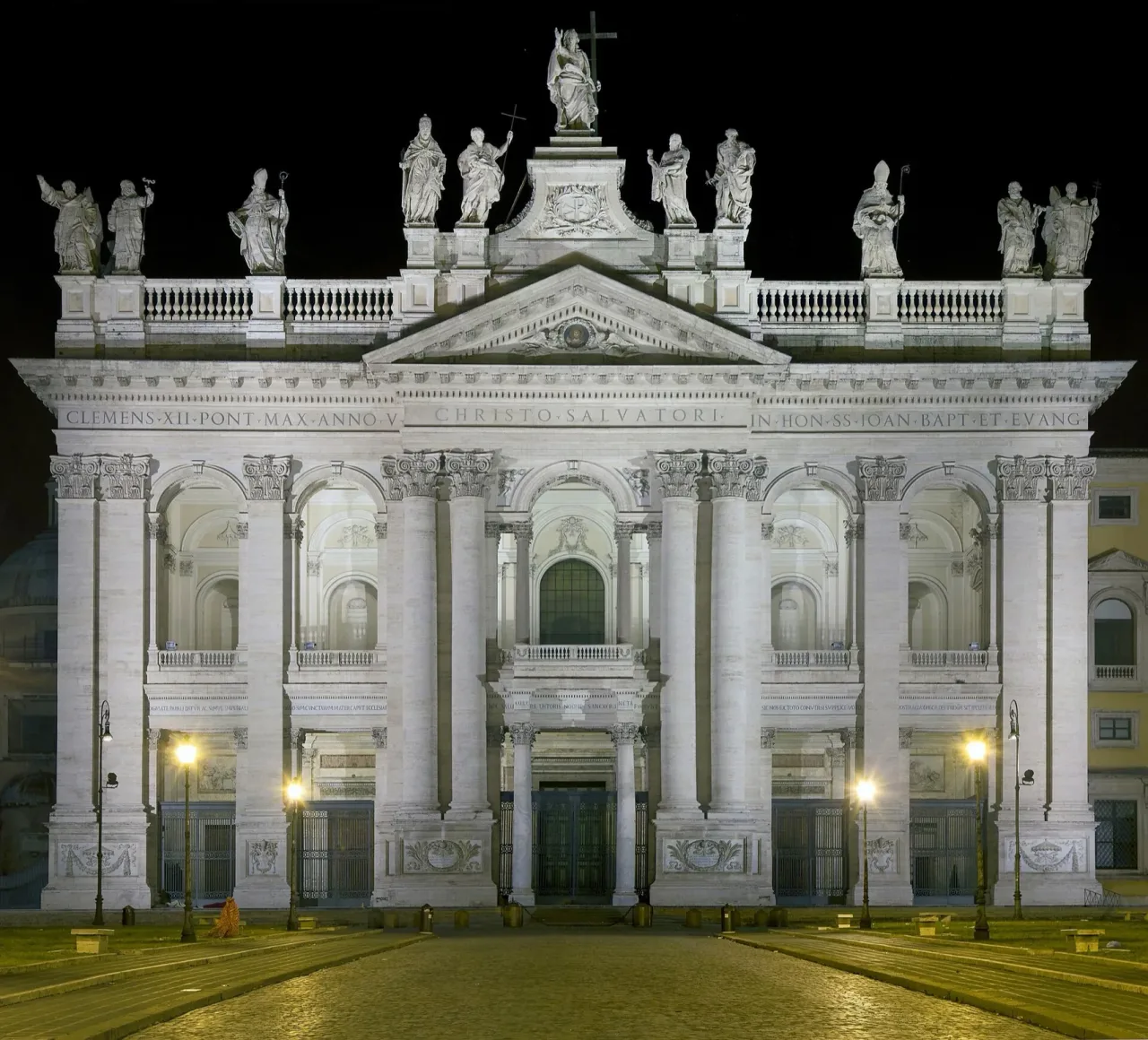
Archbasilica of St. John Lateran
The cathedral of Rome, along the road this church was fortified to watch.
-
Pilgrim shrine
The Scala Sancta and the Sancta Sanctorum
Across from the Lateran, the Holy Stairs climbed on the knees.
Map
Editorial sources
Treccani, Cathopedia, and the scholarly literature on the Passio of the Four Crowned.
Official
Awaiting source.
Last reviewed
September 13, 2026
Photo credits
- Hero. Hervé Simon / Wikimedia Commons (CC BY-SA 2.0). Source. CC BY-SA 2.0.