
- Location
- Rome, Italy 41.9237° N · 12.5205° E
- Type
- Archaeological area within the Sant'Agnese complex A circiform, or circus-shaped, covered cemetery basilica of the fourth century, about 40 by 98 metres, now roofless
- Dedication
- Raised in connection with the burial place of Saint Agnes; no dedication is in current liturgical use The plan on the ground, and what it was for
- Time Needed
- 1 hour to half a day
A roof over a graveyard
Come because this building answers a question most pilgrims never think to ask: what did Constantinian Rome actually build for its martyrs? Not a parish church. A vast covered cemetery, where ordinary Christians could be buried in the floor beside a martyr's grave, where families held funeral meals, and where Mass was said once a year on her anniversary. Standing at one end of it, with the scale visible and the roof gone, does more to explain fourth-century Christian practice than any amount of reading.
Constantina's cemetery, and why it was abandoned
The parish of the complex records that Constantina, daughter of the emperor Constantine, had the basilica built between 337 and 351 on family land near the place where Agnes was buried, and gives its dimensions as about 40.30 by 98.30 metres. Other accounts name 342 specifically. It is a substantial building by any standard and an enormous one for its date.
Its plan is the circiform type, sometimes called the circus basilica: three aisles, of which the outer two do not stop at the far wall but continue round behind the apse to form one unbroken ambulatory. About six examples are known in Rome and all belong to the Constantinian age. The shape is not decorative. It exists to let a continuous procession of people move around a burial area without obstruction.
The function follows from the shape. This was a coemeterium, a covered cemetery. The floor was given over to the graves of local faithful who wanted to lie near the martyr, the space was used for funeral banquets at burials, and the parish is explicit that regular liturgy was not what happened here: there was one Mass a year, on the anniversary of Agnes. Burial near the holy dead, ad sanctos, is one of the oldest instincts of Christian Rome, and this is what it looked like when an emperor's family paid for it.
The building was probably abandoned in the seventh century, when Honorius raised the present basilica directly over Agnes's grave. Once the Church built above the tomb itself, a covered cemetery beside it had no purpose. What remains are imposing ruins, best seen from the rear of the complex.
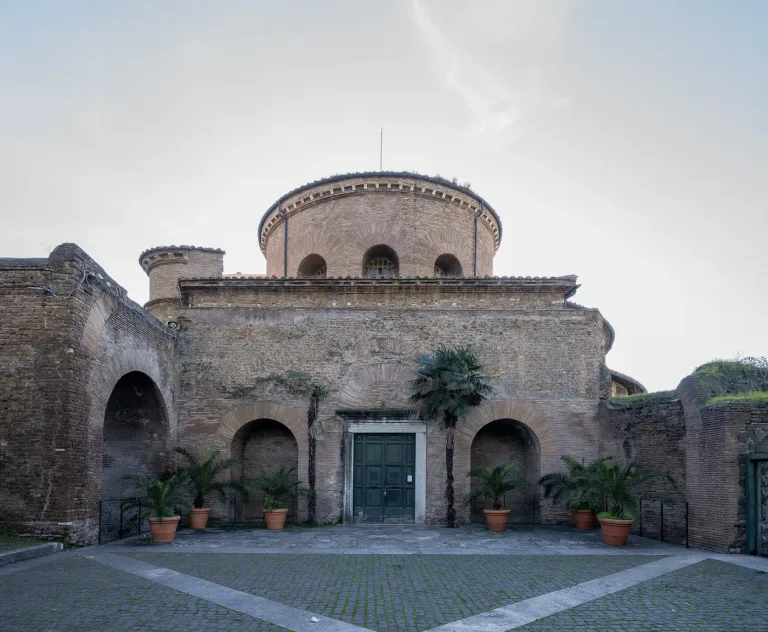
A three-aisled hall of about forty by ninety-eight metres whose side aisles curve round the apse end into a continuous ambulatory, giving the plan its resemblance to a circus. Roofless, with substantial lengths of perimeter wall standing. The Mausoleum of Santa Costanza was built against its flank, which is why the mausoleum sits at the angle it does.
The scale, which is roughly forty by ninety-eight metres and is difficult to credit until you stand at one end
The circiform plan, one of about six known in Rome and among the clearest to read on the ground
The view from Piazza Sant'Annibaliano, which is where the ruins are actually legible
It was never a church for congregations. It was a roof over a graveyard, built so the dead could lie near a martyr.
This is the one part of the complex with no liturgy in it, and the quiet is of a different kind from the basilica's. It is a graveyard whose roof has gone. Read it as that rather than as a picturesque ruin, and the visit changes.
Do Not Miss
-
The view from Piazza Sant'Annibaliano
The parish's own answer to where the ruins are visible from. The scale only registers from the open ground at the rear.
-
The ambulatory curve
Where the aisles swing round behind the apse. The single feature that identifies the circiform plan.
-
The standing north wall
The best surviving elevation, and the only place the original height is imaginable.
-
The junction with Santa Costanza
The mausoleum was built against this basilica's flank. Seeing the two together explains the mausoleum's orientation.
-
The floor area
Look at the ground rather than the walls. It was a burial surface, and that is what the building was for.
- The size, which is hard to believe for a fourth-century Christian building
- That there is no apse mosaic, no altar, and nothing to venerate, because there never was much
- How close the present basilica is, and how completely it replaced this one
- The brick, and how much of it is original fabric rather than consolidation
- That the mausoleum leans on this building rather than the other way round
Visit Plans
-
The ruins from the piazza and the junction with the mausoleum.
-
With Santa Costanza beside it.
-
The whole complex: basilica, catacomb, ruins, mausoleum.
Open ground, so weather matters more than hours. See it after the basilica and catacomb. Combine with Santa Costanza, which is a few steps away.
How to Visit
See it from Piazza Sant'Annibaliano at the rear of the complex, which the parish gives as the principal view. Do it after the basilica and the catacomb, so you already know where the tomb is and can see what this building was arranged around.
- No liturgy is celebrated here. The building was abandoned in the early Middle Ages and the liturgical life of the complex belongs to the basilica.
- In use it held one Mass a year, on the anniversary of the martyr
- The feast of Saint Agnes on January 21 is when the complex as a whole is busiest
Relics, Tombs, Sacred Objects
Tomb and Burial
- No saint is buried in the basilica itself. Its floor held the graves of ordinary Christians who wanted to lie near Saint Agnes, whose tomb is in the catacomb beneath the present church.
- Saint Agnes is buried in the adjoining cemetery, not here. The distinction is the whole point of the building.
Relics and Sacred Tradition
- There are no relics here. This is a burial ground, and what it offered was proximity to a grave rather than custody of one.
Sacred Objects
- The surviving perimeter walls, standing to a considerable height along the north side
- The curve at the far end, where the aisles ran round behind the apse to form a continuous ambulatory
- The mass of brickwork against which the Mausoleum of Santa Costanza was built
Continue Your Pilgrimage
-
City hub
Rome
Where this church sits within the wider Catholic geography of Rome.
-
Basilica
Basilica of Sant'Agnese fuori le Mura
The church Honorius built directly over the martyr's grave in the seventh century, which is what made this basilica redundant. Visit the tomb first.
-
Mausoleum and church
Mausoleum of Santa Costanza
Built against this basilica's flank by the same imperial patron, and keeping the oldest monumental Christian mosaics in Rome.

Map
The Sant'Agnese complex's parish account of the Constantinian basilica.
September 13, 2026