
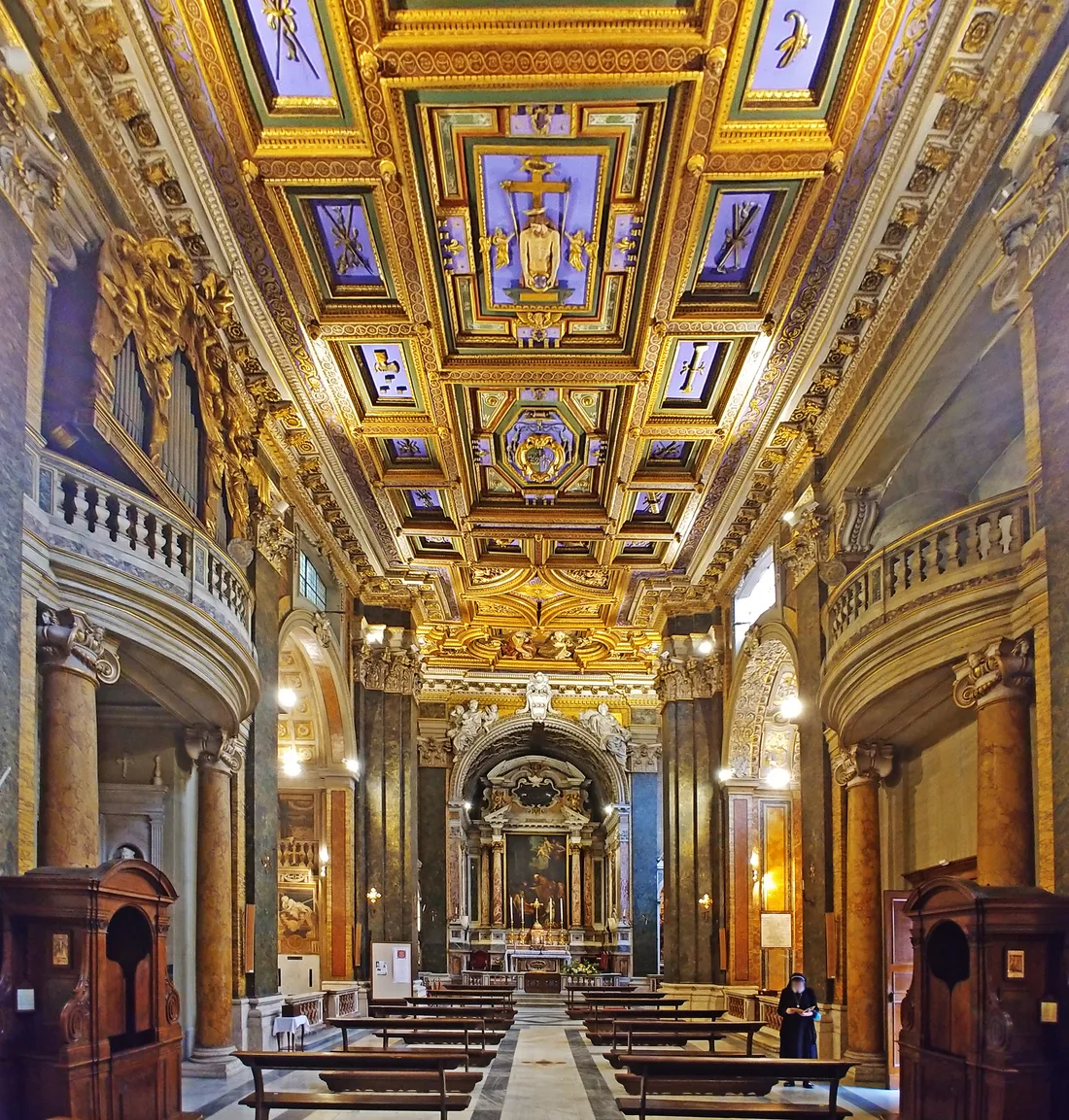
San Girolamo della Carità, Rome
The house where Philip Neri lived for thirty-two years and where the word Oratory first meant a room.
- Location
- Rome, Italy 41.8953° N · 12.4702° E
- Type
- Church of the Diocese of Rome, with the rooms of Saint Philip Neri A sixteenth-century rebuilding of an older church, with two celebrated funerary chapels added in the seventeenth and eighteenth centuries
- Dedication
- Saint Jerome The room shown as Philip's and the first oratory beside the church
- Time Needed
- 1 hour to half a day
Where the Oratory was a room before it was an institution
Most pilgrims following Philip Neri go to the Chiesa Nuova, pray at his tomb, and leave. That is the end of the story. This is the middle of it, and the middle is where the work was done. He came here in 1551, newly ordained, and stayed thirty-two years. The confessions, the conversations, the walks out to the catacombs, the gatherings of young Romans that eventually needed a room of their own: all of that happened from this address, on a street most people walk down without looking up. Come here if you want the saint at work rather than the saint at rest.
A confraternity's church, and a priest who stayed
The complex passed in 1524 to the Confraternity of Charity, founded a few years earlier by Giulio de' Medici, who became Clement VII. It was a charitable body with a hospice attached, and Philip Neri came to live in that hospice in 1551. What grew around him was informal for years: penitents, then friends of penitents, then a crowd. The gatherings were moved into a room fitted out beside the church, and that room was called the oratory. The name passed from the room to the people who met in it, and then to the Congregation they became. Gregory XIII approved the Congregation in 1575 and gave it Santa Maria in Vallicella. Philip did not follow for another eight years. He was in his late sixties when he finally left this house.
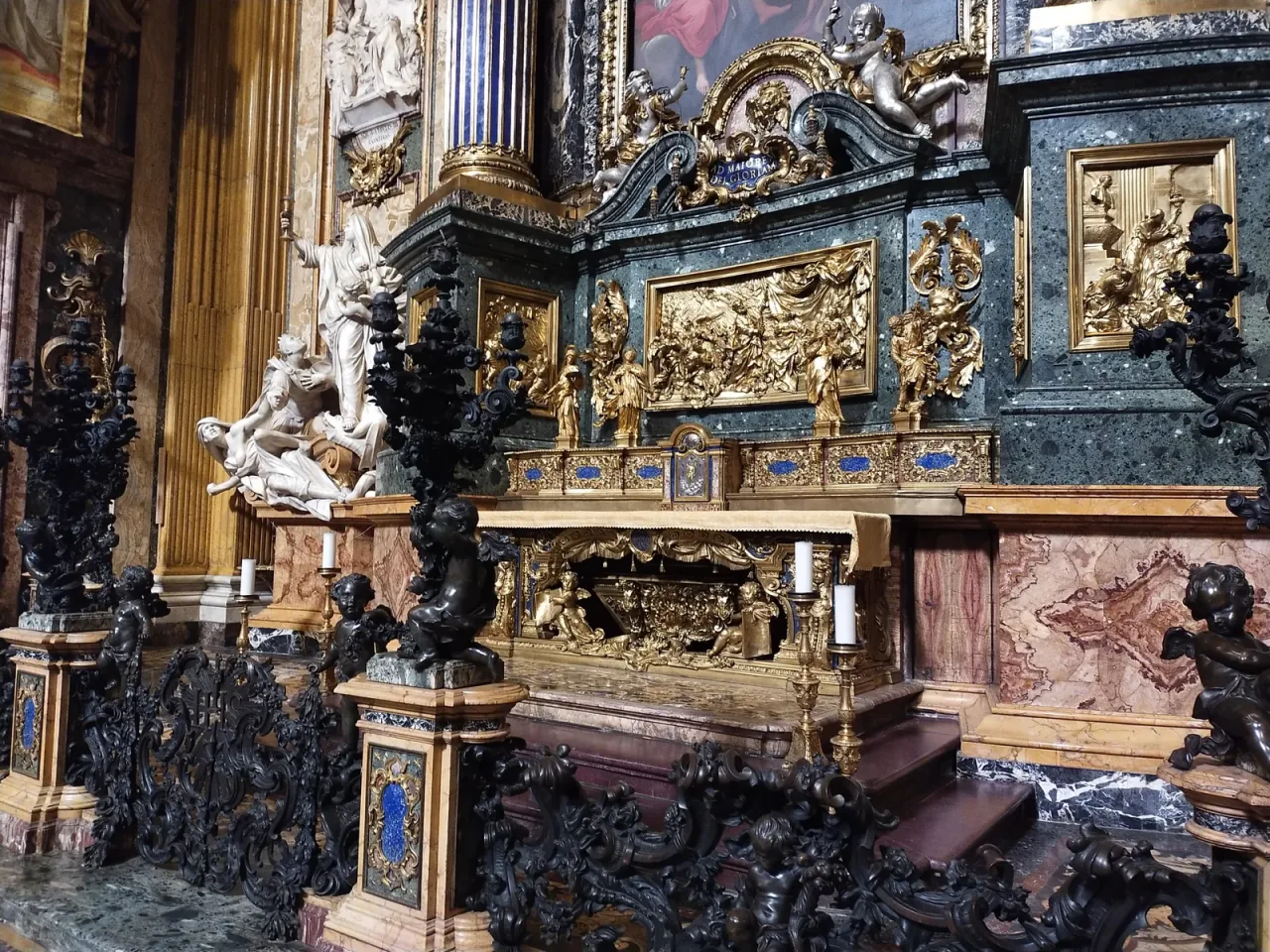
The present church is a later sixteenth-century rebuilding, plain enough in itself, and it is the two chapels that draw art historians. The Spada Chapel of the 1650s is an exercise in making marble behave like textile, its inlay worked into what looks like hanging drapery; Borromini's hand has long been assumed in it, though the design is now generally credited to Virgilio Spada. The Antamoro Chapel is Filippo Juvarra's, built in 1708 and 1709, with Pierre Le Gros's Philip Neri caught mid-ecstasy under concealed light. Beside the church, in rooms that were once a granary, are the spaces shown as Philip's own room and the first oratory.
This is where the Oratory started. The Congregation's own foundation is dated to 1575 and its church is the Chiesa Nuova, but the gatherings that became the Oratory were held here first.
Philip arrived in 1551, the year he was ordained, and stayed until 1583. The Congregation had already been given Santa Maria in Vallicella eight years before he himself moved.
The Le Gros statue is lit from a concealed window, so the saint appears to be looking into light that has no visible source.
The Oratory is named after a room in this house. The gatherings outgrew the room, and the word went with them.
This is a small church kept by a religious community, not a managed visitor site. The rooms are opened by the sisters to those who ask, which means a visit here is a request rather than a booking. That is the correct relationship to a place whose whole significance is hospitality extended informally over thirty-two years.
Do Not Miss
-
The rooms beside the church
Shown as Philip's room and the first oratory, in what was once a granary. If the community opens them, this is what you came for.
-
The Antamoro Chapel
Juvarra, 1708 to 1709, with Le Gros's statue of Philip in ecstasy lit from a window you cannot see.
-
The Spada Chapel
Marble inlay worked to look like draped cloth. Long attributed to Borromini; the design is now generally given to Virgilio Spada.
-
The nave itself
Narrow, gilded, and small. This is the room he heard confessions in for thirty-two years.
- The Oratory has two Roman addresses and they are not interchangeable. It began here; it was constituted at the Chiesa Nuova in 1575. Philip himself did not move until 1583.
- The Camerette, the rooms usually meant when a pilgrim says Philip's rooms, are at the Chiesa Nuova, above the sacristy, and are where he lived his last twelve years. The rooms here belong to the earlier and longer period.
- The word oratory is architectural before it is institutional. It meant a place of prayer, then the people who used one, then a congregation of priests.
- The church is a cardinalatial deaconry, which is why it appears in Vatican lists out of all proportion to its size.
Visit Plans
-
The church, the two chapels, and the rooms if they are open.
-
As above, then the ten-minute walk to the Chiesa Nuova and Philip's tomb.
-
Both Oratorian churches with time in between, taking Piazza Farnese and the Via Giulia on the way.
Sit in the nave before asking for anything. Then ask about the rooms. Then walk to the Chiesa Nuova and pray at the tomb, in that order, so the life comes before the death.
How to Visit
Go to the church first and sit in the nave, which is narrow enough that you can see how a confessional ministry worked in it. Then ask about the rooms. If they can be opened, they are the reason to have come; if they cannot, the church and the two chapels are worth the walk on their own. The Chiesa Nuova is about ten minutes away on foot, and the two are one visit taken in the right order: work first, then tomb.
- A small church on a quiet street, kept by a resident religious community
- The feast of Saint Philip Neri on May 26, which belongs to this house as much as to the Chiesa Nuova
- Confession, which is the ministry this place is known for
- Limited and irregular opening, arranged by the community rather than by a timetable
Relics, Tombs, Sacred Objects
Tomb and Burial
- No saint is buried here. Philip Neri died at the Chiesa Nuova in 1595 and is buried there. What this church holds is the place he lived and worked, not his grave.
Relics and Sacred Tradition
- The church does not present itself as a relic shrine. Its claim on Catholic memory is a room and thirty-two years of hearing confessions in it.
Sacred Objects
- The rooms beside the church, in a former granary, shown as Philip's room and the first oratory
- The Antamoro Chapel, designed by Filippo Juvarra in 1708 and 1709, with Pierre Le Gros's statue of Philip in ecstasy
- The Spada Chapel, refurbished in the 1650s, whose inlaid marble is worked to look like draped cloth
Continue Your Pilgrimage
-
City hub
Rome
Where this church sits within the wider Catholic geography of Rome.
-
Sacred place
Chiesa Nuova (Santa Maria in Vallicella)
The Oratorian church Philip moved to in 1583, where he is buried and where the Camerette are.
-
Sacred place
Church of the Gesù
The Jesuit mother church, built in the same Roman generation as the Oratory.

Map
The church's own history and the Oratorian sources for Saint Philip Neri's Roman years.
Awaiting source.
September 13, 2026
Photo credits
- Hero. Pufui PcPifpef, CC BY-SA 4.0, via Wikimedia Commons. Source. CC BY-SA 4.0.