
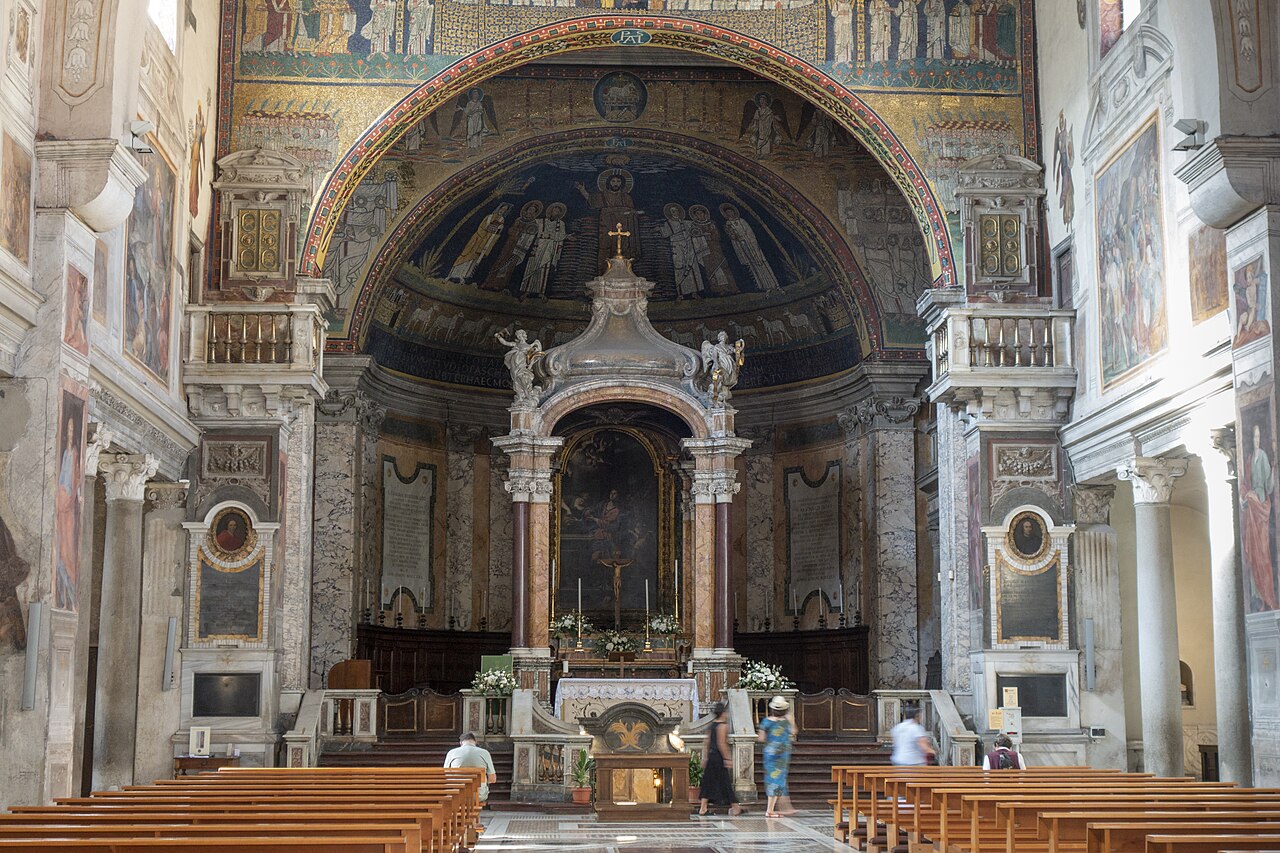
Basilica of Santa Prassede, Rome
Paschal I emptied the catacombs into this church and lined a side chapel with gold mosaic for his mother. It also holds the column venerated as that of the scourging. Almost nobody walks the two minutes from Santa Maria Maggiore to see it.
- Location
- Rome, Italy 41.8956° N · 12.4999° E
- Type
- Ancient titulus and minor basilica A ninth-century basilica raised by Paschal I on the site of an older titulus, built deliberately in the manner of the early Roman basilicas
- Dedication
- Saint Praxedes, virgin The Chapel of Saint Zeno and the column of the flagellation
- Time Needed
- 1 hour to half a day
The church Paschal I filled with martyrs
Come for the Chapel of Saint Zeno, which is the single most concentrated piece of early medieval art in Rome and takes up about as much space as a large bedroom. Come also because this church explains a habit of the ninth-century papacy that shaped the city: when the catacombs outside the walls became unsafe, the popes brought the martyrs inside. Santa Prassede is what that decision looks like when it is carried out at scale and then decorated by the best mosaicists available.
A titulus, a translation of martyrs, and a column from the East
There was a titulus here before there was a basilica, attached in tradition to the household of the senator Pudens, whose daughters Praxedes and Pudentiana are remembered as sheltering Christians in the first generations. The tradition is ancient and the church is named from it. How much of it is history is not something the sources allow us to settle, and the Church does not ask anyone to settle it.
What is documented is the rebuilding. Paschal I, pope from 817 to 824, raised the present basilica and brought into it the relics of Praxedes and Pudentiana together with a great number of martyrs taken from the catacombs, which by then lay exposed outside the walls. An inscription in the church records the translation. In the same campaign he built the Chapel of Saint Zeno as a funerary chapel for his mother Theodora and had it lined, floor to vault, entirely with mosaic. It is the only room in Rome treated that way, and it was known in the Middle Ages as the Garden of Paradise. Paschal appears in the mosaics with a square halo, the convention for a donor still alive when the work was made.
The column came later. Cardinal Giovanni Colonna, papal legate in the East during the Fifth Crusade and charged by Honorius III with bringing back what relics he could, carried it to Rome in 1223. It is a short shaft, about sixty centimeters, of a hard speckled stone quarried in the Eastern Desert of Egypt. That it came here in 1223, and from the Holy Land, is a documented translation. That it is the column at which Christ was scourged is the tradition attached to it, and the two claims are not the same claim. The Church venerates the relic without having pronounced on its identity, and Vatican News, writing about it recently, was content to call it a mystery.
A ninth-century basilica built deliberately in an older manner, with a nave of reused columns and a raised sanctuary over a confessio, looking back to the great early Roman churches rather than forward. The Zeno chapel opens off the right aisle and is entered through a doorway framed with ancient spolia. The chapel holding the column adjoins it.
The square halo on Paschal I in the mosaics, which marks a living donor rather than a saint
The vaulting of the Zeno chapel, known since the Middle Ages as the Garden of Paradise
The plainness of the street entrance, which gives no warning of what is inside
Paschal I built a reliquary the size of a church, and then lined one room of it with gold.
A working parish church in a plain street, almost always quiet, two minutes from one of the most crowded basilicas in Rome. The contrast is the experience. It is dim until the lights are fed, and the mosaics are meant to be seen lit, so the coin box is not an indignity but part of how the room works.
Do Not Miss
-
The Chapel of Saint Zeno
Off the right aisle, entirely lined with ninth-century mosaic, built for Paschal's mother Theodora. Feed the light. This is the reason to come.
-
The column of the flagellation
In its own chapel beside the Zeno chapel, in a small gilded reliquary of 1898. Short, dark, speckled stone. Venerated as the column of the scourging.
-
The apse and triumphal arch
The same ninth-century campaign, with Paschal I carrying a model of the church and wearing the square halo of a living donor.
-
The inscription of the translation
Recording the martyrs brought in from the catacombs. The church's own account of why it is full of relics.
-
The porphyry disc in the nave
Marking the tradition of the well in which Praxedes is said to have gathered the blood of martyrs. A tradition, and presented as one.
- How dark the church is before the chapel lights are fed, and how completely that changes
- The reused ancient columns in the nave, which are older than the building around them
- That the Zeno chapel has no flat wall left undecorated, including the vault
- The size of the column, which is far smaller than most people expect
- How few people are here, two minutes from Santa Maria Maggiore
Visit Plans
-
The Zeno chapel, the column, and the apse without hurrying.
-
The same, with time to sit in the nave and read the mosaics properly.
-
With Santa Maria Maggiore next door, which is the pairing the geography intends.
Quiet nearly always. Best in the late morning when light reaches the apse. Pair with Santa Maria Maggiore.
How to Visit
Walk from Santa Maria Maggiore, which takes about two minutes and is the way the church makes sense. Bring coins for the chapel lighting. Go to the Zeno chapel first while your eyes are fresh, then the column, then the apse.
- Parish and titular life in a quiet street behind Santa Maria Maggiore
- The feast of Saint Praxedes on July 21
- A station church of the Roman stational tradition in Lent
- Veneration of the column, kept in its own chapel beside the Chapel of Saint Zeno
Relics, Tombs, Sacred Objects
Tomb and Burial
- The relics of Saint Praxedes and of Saint Pudentiana, brought here by Paschal I when he rebuilt the church
- The relics of a large number of Roman martyrs, translated from the catacombs in the same campaign and recorded on an inscription in the church
Relics and Sacred Tradition
- The column venerated as that at which Christ was scourged, brought from the Holy Land in 1223 and kept in its own chapel beside the Chapel of Saint Zeno
- The relics of the martyrs gathered here by Paschal I from the catacombs outside the walls
Sacred Objects
- The Chapel of Saint Zeno, built by Paschal I as a funerary chapel for his mother Theodora, the only room in Rome entirely lined with mosaic
- The apse and triumphal arch mosaics, of the same ninth-century campaign
- The reliquary of the column, a small gilded temple made by Duilio Cambellotti in 1898
- The porphyry disc in the nave floor, marking the tradition of the well where Praxedes gathered the blood of martyrs
Continue Your Pilgrimage
-
City hub
Rome
Where this church sits within the wider Catholic geography of Rome.
-
Papal basilica
Basilica of Santa Maria Maggiore
The patriarchal basilica around the corner, built by the same Sixtus III who rebuilt the Lateran font. The two are a single stop in practice.
-
Basilica of the Passion relics
Santa Croce in Gerusalemme
The other Roman church of the Passion relics. Visiting both makes the city's Passion geography legible.
-
Basilica
Basilica of San Clemente
Toward the Lateran, another church built over its own older layers.

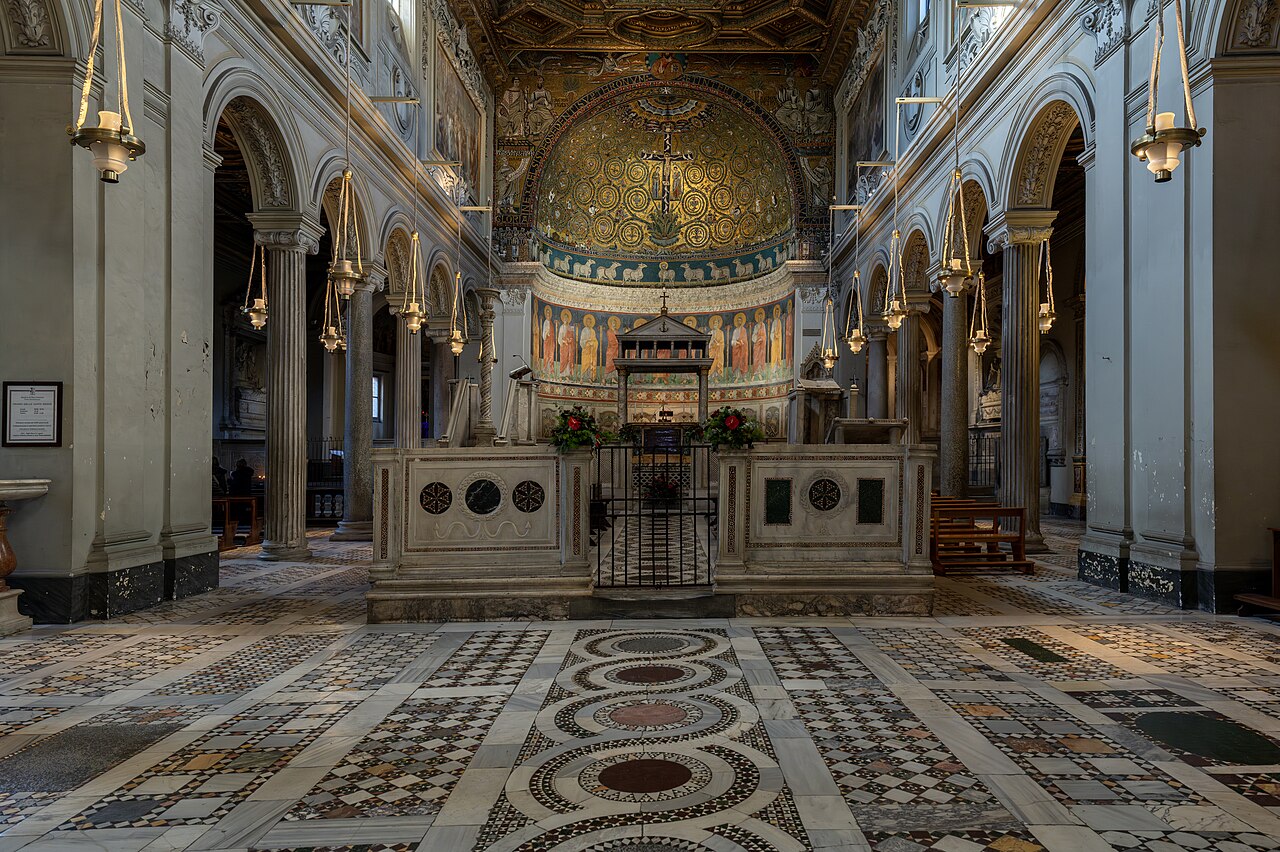
Map
Vatican News and standard accounts of the ninth-century rebuilding.
Awaiting source.
September 13, 2026
Photo credits
- Hero. Nicholas Hartmann / Wikimedia Commons (CC BY-SA 4.0). Source. CC BY-SA 4.0.