Body relics of Saint Agnes
Tomb and body relicYes, beneath the high altar
Basilica of Sant'Agnese fuori le MuraSant'Agnese fuori le Mura is the basilica raised over the catacomb where Saint Agnes was buried on the Via Nomentana. Her body relics rest beneath the high altar, under a seventh-century apse mosaic, in a church sunk below the modern city beside the mausoleum of Santa Costanza.
Come here to pray at the grave itself. Of all the places in Rome that remember Agnes, this is the one built over her tomb, in the catacomb where her devotion began. The basilica is quieter than the great churches of the center and keeps the atmosphere of early Christian Rome.
Agnes was buried in a cemetery along the Via Nomentana, beyond the walls, after her martyrdom in the early fourth century. Her grave drew Christians almost at once: Constantina, the daughter of Constantine, raised a great covered cemetery basilica beside it, and was herself buried in the round mausoleum that survives next door as Santa Costanza. The present church was rebuilt by Pope Honorius I in the seventh century, directly over the martyr's grave, and given the apse mosaic that still stands. The body relics of Agnes are venerated beneath its high altar; her skull is venerated across the city at Sant'Agnese in Agone.
The basilica sits below the modern street, reached by a long marble staircase set with early Christian inscriptions. Inside, the seventh-century plan keeps its upper women's galleries, the matroneum, above the nave, and the gold apse mosaic of Agnes between two popes above the altar. The effect is of descending into the ancient city to reach the grave.
The primary pilgrimage church of Saint Agnes, over her tomb and catacomb
A seventh-century apse mosaic among the oldest images of the saint
The annual blessing of lambs for the pallia of new archbishops
A quieter destination than the basilicas of the center, in the atmosphere of early Christian Rome
This is a place of burial and prayer before it is a monument. It is best approached slowly: the descent, the tomb, the mosaic, and the catacomb below, where the veneration of Agnes first took root.
Beneath the high altar, the body relics traditionally venerated as those of Saint Agnes, with the relics of Saint Emerentiana, her foster-sister in the tradition. This is the reason the basilica stands where it does.
Above the altar, Agnes stands in the gold of a Byzantine empress between Popes Honorius I, who holds a model of the church he rebuilt, and Symmachus. It is one of the oldest surviving images of the saint in Rome.
The marble staircase down to the church is set with early Christian epitaphs gathered from the catacomb. The basilica itself sits well below the modern street, at the level of the ancient burial road.
The underground cemetery where Christians first venerated Agnes, within decades of her death. The basilica above was built precisely to mark and shelter this grave.
On her feast, two lambs are blessed here; their wool is later woven into the pallia worn by new archbishops. The name Agnes echoes the Latin agnus, lamb.
Descend the marble staircase into the sunken basilica, pray at the high altar over the tomb of Saint Agnes, and read the seventh-century apse mosaic above it. Step next door to Santa Costanza before leaving.
Add the guided catacomb of Sant'Agnese beneath the basilica and the open ruins of the Constantinian cemetery basilica beside it. Together they show how a martyr's grave grew into a sacred complex on the Via Nomentana.
Pair this church, over her tomb and catacomb beyond the walls, with Sant'Agnese in Agone on Piazza Navona, which marks her public witness and keeps the reliquary venerated as her skull. Take them in either order.
Do not rush the descent. The staircase, the sunken nave, and the catacomb below are not obstacles before the tomb; they are how the church teaches you that you are arriving at a grave.
Go down the staircase into the sunken nave and walk to the high altar, where the body relics of Saint Agnes are venerated beneath the seventh-century apse mosaic. If the catacomb is open, join a guided visit to the burial galleries below. Step next door to Santa Costanza for its early Christian mosaics, and to the ruins of the Constantinian basilica beside the church. Confirm current hours for the basilica and the catacomb before planning around them.
Prayer and liturgy
Visiting and access
Catacomb entry is ticketed, with reductions for students and young visitors; children under six enter free.
Yes, beneath the high altar
Basilica of Sant'Agnese fuori le MuraBy guided visit, hours permitting
Pontifical Commission for Sacred ArchaeologyAssociated with the basilica
Basilica traditionSource note Traditional attributions are presented as tradition, with documentation named where it exists.
This is the church of Saint Agnes above all, raised over her grave. The saints gathered here belong to her story and to the early Roman world of catacomb and martyr that surrounds it.
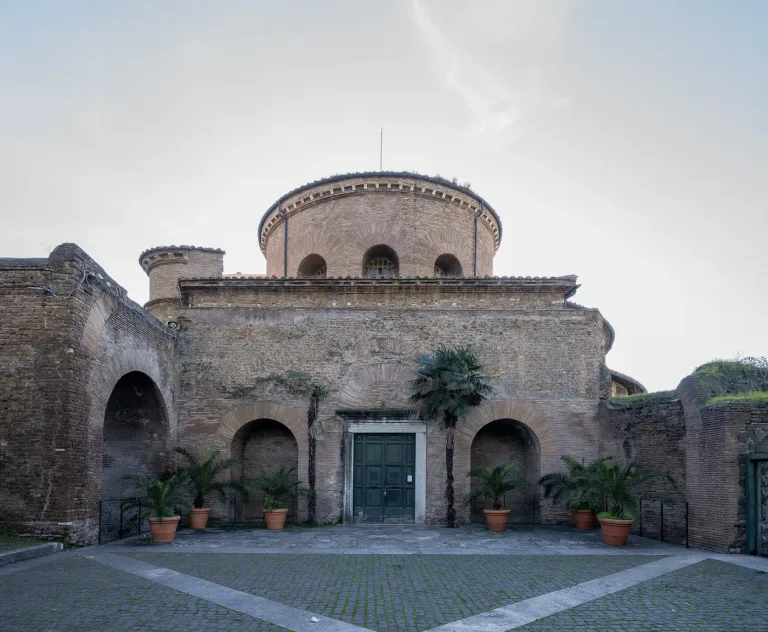
A few steps away, the round fourth-century mausoleum of Constantina, daughter of Constantine, ringed by some of the earliest Christian mosaics in Rome.
Beside the present church, the open ruins of the great fourth-century covered cemetery basilica first raised over the martyr's grave.
This basilica keeps Agnes's tomb. Continue to Piazza Navona, where another church preserves the tradition of her martyrdom.
Cross the city to Piazza Navona, where the other Agnes church keeps the memory of her public witness and venerates her skull relic.
Agnes and Cecilia make the early Church visible across tombs, house-church memory, and the catacomb roads beyond the center.
Traditional attributions are identified in context.
The basilica's own source. Relic and tomb language follows long-standing Roman tradition: the body relics venerated here, the skull venerated at Sant'Agnese in Agone.
July 9, 2026
Use this for corrections, broken links, missing places, and planning ideas.