Pilgrimage Guide · Paris

Two Days in Catholic Paris

The cathedral and its relics on the first day, Marian Paris and the hill of adoration on the second.

  • 2 days
  • Unhurried; two full but walkable days
  • Reviewed July 2026
  • Desk researched

Suicasmo / Wikimedia Commons (CC BY-SA 4.0)

The argument

The shape of these days

Paris is walked most honestly as a Catholic city, not a set of famous buildings that happen to be churches. The order here follows two arguments rather than a map.

Day one is the cathedral and its relic memory. Notre-Dame reopened at the end of 2024, and it is again the center of the diocese and the keeper of the Crown of Thorns; from its island you are a few minutes from Sainte-Chapelle, the reliquary King Louis IX built for that same crown, and a short climb from the shrine of St. Genevieve, who has been called the guardian of the city since the fifth century.

Day two turns to Marian Paris and the hill above it. Rue du Bac is where Catherine Laboure received the Miraculous Medal, and it remains the second most visited pilgrimage in France. Montmartre closes the two days not as a viewpoint but as a sanctuary where the Blessed Sacrament has been adored without interruption since 1885.

What this guide leaves out, on purpose

  • The Basilica of Saint-Denis. The royal necropolis and first Gothic choir sit north of the city and deserve their own half-day. Adding it here would break the walkable rhythm of day one; it is offered as an optional extension instead.
  • The Louvre and secular Paris. This is a pilgrimage, not a city tour. The great museums and monuments are left to a different kind of visit so these two days can stay prayerful.
  • Long guided tower and archaeology visits. Climbing towers and timed museum circuits eat the hours that the churches themselves reward. The guide keeps the days inside the sanctuaries.

Day 1

The cathedral, its relics, and historic Paris

The first day holds the two crowns of Paris in one walk: the Crown of Thorns itself at Notre-Dame, and the golden reliquary chapel Louis IX raised to house it. It ends on the hill where the city keeps St. Genevieve.

  • Give the morning to the cathedral before the island fills, then let the afternoon stay on the Left Bank.
  • All on foot. Notre-Dame and Sainte-Chapelle share the Ile de la Cite; Saint-Etienne-du-Mont is a ten-minute walk up onto the Montagne Sainte-Genevieve.
  • See this day on the map
  1. First thing, when the doors open

    Notre-Dame Cathedral, Paris

    Plan on about 1 hour, longer on a veneration Friday

    Begin where the diocese begins. Walk the restored nave slowly before the crowds thicken; the point of the morning is not the ceiling but what the cathedral now guards again. Since the reopening the Crown of Thorns has returned to Notre-Dame, kept in a new reliquary and brought out for veneration on Fridays and through Lent. If your day falls on a veneration Friday, shape the morning around that hour rather than the architecture. Come as a pilgrim first and a visitor second.

    Give your time to the Crown of Thorns and the rhythm of prayer at the heart of the cathedral; the vaults and the facade will find you on the way in and out.

    Entry is free and busy. Advance booking shortens the wait, and Crown of Thorns veneration follows a Friday and Lenten schedule; confirm the current times on the cathedral site before building a Friday around it.

  2. A five-minute walk within the island, from the cathedral to the Palais de la Cite complex.

  3. Late morning, after the cathedral

    Sainte-Chapelle

    Plan on about 45 minutes

    Sainte-Chapelle is the second half of the same thought. King Louis IX built this upper chapel in the 1240s as a reliquary in stone and glass for the very Crown you prayed before at Notre-Dame. Go up to the upper chapel and give it time; the fifteen windows are meant to be read, not glanced at, and they hold the whole of salvation history in light. Come when the sky is bright if you can, and stand still long enough for the room to work.

    Give your time to the upper chapel and its windows, understood as the setting once built to hold the Passion relics.

    Sainte-Chapelle has airport-style security and timed entry; book ahead and expect a queue at peak hours.

  4. A ten-minute walk south and uphill from the island onto the Left Bank heights, past the Pantheon.

  5. Early afternoon

    Saint-Étienne-du-Mont

    Plan on about 40 minutes

    Climb onto the Montagne Sainte-Genevieve to keep the memory the city has never let go of. St. Genevieve turned back invasion by prayer in the fifth century and has been held as the guardian of Paris ever since. Her shrine stands here, near the site of the great abbey that once bore her name, and the church keeps the finely carved rood screen that is the only one left in Paris. This is where the Christian memory of Paris feels oldest and most local, away from the island crowds.

    Give your time to the shrine of St. Genevieve and the carved rood screen; sit a while in a church that still belongs to its neighborhood.

  6. Optional · Only if you have a spare half-day

    Basilica Cathedral of Saint-Denis

    Plan on about 1 hour 30 minutes with travel

    If two days becomes two and a half, give the extra time to Saint-Denis, north of the city. This is where the first Gothic choir was raised and where the kings of France are buried around the tomb of the martyr-bishop who gave Montmartre its name. It is a real detour by Metro and does not fit the walking rhythm of the core day, which is why it stands apart here rather than inside it.

    Give your time to the early Gothic choir and the royal necropolis around St. Denis's tomb.

    Saint-Denis is a Metro ride to the northern suburbs; treat it as a separate outing, not an add-on to a full day.

Stay on the Left Bank for the evening. A quiet Mass or a walk back along the Seine keeps the day's rhythm before day two crosses the river.

Day 2

Marian Paris and the hill of adoration

The second day is quieter and more interior. It begins in the chapel where Our Lady gave the Miraculous Medal and ends on the hill where the Church has adored the Blessed Sacrament without a single night's interruption since 1885.

  • Give the morning to Rue du Bac unhurried, then let the afternoon and evening belong to Montmartre.
  • A short Left Bank walk in the morning, then the Metro north to Montmartre, where the last stretch is a climb or the funicular up to the basilica.
  • See this day on the map
  1. Morning, soon after it opens

    Chapel of Our Lady of the Miraculous Medal

    Plan on about 1 hour

    Come early, because this small chapel behind a courtyard on Rue du Bac fills through the day. In 1830 Our Lady appeared here to the young sister Catherine Laboure and asked that the Miraculous Medal be struck. Catherine's incorrupt body lies in the chapel, and pilgrims still come by the million; this is the second most visited pilgrimage in France after Lourdes. Sit for the prayer rather than the sightseeing, then take a medal from the counter as generations have done before you.

    Give your time to quiet prayer at the altar of the apparitions and the resting place of St. Catherine Laboure; receive a Miraculous Medal.

    The chapel closes over the middle of the day and is busiest late morning; arrive near opening for the quietest hour.

  2. Metro north from Sevres-Babylone toward Montmartre, then the climb or the funicular up to the basilica.

  3. Afternoon into the evening

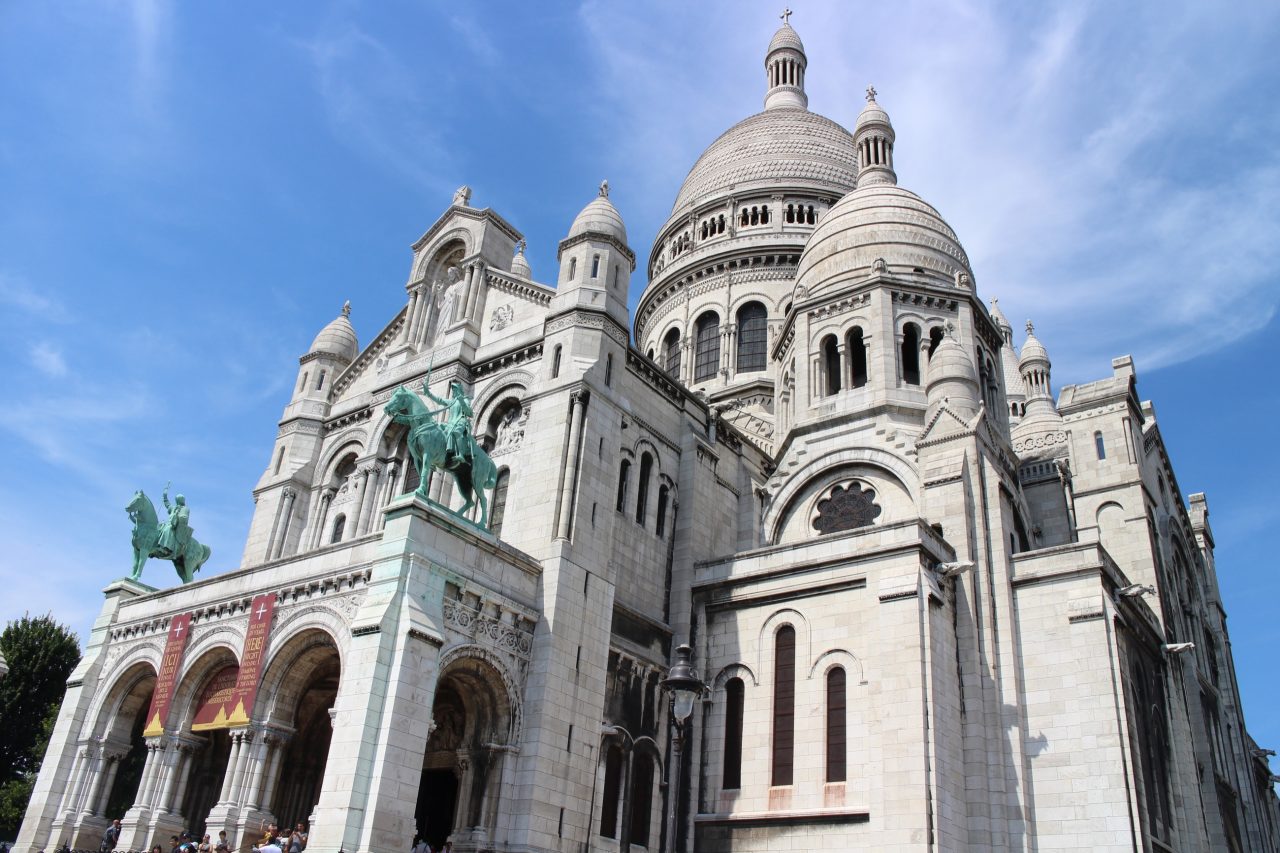
    Sacré-Cœur, Montmartre

    Plan on about 1 hour, more if you stay to adore

    End the two days on the hill, but end them inside the basilica rather than on its steps. Sacre-Coeur was raised as a national act of reparation, and since 1885 the Blessed Sacrament has been exposed and adored here day and night without stopping, through war and siege and pandemic. Let the view wait. Go in, kneel before the exposed Sacrament under the great mosaic of Christ, and let the guide close where a pilgrimage should, in adoration. The martyr memory of Montmartre, the mount of martyrs, is under your feet.

    Give your time to time before the exposed Blessed Sacrament under the apse mosaic; the panorama is the least of what the hill offers.

    The basilica is open late into the evening and keeps reverence for adoration; dress and move as you would in any sanctuary. Organ restoration runs through 2026.

There is no better close than the adoration itself. If you can, stay for a while after the light goes down and the day-trippers leave the hill to the pilgrims.

When plans bend

Adapting these days

If you only have one day

Keep day one and add Rue du Bac in the late afternoon. You will lose Montmartre and the adoration, which is a real loss, but you will still hold the Crown of Thorns, Sainte-Chapelle, and the Miraculous Medal in a single walk.

If you want a Friday around the Crown of Thorns

Anchor the whole itinerary on a Friday and confirm the cathedral's veneration hour in advance. Move Sainte-Chapelle and Saint-Etienne-du-Mont around that fixed hour rather than the reverse.

If you are traveling with limited mobility

Day one is largely level once you are on the island; the climb to Saint-Etienne-du-Mont is the hardest stretch. In Montmartre, use the funicular rather than the stairs, and verify current step-free access at each church before you go.

My Journey

Make these days your own

The cathedral and its relics on day one, Marian Paris and adoration on day two. Confirm Crown of Thorns veneration times and chapel midday closures before you set the order.

  • 5 places across 2 days, in the guide's order
  • Day structure comes with it; nothing is scheduled to the clock until you ask
  • Optional stops stay out of the plan; save the ones you want from their cards above
  • Works without an account, in this browser

You choose the journey it joins before anything is saved.

Editorial responsibility

How this guide was prepared

Prepared by
Eternal Roam Editorial
Responsible editor
Luke Gordon, Eternal Roam
Last reviewed
July 2026
Verification
Desk researched

Researched from official and reliable sources, including the sanctuaries' own published information. This itinerary has not yet been field verified by an Eternal Roam contributor.

Built from the cathedral's and sanctuaries' own published information and the sources below, over Eternal Roam's canonical Paris place records, with distances and transit checked against maps rather than memory. No contributor walked this itinerary; practical hours and veneration times are volatile and should be confirmed on the official sites.

Opening hours, Mass times and access change; each place page above carries its current sources. How Eternal Roam researches and reviews its guides is described in our editorial standards.

Sources consulted