The Dante inscription
Facade mosaicRead it before entering. It is the parish's statement of what the building is for.
Saints Peter and Paul ChurchThe Italian church of North Beach, rebuilt after 1906 and finished in 1924, now praying in English, Italian and Cantonese, and the first stamp after the bridge.
Coming south over the Golden Gate and east through the Presidio, this is the first church a pilgrim meets on the city side of the Camino, and its spires are visible long before the door is. It is also the point where the route stops being about missions and starts being about immigrants.
San Francisco's Catholic history is not only Spanish. It is Italian, Irish, Chinese, Latin American and Filipino, and this parish is where that is most legible: founded for Italians, rebuilt after the city burned, and now celebrating Mass in English, Italian and Cantonese in the same building.
The parish traces its foundation to 1884, when its first church stood at Filbert Street and Grant Avenue. The Salesians of Don Bosco came to North Beach in the 1890s to serve the Italian community, and have been here since.
The earthquake and fire of 1906 razed the first church to the ground. Construction of the present building began in 1913 and was completed in 1924. Its twin spires rise 191 feet and have been a North Beach landmark ever since; the nave is 160 feet long and 100 feet wide, and the rose window is fourteen feet across.
What was once Little Italy is now a mixed neighborhood, and the parish has changed with it. Joe DiMaggio was married here in 1939, which is the fact most visitors arrive knowing; the more important one is that the parish still gathers an Italian congregation and a Cantonese-speaking one in the same church.
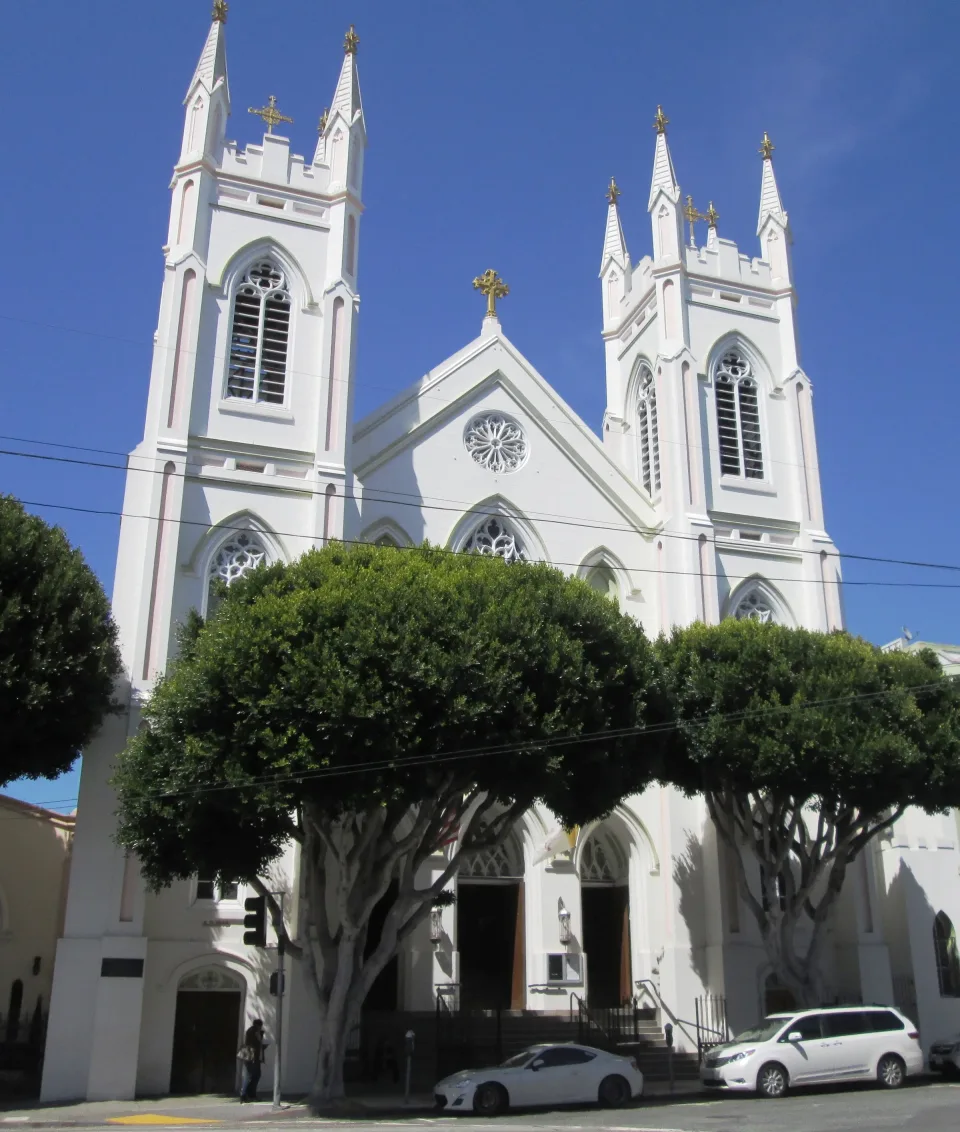
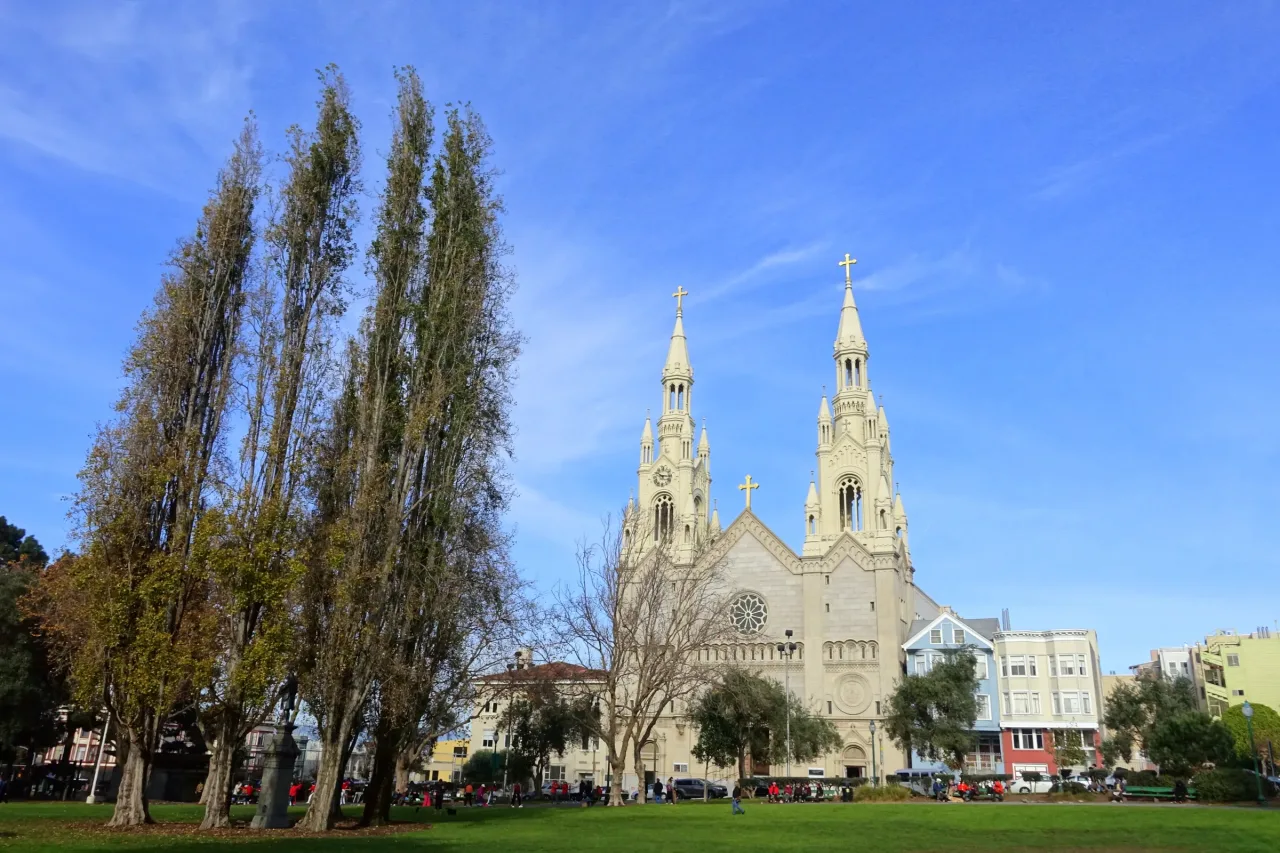
A tall white front on the north side of Washington Square, with twin spires of 191 feet. A mosaic ribbon of verse from Dante's Paradiso, beginning "La gloria di colui che tutto move", runs above the three entrances and links four great pillars carrying the symbols of the Evangelists: the angel of Matthew, the lion of Mark, the ox of Luke and the eagle of John. The original design called for mosaics across the whole facade; they were never made.
More of this church's meaning is outside the doors than in most buildings on the route.
A line from the Paradiso in mosaic above the three doors, joining the pillars beneath the Evangelists.
Angel, lion, ox and eagle: Matthew, Mark, Luke and John, carried on the pillars the inscription connects.
191 feet, and the reason pilgrims can see this church from a long way off.
English, Italian and Cantonese, in a parish that was founded for one of them.
Parish founded in 1884 at Filbert Street and Grant Avenue
The first church destroyed in the earthquake and fire of 1906
The present church begun in 1913 and completed in 1924
Joe DiMaggio married here in 1939
A busy urban parish with a school, a youth club and three language communities, which is the Salesian pattern. It is not a quiet church, and the noise is part of what it is.
Stand back across Washington Square and read it before entering.
Taken at the parish office, which keeps weekday hours different from the church's.
The National Shrine of St. Francis is a few streets away; the two belong together on this route.
The facade, the church and the stamp, before the short walk to the shrine.
Read the Dante inscription and find the four Evangelist symbols before going in. Check the parish office hours for the Camino stamp, which are not the same as church hours. Then walk two blocks to the National Shrine.
Pilgrims who arrive at the weekend can find the church open and the office shut.
The Camino stamp
Read it before entering. It is the parish's statement of what the building is for.
Saints Peter and Paul ChurchThe spires are visible from the headlands and from the bridge; pilgrims see this church before they reach it.
Saints Peter and Paul ChurchSource note Traditional attributions are presented as tradition, with documentation named where it exists.
The Franciscan shrine a few streets away, and the next stop on the Camino.
The cathedral of the archdiocese, west along the route on Cathedral Hill.
The first stamp church after the Golden Gate crossing, a few streets from the National Shrine.
Official church sources.
September 20, 2026
Use this for corrections, broken links, missing places, and planning ideas.