National Shrine of Saint Elizabeth Ann Seton
The national shrine in Emmitsburg where Saint Elizabeth Ann Seton's remains rest and where her historic houses, school memory, museum, cemetery, and religious foundation can be walked together.
- Location
- Emmitsburg, Maryland, United States 39.6978° N · 77.3311° W
- Type
- National shrine, minor basilica, saint tomb, museum, and historic campus Twentieth-century red-brick basilica with a broad domed sanctuary
- Dedication
- Saint Elizabeth Ann Seton Her remains beneath the Altar of Relics and the Emmitsburg foundation
- Time Needed
- 1 to 2 hours
An American Landscape of Conversion and Beginning Again
Mother Seton's tomb is the devotional center, but the grounds make her whole vocation visible. She came to Emmitsburg as a widowed mother and adult convert carrying financial uncertainty. Here she founded a religious community and a school whose influence endured. Pilgrims can pray where her remains rest and then walk the material scale of the work she built.
From Saint Joseph's Valley to a National Shrine
Elizabeth Ann Seton arrived in Emmitsburg in 1809 and founded the Sisters of Charity of Saint Joseph and Saint Joseph's Academy and Free School. She died here in 1821. After her beatification, the community chapel completed in 1965 became her national shrine; her remains were transferred beneath the Altar of Relics in 1968. Canonization followed in 1975. The grounds preserve historic houses, a cemetery, museum interpretation, and the living worship of the basilica.
The basilica's red brick and broad central dome give the modern sanctuary a quiet solidity. Its interior is ordered around the altar and the Altar of Relics rather than around spectacle. The surrounding houses and grounds supply the domestic and institutional scale the basilica alone cannot carry.
The basilica and historic landscape hold wife, mother, widow, convert, educator, and founder together.
The shrine, houses, cemetery, and grounds hold enough together that Emmitsburg can be visited as a complete pilgrimage in itself.
Spiritual Significance
Seton entered the Catholic Church through love for the Eucharist, and the shrine remains first a place of worship. Its American historical importance serves that Catholic center. Conversion, grief, parenthood, education, charity, and religious life meet here without one erasing the others.
Do Not Miss
-
The Altar of Relics
The National Shrine identifies a small copper casket beneath the marble altar as holding Mother Seton's remains, transferred there in 1968.
-
The museum and historic houses
Letters, artifacts, and household objects give the domestic and institutional scale of the community and school she founded, which the basilica alone cannot carry.
-
Saint Joseph's Cemetery and the scale of the original foundation
The grounds hold the burials of the early Sisters of Charity, showing how quickly the 1809 foundation grew around her.
- How domestic responsibility and public institution-building remain joined.
- The Eucharistic center of Seton's conversion.
- The difference between a founder myth and the material hardship of beginning.
Visit Plans
-
Museum and Basilica
A focused museum and basilica visit.
-
Mother Seton's Emmitsburg
3 ordered stopsA complete shrine visit through museum, basilica, tomb, houses, and grounds.
- Begin at the Visitor Center and museum.
- Pray in the basilica at the Altar of Relics.
- Continue to the historic houses and cemetery as access permits.
How to Visit
Begin at the Visitor Center for the current museum and tour options. Allow roughly two hours for the museum, basilica, historic houses, and grounds. Verify current hours, Mass, Confession, Adoration, and tour availability on the shrine website before traveling.
- Mass in the basilica
- Confession and Eucharistic Adoration on the published schedule
- Pilgrim prayer at the Altar of Relics
Allow time for both tomb and landscape.
The official shrine recommends about two hours for the museum and basilica; historic-house tours and worship follow the current daily schedule.
- Address
- 339 South Seton Avenue, Emmitsburg, MD 21727
- Allow
- About two hours for museum, basilica, and grounds
- Parking
- Free on-site parking
Arrival and worship
- The museum is free according to the official visitor page.
- The shrine describes its principal sites and walkways as accessible.
- Special events can change normal access.
- The grounds and cemetery have a different rhythm from indoor buildings.
Relics, Tombs, Sacred Objects
Source note Traditional attributions are presented as tradition, with documentation named where it exists.
Connected Saints
Seton is the principal saint; Vincent names the charitable tradition her community received and adapted in the United States.
Continue Your Pilgrimage
-
National Marian shrine
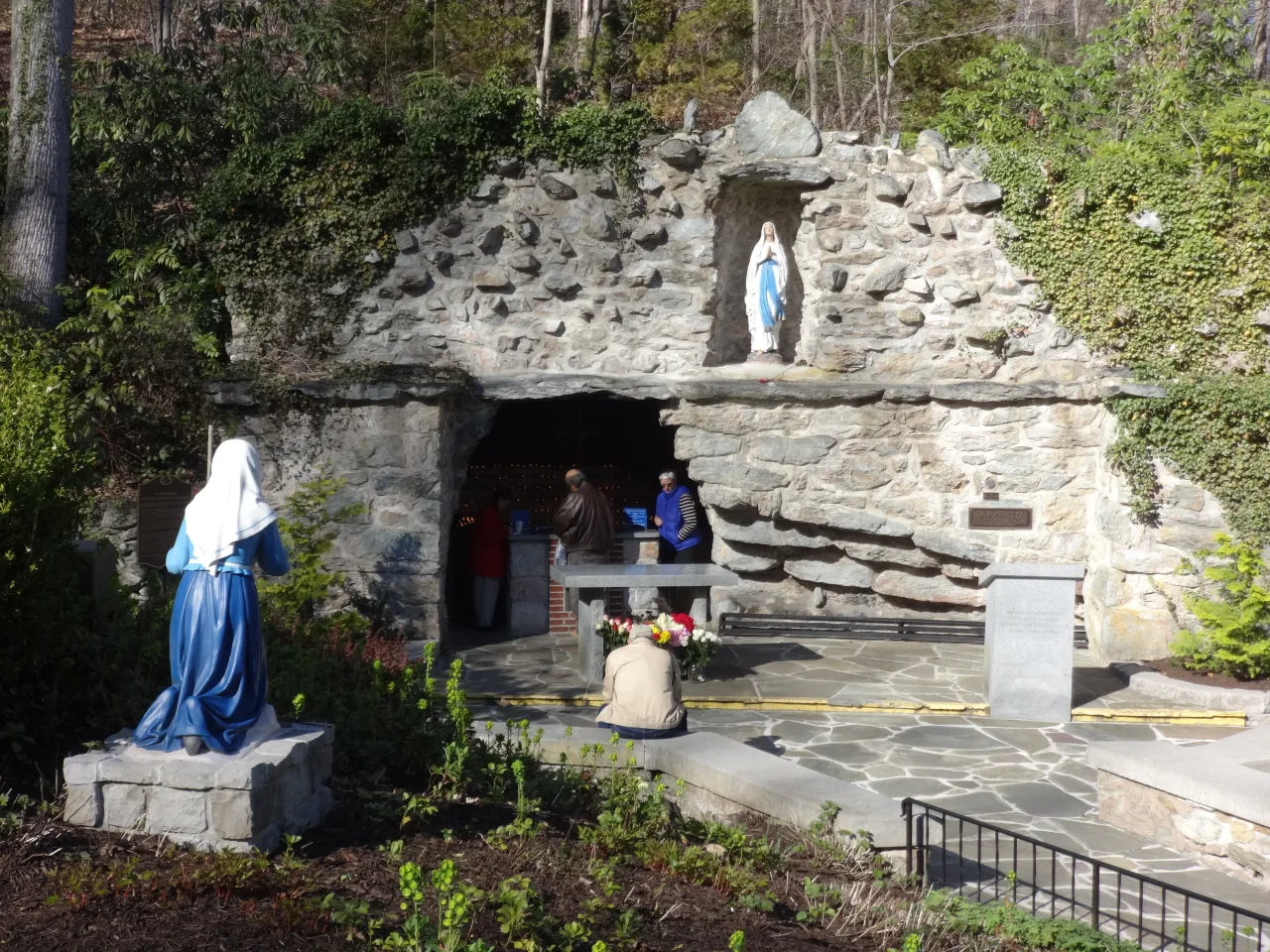
National Shrine Grotto of Our Lady of Lourdes
The mountain shrine preserves Mother Seton's documented prayer and teaching landscape and the later Lourdes devotion.
-
Basilica and national shrine
Baltimore Basilica
America's first cathedral gives the ecclesial setting from which Seton's Catholic life and work in Maryland unfolded.
Map
The page uses the official National Shrine for biography, tomb, campus, and current visitor planning, with Pope Paul VI's canonization homily and the National Women's History Museum as independent checks.
July 29, 2026
Photo credits
- Hero. Farragutful / Wikimedia Commons (CC BY-SA 4.0). Source. CC BY-SA 4.0.
- Mother Seton's Shrine. Photo: Farragutful, CC BY-SA 4.0, via Wikimedia Commons. Source. CC BY-SA 4.0.