

Baltimore Basilica
The Baltimore Basilica is where the Catholic Church in the young United States first built at cathedral scale and gathered to shape its national mission.
- Location
- Baltimore, Maryland, United States 39.2953° N · 76.6161° W
- Type
- Roman Catholic minor basilica, national shrine, and former cathedral Early American neoclassical cathedral by Benjamin Henry Latrobe, centered on a luminous dome
- Dedication
- The Assumption of the Blessed Virgin Mary
- Time Needed
- 1 to 2 hours
America’s first cathedral, filled with light
Come to pray where American Catholic life first took national architectural form.
The building’s clear dome and open nave carry the confidence of a Church emerging from legal restriction into public worship without surrendering the humility of the altar. Stay long enough to connect the architecture to the pastoral decisions made here: education, formation, discipline, and mission. The basilica is most moving when national history is received as an unfinished duty to serve faithfully in freedom.
John Carroll and the Church in the new republic
After the American Revolution, John Carroll became the first bishop in the United States and later archbishop of Baltimore. He commissioned Benjamin Henry Latrobe, architect of the U.S. Capitol, for a cathedral begun in 1806 and dedicated in 1821. Later councils met here to address Catholic education, discipline, mission, and national coordination.
Latrobe’s neoclassical design uses a broad dome, clear windows, and restrained geometry rather than the darkness often associated with Gothic churches. The restoration recovered this luminous interior and the building’s early republican character.
Built from 1806 to 1821 as the first cathedral of the Roman Catholic Church in the United States.
John Carroll, the first bishop and archbishop in the United States, commissioned Benjamin Henry Latrobe.
The provincial and plenary councils held here shaped Catholic institutions and the Baltimore Catechism.
Named a minor basilica in 1937 and a national shrine in 1993.
Spiritual Significance
The basilica is a working Catholic church before it is a national monument. Its history matters because worship endured and the American Church learned to serve a free society from the altar outward.
Do Not Miss
-
The great dome
Notice how light, rather than ornament alone, orders the worship space.
-
The crypt
Receive the memory of the early American bishops within the church they served.
-
The cathedral’s civic setting
Read its public neoclassical form alongside the young republic’s promise of religious freedom.
- The bright interior and restrained neoclassical geometry
- The distinction between historical cathedral status and its current life as basilica and national shrine
- How national Church councils shaped institutions far beyond Baltimore
Visit Plans
-
Altar, dome, and American Catholic memory
3 ordered stopsPray first, then read the building as a national Catholic witness in the early republic.
- Attend Mass or begin quietly in the nave.
- Stand beneath the dome and study the recovered light.
- Enter the crypt or join a guided tour if open.
How to Visit
Use the current Mass, confession, tour, and access pages. Weekday public hours are shorter; the Sunday evening Mass is held at the nearby Oratory rather than in the basilica.
- Daily and Sunday Mass according to the current basilica schedule
- Scheduled confession
- Pilgrim prayer in the nave and crypt
- National-shrine and parish worship
Weekday hours are short; anchor the visit to Mass or a confirmed tour.
The basilica publishes distinct weekday and weekend opening, worship, confession, and tour information. Confirm the location of every liturgy, especially the Sunday evening Oratory Mass.
- Address
- 409 Cathedral Street, Baltimore, MD 21201
- Time needed
- One to two hours; longer with Mass and a guided tour
- Weekday note
- Public opening normally ends in early afternoon; verify before setting out
Worship and tours
- Check special liturgies and holy days.
- Groups of ten or more and out-of-schedule tours require advance arrangement, normally at least two weeks; obtain written confirmation.
- Official visitor and tour pages give different weekend opening windows; confirm the day with the office.
Access
- Contact the basilica for current crypt access.
- Do not assume on-site parking.
Relics, Tombs, Sacred Objects
Tomb and Burial
- No canonized saint is claimed as buried here.
Relics and Sacred Tradition
- The basilica’s primary significance is ecclesial, architectural, and historical; verify any current relic display directly with the basilica.
Sacred Objects
- The cathedral altar beneath Latrobe’s great dome
- The crypt and historic episcopal tombs
- The luminous neoclassical nave
Continue Your Pilgrimage
-
Basilica, tomb, and historic campus
National Shrine of Saint Elizabeth Ann Seton
The next major chapter north: Mother Seton’s tomb and the ground of her Emmitsburg community.
-
National Marian shrine
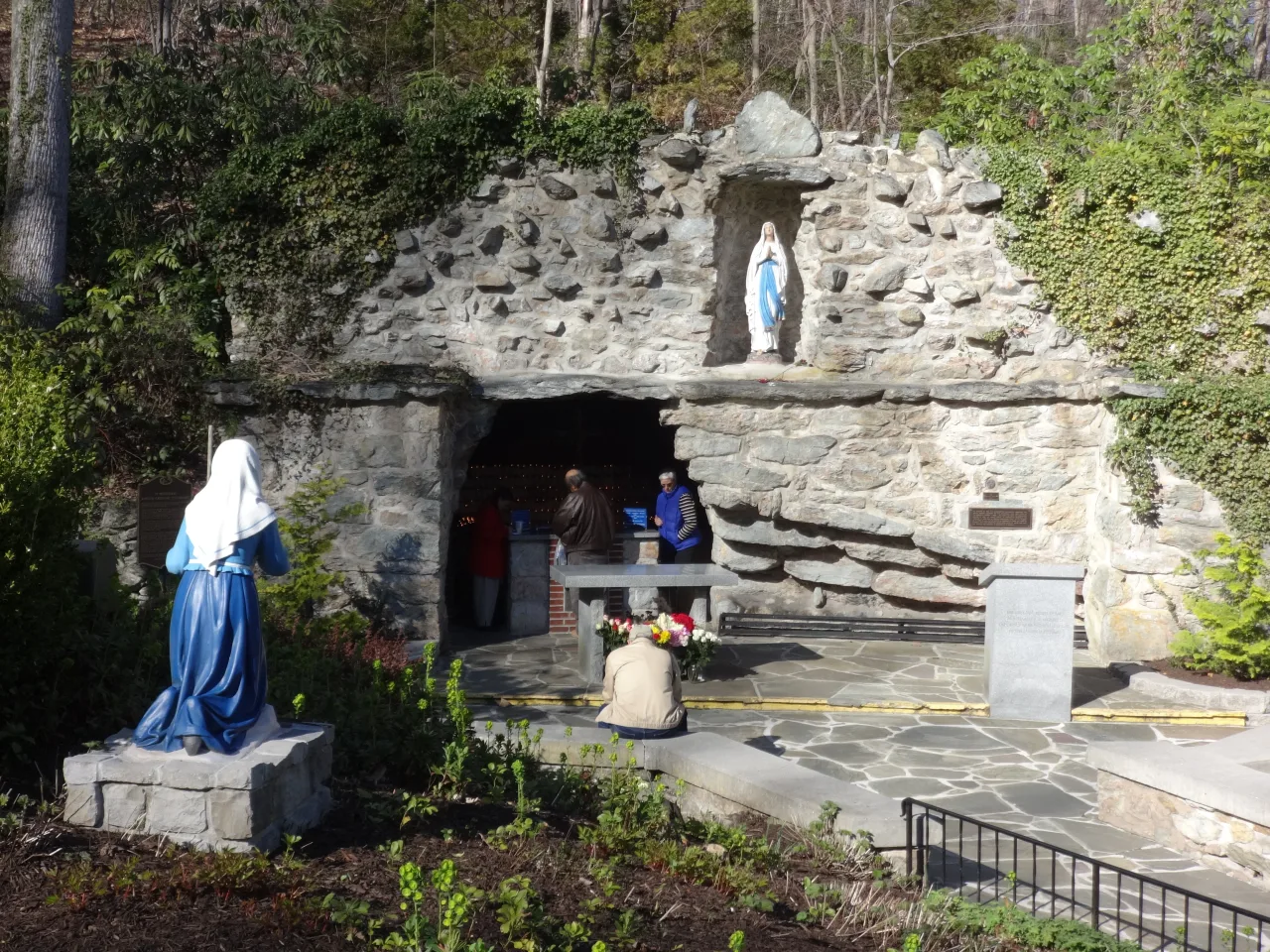
National Shrine Grotto of Our Lady of Lourdes
A mountain Marian pilgrimage near Emmitsburg, best paired with the Seton Shrine on a separate day.

Map
The Sunday evening liturgy currently belongs to the nearby Oratory, not the basilica.
August 24, 2026
Photo credits
- Hero. Baltimore Basilica, Baltimore, Maryland. Bobindrums, CC BY-SA 3.0, via Wikimedia Commons. Source. CC BY-SA 3.0.
- The luminous nave. Sarah Stierch, CC BY 4.0, via Wikimedia Commons. Source. CC BY 4.0.