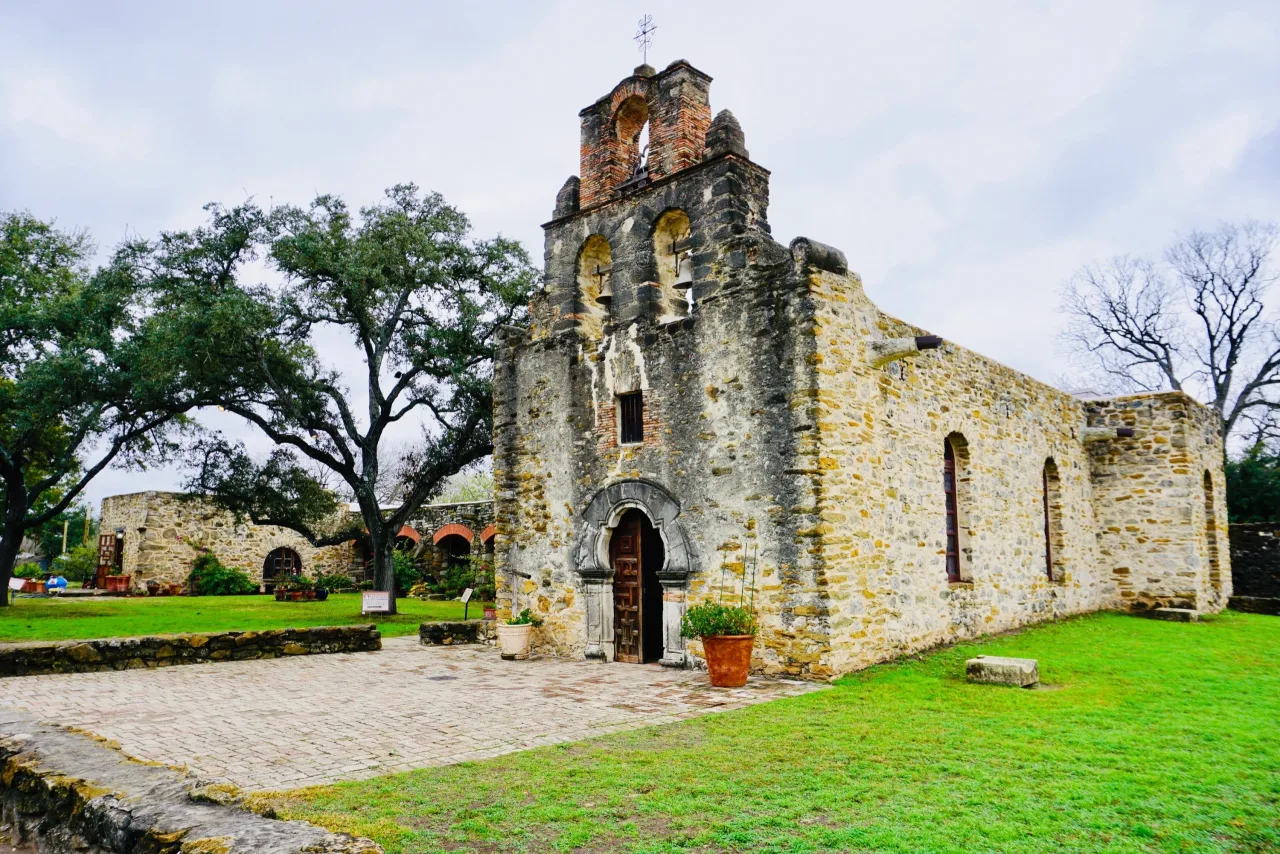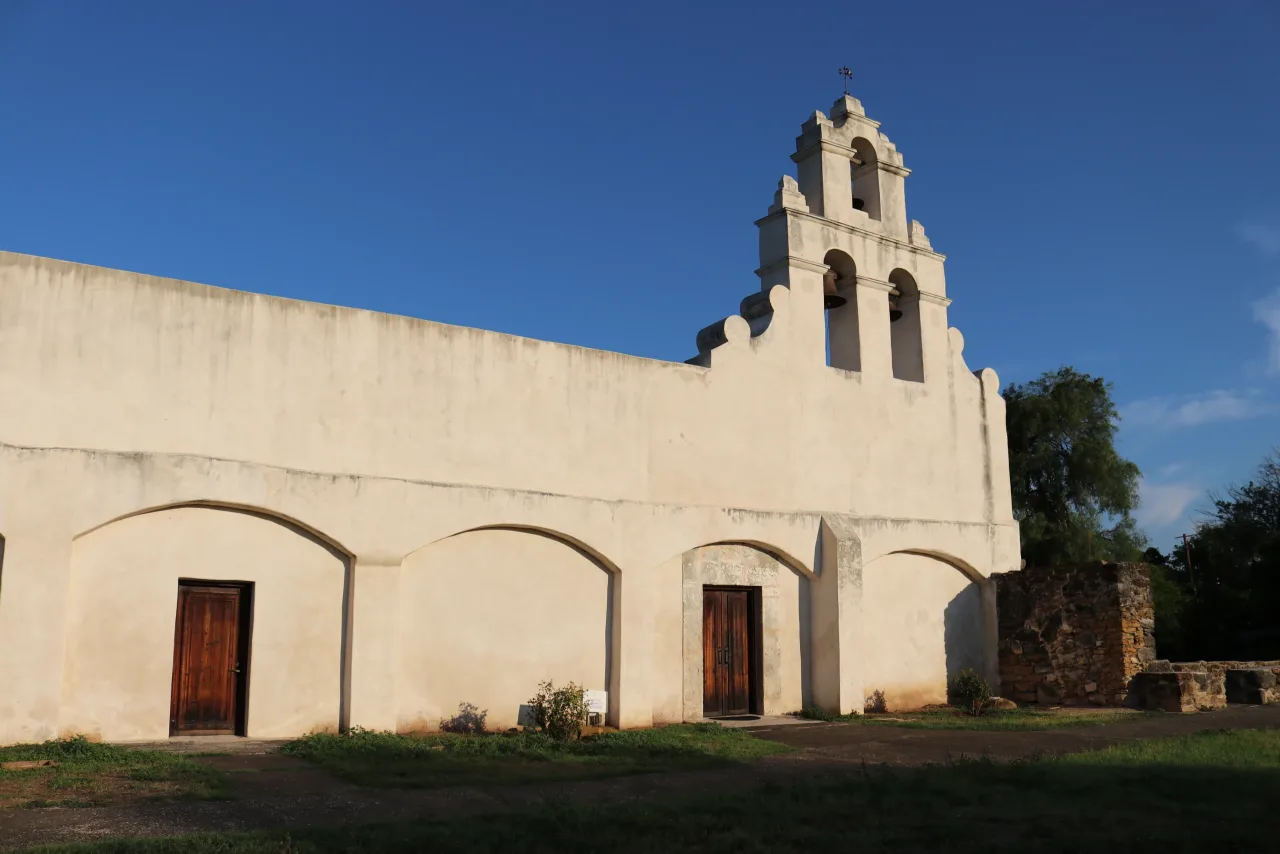
Mission church and altar
Living liturgical centerUsed for current Catholic worship.
National Park Service Mission San Juan and church informationSan Juan's modest church and agricultural landscape make it essential to understanding mission life beyond monumental facades.
San Juan is easy to underestimate after the drama of Espada or before the grandeur of San Jose. Do not rush it. The white church and three-bell gable stand within a mission landscape built around water, crops, livestock, craft, and family life. Here the Camino asks the pilgrim to honor ordinary labor and the Indigenous knowledge that made survival possible.
Pray in the active church if it is open, then walk toward the acequia, granary, and unfinished larger church. Their relationship tells a fuller truth than a single photogenic facade.
The mission began in East Texas and moved to the San Antonio River in 1731. Franciscan evangelization and Spanish colonial policy gathered Indigenous families into a community of worship, agriculture, craft, and trade. The people built irrigation works and cultivated a productive landscape, while disease, raids, colonial pressure, and displacement repeatedly threatened the community. The mission never completed the larger church it once planned. Its smaller church and parish endured.
The present church is restrained: white walls, a compact nave, and a three-bell gable. Nearby ruins of an unfinished larger church reveal ambitions left unrealized. Read both against the granary, acequia, and fields; San Juan's strongest architecture is the relationship between sacred building and sustaining landscape.
San Juan becomes legible when the pilgrim looks beyond the facade.
The modest church front marks a living parish without monumental display.
The larger walls record a project the mission community did not complete.
Water management and agricultural skill sustained daily life.
Provision was part of mission organization and survival.
Moved to the San Antonio River in 1731
Modest active church
Historic acequia and agricultural fields
Granary
Unfinished larger church walls
The small active church honors Christ through ordinary parish faithfulness. Its scale fits a Camino prayer for workers, farmers, families, and all whose labor is hidden.
Do not mistake modest scale for lesser sacred importance.
They reveal labor, knowledge, and provision central to mission life.
Let incompletion correct any story of effortless colonial success.
Join quiet church prayer to the agricultural systems that sustained mission life.
Confirm park and church access. Outdoor paths, heat, uneven ground, seasonal agriculture, and services can shape the stop. One exact governed exterior is used; a weak interior candidate was rejected rather than substituting an inferior image.
San Juan is an active parish within an outdoor historical landscape. Heat and service closures matter.
Church
Landscape
Carry water and verify trail and weather conditions.
Used for current Catholic worship.
National Park Service Mission San Juan and church informationReceive as the landscape of work and provision surrounding the church.
National Park Service Mission San Juan historySource note Traditional attributions are presented as tradition, with documentation named where it exists.
Use this for corrections, broken links, missing places, and planning ideas.