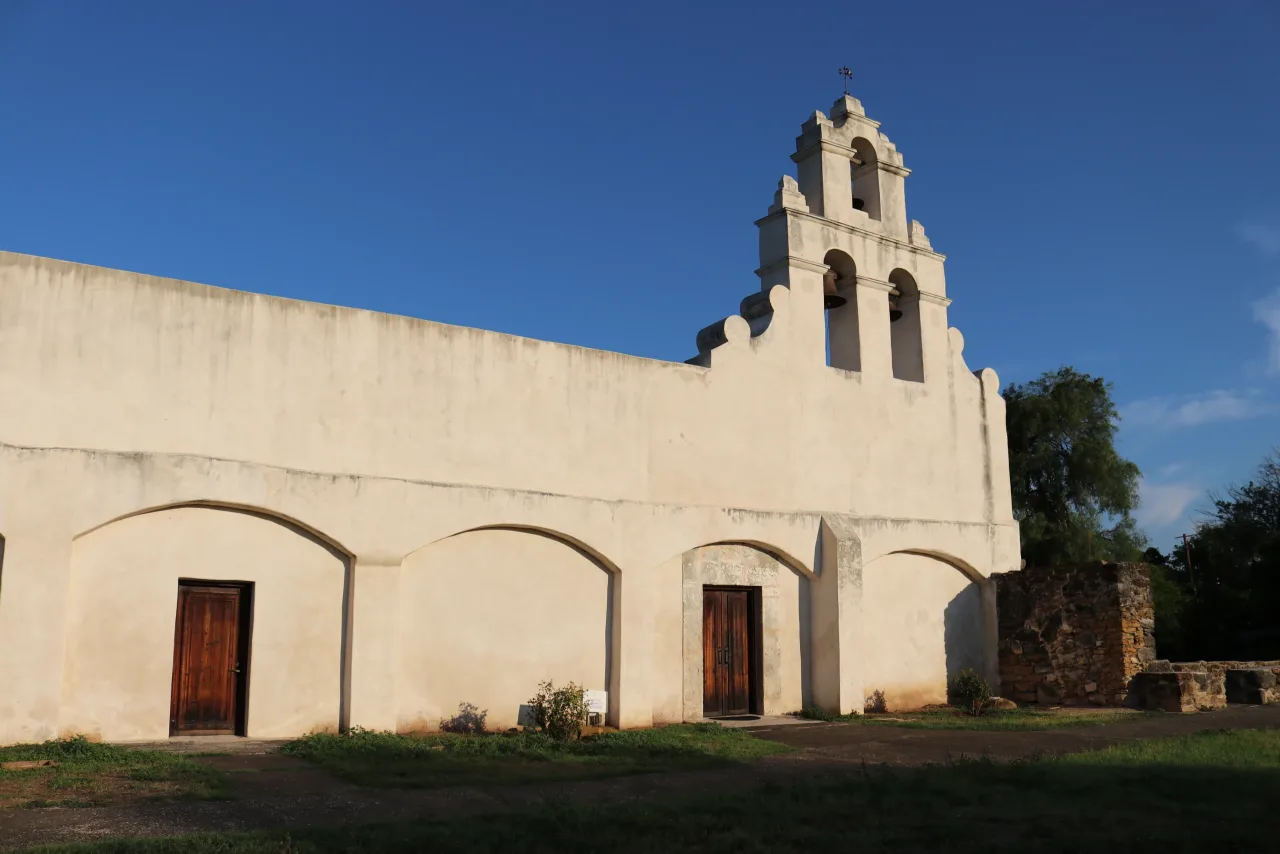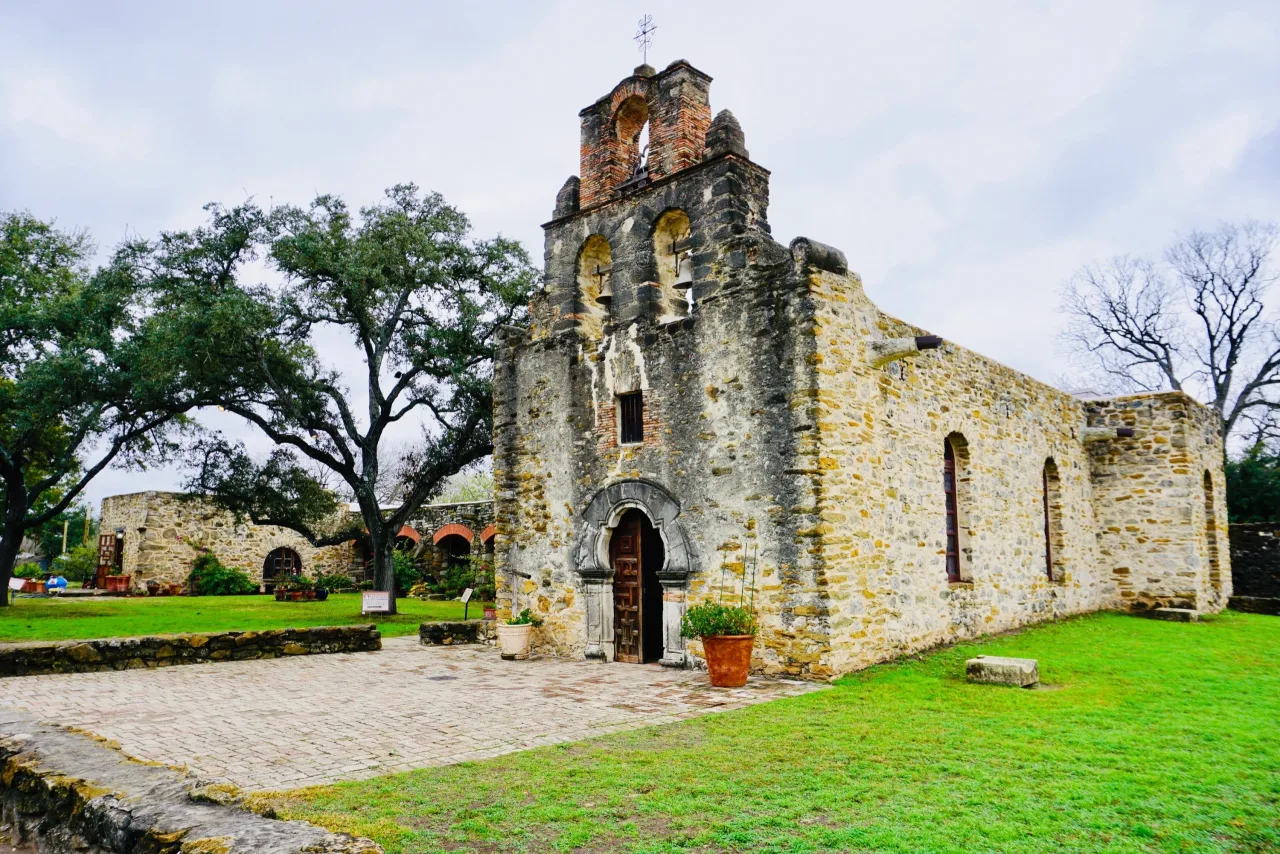
Mission church and altar
Living liturgical centerUsed for current Mass and parish prayer.
Mission Espada parish and National Park ServiceEspada begins the Camino with Saint Francis, a living parish church, and an irrigation landscape that still carries the marks of mission labor.
El Camino begins at Espada, not because it is the largest mission, but because the southern church gives the pilgrim a truthful threshold. The narrow nave, rough stone, arched doorway, and bell gable ask for humility. Pray with Saint Francis for conversion and peace, receive the first stamp according to current instructions, and begin walking north.
Before leaving, make time for the acequia and aqueduct. Water sustained fields, households, and mission life. The system embodies remarkable Indigenous and colonial engineering and labor, yet it belonged to a mission order marked by disease, pressure to convert and settle, unequal power, flight, loss, and endurance. Descendant communities and parish worship refuse an account in which Indigenous people simply disappear.
Espada traces its institutional origin to a 1690 East Texas mission and was moved and renamed on the San Antonio River in 1731. The friary, church, acequia, and aqueduct took shape in the mid-eighteenth century. Franciscan friars sought conversion and communal Christian life within Spain's colonial system. Indigenous residents built, farmed, adapted, resisted, left, returned, formed families, and endured epidemics and disruption. Secularization changed property and governance, but Catholic worship continued and descendants remain part of the story.
The church's irregular stonework, arched doorway, small windows, and three-bell gable make a compact sacred house rather than a monumental statement. Read the friary and compound with the acequia and aqueduct: church, water, labor, and community belonged together.
Espada's meaning lies in the relationship of worship, labor, and landscape.
The irregular stone entrance gives the small church its unforgettable threshold.
The bells mark a parish presence rather than a ruin.
The simple interior gives the Camino its proper beginning in prayer.
The waterworks reveal skill, labor, provision, and the mission's material order.
Mission origin in 1690 and move to San Antonio in 1731
Friary and church built in the mid-eighteenth century
Distinctive doorway and bell gable
Historic acequia and aqueduct
Espada is dedicated to Saint Francis and remains a parish. Begin with the Poverello's call to penance and peace, then walk without romanticizing poverty imposed on others.
Begin by asking for conversion, humility, and peace.
Receive the water system as evidence of labor, knowledge, survival, and colonial order.
Follow current official instructions; do not assume availability outside published hours.
Join pilgrim registration, church prayer, and the waterworks before setting out north.
Confirm the parish's current Mass and church access, NPS grounds and trail conditions, the Pilgrimage Center's hours, passport availability, and stamp procedure. The official Pilgrimage Center is near Espada but has its own schedule and is currently closed Sunday and Monday; never assume it will be open.
Passport pickup, parish access, park conditions, and the long exposed route require current verification.
Passport and church
Walking conditions
Carry water, sun protection, food, a charged phone, and an exit plan.
Used for current Mass and parish prayer.
Mission Espada parish and National Park ServiceReceive as evidence of communal labor and provision rather than a devotional object.
National Park Service Mission Espada historySource note Traditional attributions are presented as tradition, with documentation named where it exists.
Official church sources.
August 25, 2026
Use this for corrections, broken links, missing places, and planning ideas.