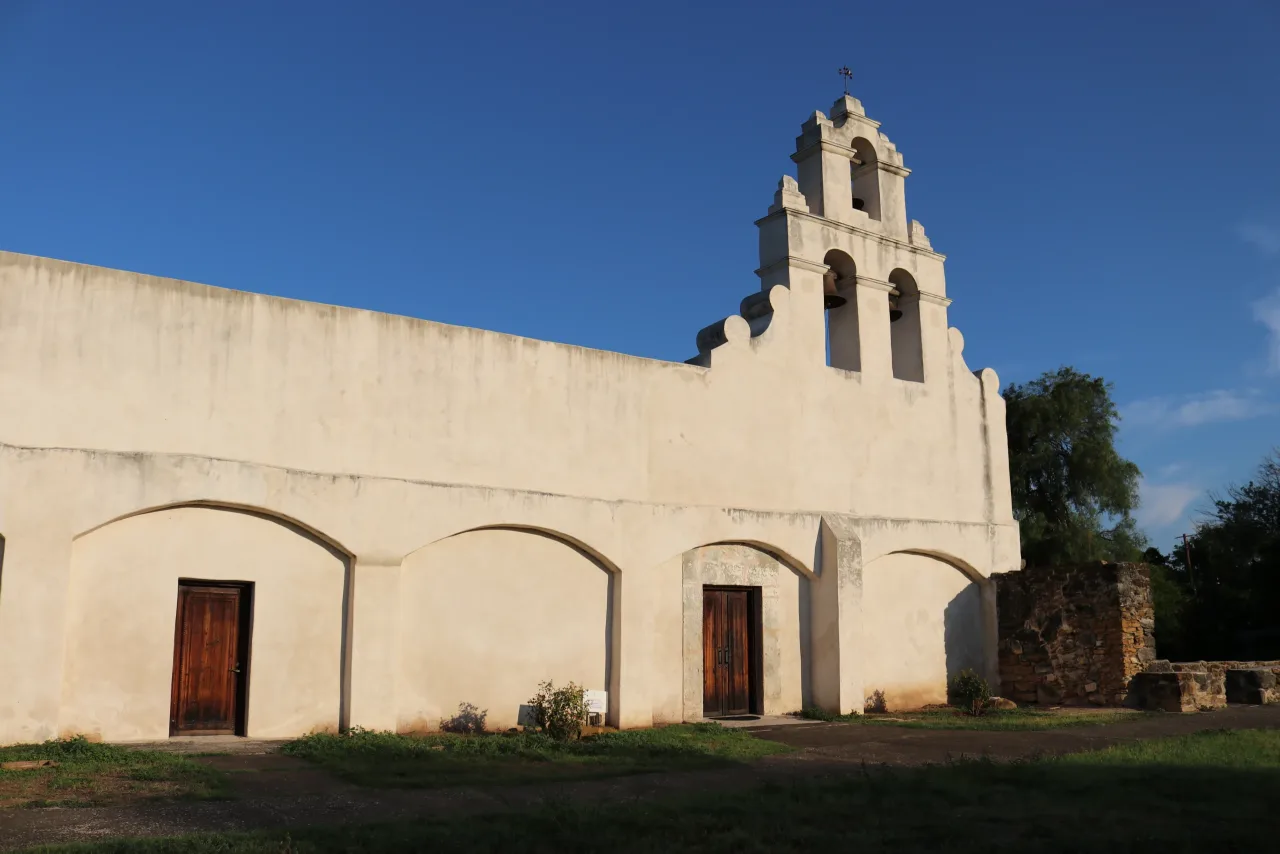
Parish church and altar
Living liturgical centerUsed in current Catholic worship.
National Park Service church and Mission San Jose historiesThe Queen of the Missions is monumental, but its true center remains the active church dedicated to Saint Joseph.
San Jose is the route's largest mission and deserves the Camino's longest stop.
The carved church facade, Rose Window, granary, convento, defensive walls, and restored quarters make the mission system legible at a scale the other sites cannot. Begin in the church if it is open, ask Saint Joseph to teach faithful labor and guardianship, then walk the compound with enough time to confront both achievement and cost.
The title Queen of the Missions can tempt a purely triumphant story. A truthful Catholic visit honors evangelization and sacramental life while naming epidemic disease, colonial control, cultural disruption, and the constrained choices faced by Indigenous peoples. It also refuses to erase Indigenous skill, adaptation, family life, and descendants.
Franciscan Antonio Margil de Jesus founded San Jose in 1720. The mission gathered Indigenous peoples from several bands into a Catholic and Spanish colonial community organized around church, agriculture, craft, defense, and instruction. The present limestone church began in 1768. Disease and the pressures of mission life diminished the community; secularization later redistributed mission lands. In the twentieth century, major restoration—including work associated with public relief programs—reconstructed much of the compound. Franciscan friars returned in 1931 and continue a living presence.
Read San Jose from the whole compound toward the carved church. Walls and quarters describe the mission community; the granary reveals agricultural organization; the convento records Franciscan life. At the church, slow down for the elaborate portal, dome, bell tower, buttresses, and Rose Window. Distinguish surviving fabric from twentieth-century reconstruction.
San Jose's scale explains how mission life was organized.
The enclosure joined worship, household life, labor, protection, and control.
Food systems and Franciscan administration were essential to the community.
Carved stone gathers Catholic imagery at the threshold.
The window's craftsmanship is certain even where popular stories about its maker are not.
Founded in 1720
Present limestone church begun in 1768
Rose Window
Largest mission compound
Twentieth-century restoration
The active parish altar and dedication to Saint Joseph keep grandeur from becoming spectacle. Pray for the families, laborers, friars, and descendants bound to this ground.
When open, begin with prayer rather than interpretation panels.
Admire the documented carving without repeating uncertain romantic legends as fact.
They reveal mission community, labor, provision, and control.
Ask the mission's patron for honest, faithful guardianship of memory.
Pair church prayer with a full reading of the largest mission compound and a real rest.
Use the NPS visitor center and current ranger information, but let the parish schedule govern church access. Allow more time here than at the smaller missions. Services, funerals, weddings, heat, and park operations can alter the visit.
San Jose has the park's principal visitor center as well as an active parish church. Their schedules and responsibilities differ.
Church
Park and trail
Current interpretation, restrooms, water, and ranger programs can materially help a Camino day.
Used in current Catholic worship.
National Park Service church and Mission San Jose historiesRead from the church exterior without blocking worship or parish use.
National Park Service Mission San Jose historySource note Traditional attributions are presented as tradition, with documentation named where it exists.
Use this for corrections, broken links, missing places, and planning ideas.