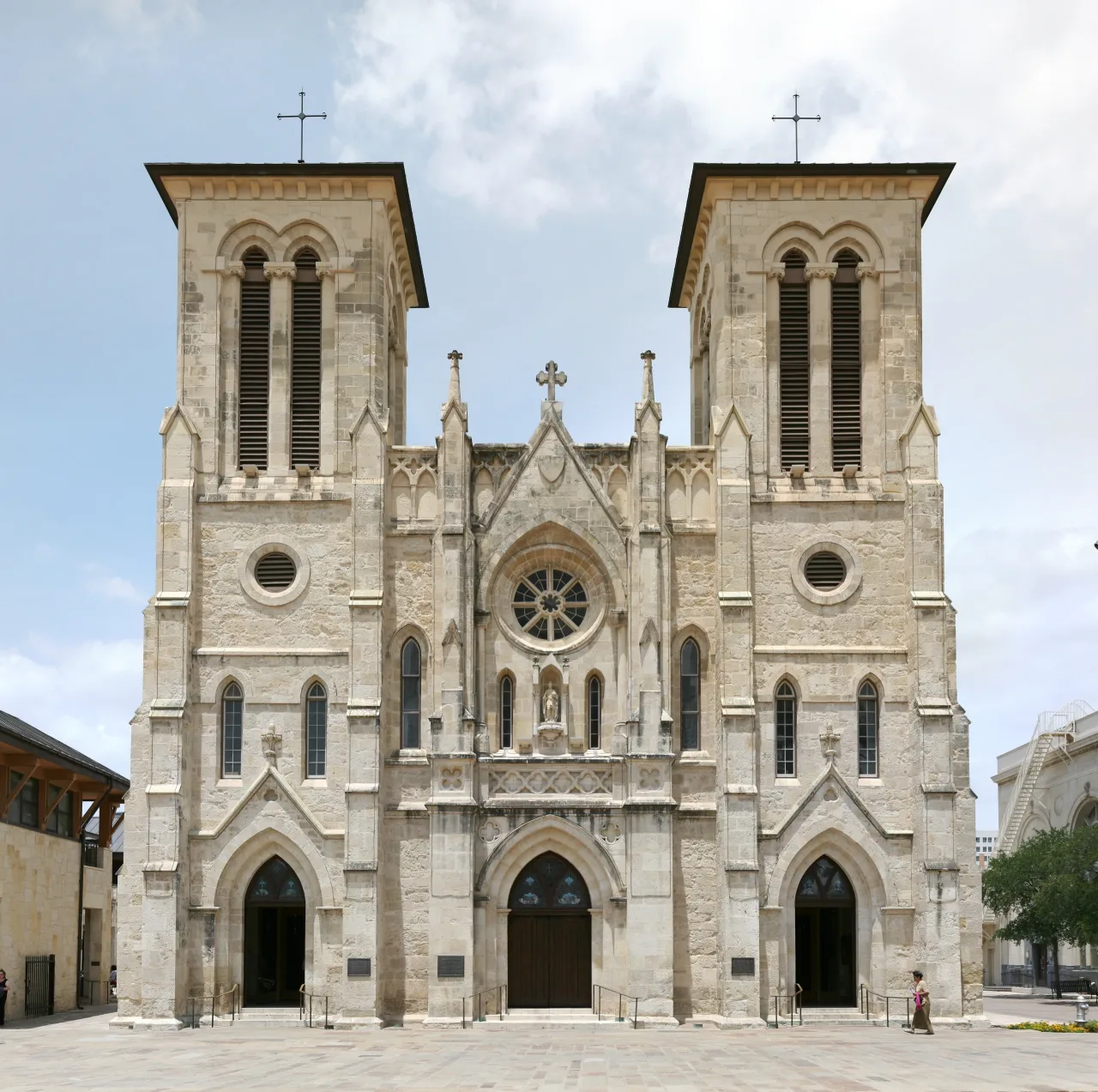
Mission church and altar
Living liturgical centerUsed for current Mass and parish prayer.
Mission Concepcion parish and National Park ServiceConcepcion is both one of the most intact Spanish colonial churches in the United States and a parish chapel where the Eucharist is still celebrated.
Concepcion rewards the pilgrim who enters slowly.
Its massive stone church, completed and dedicated in 1755, retains more of its original form than the other San Antonio mission churches. Faded frescoes and the cool vaulted interior reveal a sacred environment once brighter with color. Yet the decisive fact is present tense: Mass is still offered here.
Pray beneath Mary's title of the Immaculate Conception, then read the surviving art as the work of a mission community formed amid conversion, cultural exchange, coercive colonial structures, disease, and endurance. Catholic confidence does not require hiding suffering; it asks us to tell the truth and receive the living faith of descendants with reverence.
The mission was transferred to the San Antonio River in 1731 and its stone church dedicated in 1755. Franciscan friars, Indigenous residents, soldiers, and colonial authorities inhabited a system meant to form Christian communities and Spanish subjects. The record includes genuine sacramental life and skilled Indigenous labor, but also epidemic disease, constrained freedom, displacement, and unequal power. Concepcion's preservation makes that history unusually tangible; its active parish life prevents the story from ending with secularization.
Begin with the twin towers, dome, and thick limestone walls. Inside, look for surviving fresco fragments and the way stone vaults carry the church without a later ornamental shell. The relative lack of reconstruction is itself important, though every historic place has known repair and conservation.
Concepcion's restraint is one of its gifts.
The exterior massing declares a permanent stone church along the river.
Faded paint preserves traces of a more colorful sacred world.
Current worship keeps the mission from becoming an emptied period room.
Church dedicated in 1755
Original stone roof and dome
Twin towers
Interior and exterior fresco traces
The mission's dedication to Mary's Immaculate Conception and its current altar keep history oriented toward worship, repentance, and hope.
Give your eyes time to adjust; the surviving color is quieter than a restored mural cycle.
Receive it first as a place of Mass.
Hold evangelization, Indigenous agency, colonial pressure, disease, and endurance together.
Give the living church priority, then read the compound and documented frescoes.
The church lies within San Antonio Missions National Historical Park but remains an active Catholic worship space. Confirm park hours and the parish's current church and Mass schedule; weddings, funerals, and services can close the church.
The National Park Service manages the surrounding historic site; the Archdiocese manages the active church.
Church access
Park visit
Grounds, visitor services, heat, weather, and trail conditions can change.
Used for current Mass and parish prayer.
Mission Concepcion parish and National Park ServiceRead as fragments of the church's original sacred environment.
National Park Service Mission Concepcion historySource note Traditional attributions are presented as tradition, with documentation named where it exists.
Official church sources.
August 25, 2026
Use this for corrections, broken links, missing places, and planning ideas.