Guide · Padua

One Day in Catholic Padua

Begin at Anthony's tomb, but do not let the tomb become the whole city. Padua can hold a Franciscan morning, a Benedictine martyr basilica, the local Church's cathedral and Baptistery, and the small place where Anthony died. Four stops are enough for one honest day.

  • 1 day
  • Four core churches across one full day, with two substantial prayer stops and one transit leg
  • Reviewed September 2026

The argument

The shape of these days

Let Padua widen outward from Anthony without losing him: tomb, ancient martyr church, baptismal mother church, and place of death.

What this guide leaves out, on purpose

  • The Sanctuary of Saint Leopold Mandić. Saint Leopold's tomb, confessional cell, and continuing ministry of reconciliation deserve a real visit. Use the shrine as a deliberate substitution for the Cathedral and Baptistery, or give it a second morning. Adding it as a fifth stop weakens every place.
  • The Scrovegni Chapel and the wider Padua fresco cycle. These are major sacred artworks, but they require reservations and a different itinerary centered on Padua Urbs Picta. This guide keeps the Cathedral Baptistery because baptism and the living local Church belong to the pilgrimage's theological spine.
  • Camposampiero and the full Last Walk. The official devotional route is about 23.5 km from Camposampiero through Arcella to the Basilica. It requires route, access, transport, and safety verification as its own V1.1 guide. This city day does not imitate it.

Day 1

Anthony's tomb, Padua's ancient Church, and Arcella

Begin where Anthony is buried, widen into Padua's martyr, monastic, cathedral, and baptismal life, then finish where he died.

  • Protect prayer at the tomb and do not sacrifice the final Arcella visit to overlong sightseeing. If a liturgy begins, receive that as the life of the Church rather than a disruption.
  • Walk about ten minutes from the Basilica to Santa Giustina, then about twenty to twenty-five minutes to Piazza Duomo. Reserve a separate northern transfer for Arcella and confirm it before the day begins.
  • See this day on the map
  1. Early morning, with at least 90 minutes protected

    Basilica of St. Anthony of Padua

    Padua begins at Anthony's tomb because the basilica was built to receive his body and still orders its life around pilgrims, Franciscan prayer, confession, and the Eucharist. Go first to the tomb in the Chapel of Saint Anthony. Join the movement behind it and bring your petitions before God through Anthony's intercession. Then cross the church to the separate Chapel of the Treasury, where his relics are venerated and the friars give a blessing at published times.

    Whose life this is Saint Anthony of Padua

    Give your time to The tomb first, the Chapel of the Relics second, and confession or Mass when the current schedule allows. The Black Madonna chapel and Blessed Luke Belludi deepen the visit after the devotional core.

  2. In passing · About ten minutes

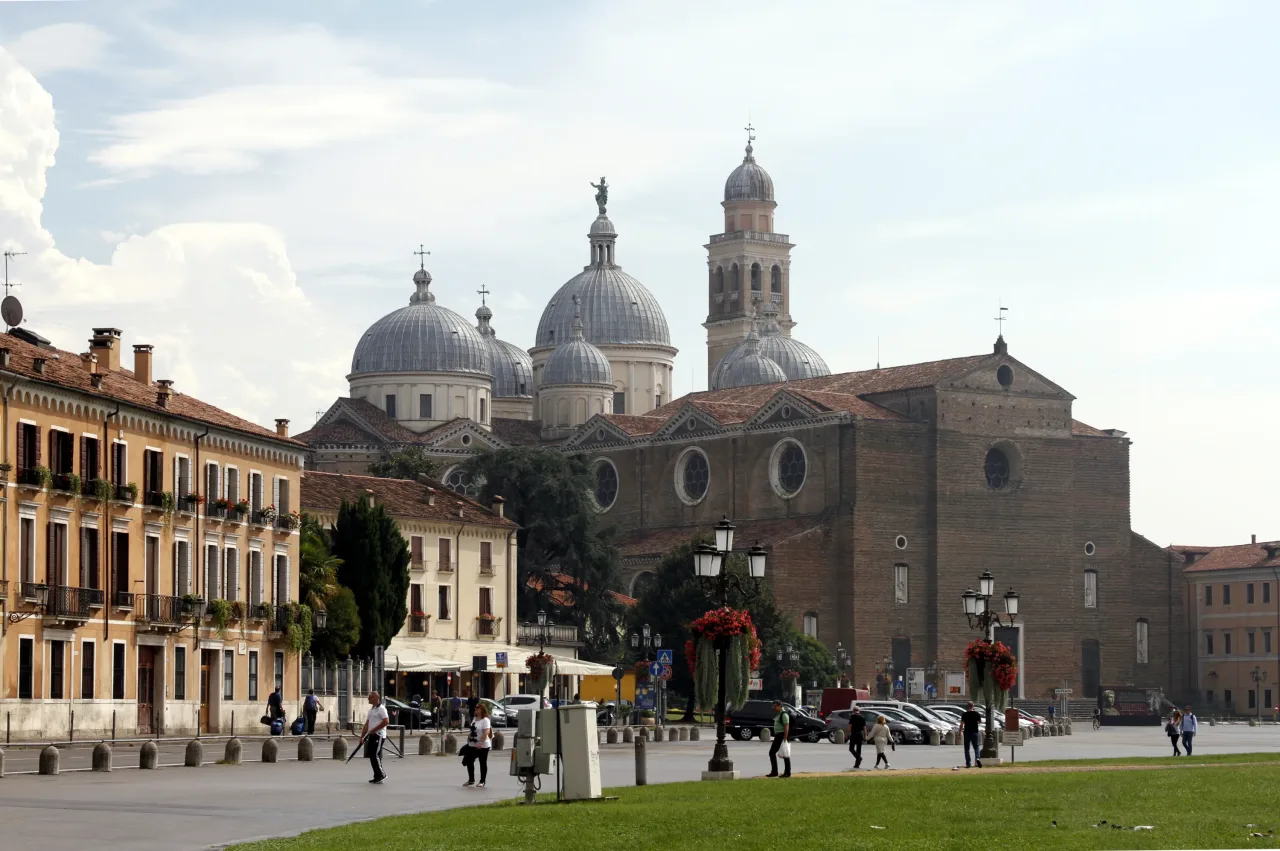
    Walk south to Prato della Valle

    The short walk prevents Santa Giustina from feeling like a separate excursion. Anthony's medieval tomb church opens into a much older Christian memory at the edge of the great square.

  3. Late morning, before lunch near Prato della Valle

    Basilica and Abbey of Santa Giustina

    Santa Giustina keeps Padua from becoming only Anthony's city. Pray with the local martyr whose ancient veneration shaped this place, receive the Benedictine community's continuing witness, and approach the shrine traditionally associated with Saint Luke the Evangelist. The abbey's own historical account notes both the ancient veneration and the limits of what modern study can establish. That honesty belongs inside devotion, not against it.

    Give your time to Saint Justina's tomb, the Saint Luke shrine, and the Martyrs' Corridor with the Oratory of Saint Prosdocimus when accessible. Do not cross monastic boundaries or treat a closed historic space as a failure.

  4. In passing · Protect a real midday pause, then allow twenty to twenty-five minutes on foot

    Lunch, then walk to Piazza Duomo

    The route now leaves the southern pair and returns through Padua's center. Eat, rest, and arrive for the reserved Baptistery window without turning the city's streets into dead time.

  5. Early afternoon, aligned to a confirmed Baptistery reservation

    Padua Cathedral and Baptistery

    The Cathedral restores the bishop's church and the local Catholic community to a pilgrimage that might otherwise become a sequence of saint shrines. Pray at the altar before entering the Baptistery. Inside, Giusto de' Menabuoi's cycle surrounds the place of baptism with creation, covenant, Christ's saving work, the final things, and the communion of saints.

    Give your time to Prayer in the Cathedral, then Christ Pantocrator and the communion of saints in the Baptistery. Read the frescoes from baptism outward rather than collecting scenes.

  6. In passing · Allow thirty to forty-five minutes door to door, including waiting and orientation

    North to Arcella

    Arcella is the day's necessary change of scale. The compact center gives way to a real transfer because Anthony's death occurred on the road into Padua, not beside the basilica that later received his body.

  7. Late afternoon, with access confirmed in advance

    Arcella Sanctuary

    Anthony became gravely ill at Camposampiero and asked to return to Padua. The friars carried him toward the city, but at Arcella they stopped at the Poor Clares' monastery. Here he received the anointing of the sick and died on June 13, 1231. Ending here lets the human saint stand behind the monumental tomb visited that morning.

    Give your time to The memorial of the place of death and quiet prayer. Keep the distinction clear: Arcella is the place of death; the Basilica of Saint Anthony holds the tomb and principal relics.

  8. Optional · Do not add this as a fifth core stop

    Sanctuary of Saint Leopold Mandić

    Saint Leopold's tomb, preserved confessional cell, and continuing ministry of reconciliation make this one of Padua's most important Catholic places. It is included here so it is not hidden, but the geography and sacramental purpose deserve more than a hurried detour.

    Give your time to The tomb, the confessional cell, and confession or Mass when available. Use it in place of the Cathedral and Baptistery if mercy and reconciliation are the day's principal focus, or return on a second morning.

When plans bend

Adapting these days

If confession is the day's center

Keep the Basilica of Saint Anthony first, then visit Santa Giustina and substitute Saint Leopold for the Cathedral and Baptistery. This gives two real sacramental windows without turning reconciliation into a box to check. Confirm both shrines' schedules.

If the Baptistery is unavailable

Still visit the Cathedral as Padua's mother church, but shorten the stop and give the recovered time to Santa Giustina or Arcella. Do not replace a closed Baptistery with a random church merely to preserve the stop count.

If mobility or weather limits the day

Keep the Basilica and Santa Giustina as the walkable pair, then use local transit to either the Cathedral or Arcella. Two or three prayerful stops are better than four exhausted arrivals. Confirm step-free access directly where it matters.

If you have a second morning

Give it to Saint Leopold, then return to the Basilica of Saint Anthony for confession, Mass, or the relic blessing according to the current schedule. This is the strongest Catholic extension within Padua itself.

If you want the Last Walk

Plan it as a separate future route from Camposampiero through Arcella to the Basilica, not as an improvised extension of this day. The official distance is about 23.5 km, and trail conditions, transport, church access, and safety should be checked close to the date.

My Journey

Make these days your own

Begin at the Basilica of Saint Anthony, walk to Santa Giustina, continue to the Cathedral and reserved Baptistery visit, then transfer north to Arcella. Confirm all church access and the Baptistery ticket before setting the day. Keep Saint Leopold as a substitution or second morning, not a fifth core stop.

  • 5 places across 1 days, each in the day and order the guide gives it
  • The days arrive already built; reorder them, move a place, or drop one whenever you like
  • Of those, 1 is marked optional and stay easy to drop
  • Works without an account, in this browser

You choose the journey it joins before anything is saved.

Editorial responsibility

How this guide was prepared

Prepared by
Eternal Roam Editorial
Responsible editor
Luke Gordon, Eternal Roam
Last reviewed
September 2026
Verification
Desk researched

Researched and editorially reviewed from official Church, shrine, transport, and other reliable sources. Confirm current practical details with the official sources before travel.

Saint Anthony's death and Arcella were checked against the Basilica's official custodial account. Santa Giustina's history and Saint Luke relic tradition were checked against the abbey's official pages, including its account of scientific examination. Cathedral and Baptistery history and access were checked against the Cathedral, Diocese of Padua, and Diocesan Museum. Saint Leopold's tomb, confessional cell, and living ministry were checked against the sanctuary's official pages. Walking and transfer estimates come from verified coordinates and should be rechecked against current local conditions before travel.

Opening hours, Mass times and access change; each place page above carries its current sources. How Eternal Roam researches and reviews its guides is described in our editorial standards.

Sources consulted

Photo credits
  1. Guide hero: One Day in Catholic Padua. José Luiz Bernardes Ribeiro, CC BY-SA 4.0, via Wikimedia Commons. Source. CC BY-SA 4.0.
  2. Day 1, photo 1: The Chapel of the Relics is distinct from Anthony's tomb chapel; a complete basilica pilgrimage receives both. Didier Descouens / Wikimedia Commons. Source. CC BY-SA 4.0.
  3. Day 1, photo 2: Santa Giustina's nave receives an ancient martyr site and the relic tradition of Saint Luke into Benedictine prayer. Armin Kleiner, CC BY-SA 4.0, via Wikimedia Commons. Source. CC BY-SA 4.0.
  4. Day 1, photo 3: The Baptistery surrounds the baptized with salvation history, Christ in glory, and the communion of saints. Syrio, edited by MenkinAlRire, CC BY-SA 4.0, via Wikimedia Commons. Source. CC BY-SA 4.0.
  5. Day 1, photo 4: Arcella preserves Anthony's place of death north of central Padua. luciobocchi, CC BY-SA 4.0, via Wikimedia Commons. Source. CC BY-SA 4.0.