
With only one day
Keep the National Shrine, a real midday rest, and the crossing to the historic basilica. The river and Via Sacra deserve time you do not have; resist turning them into brief vehicle stops.
Guide · Aparecida
Begin where the pilgrims gather now, then return to the river where the devotion began. The first day belongs to the National Shrine and its earlier basilica. The second follows the image’s origin outward through the Rosary and the Way of the Cross, before returning to the sanctuary in thanksgiving.
The argument
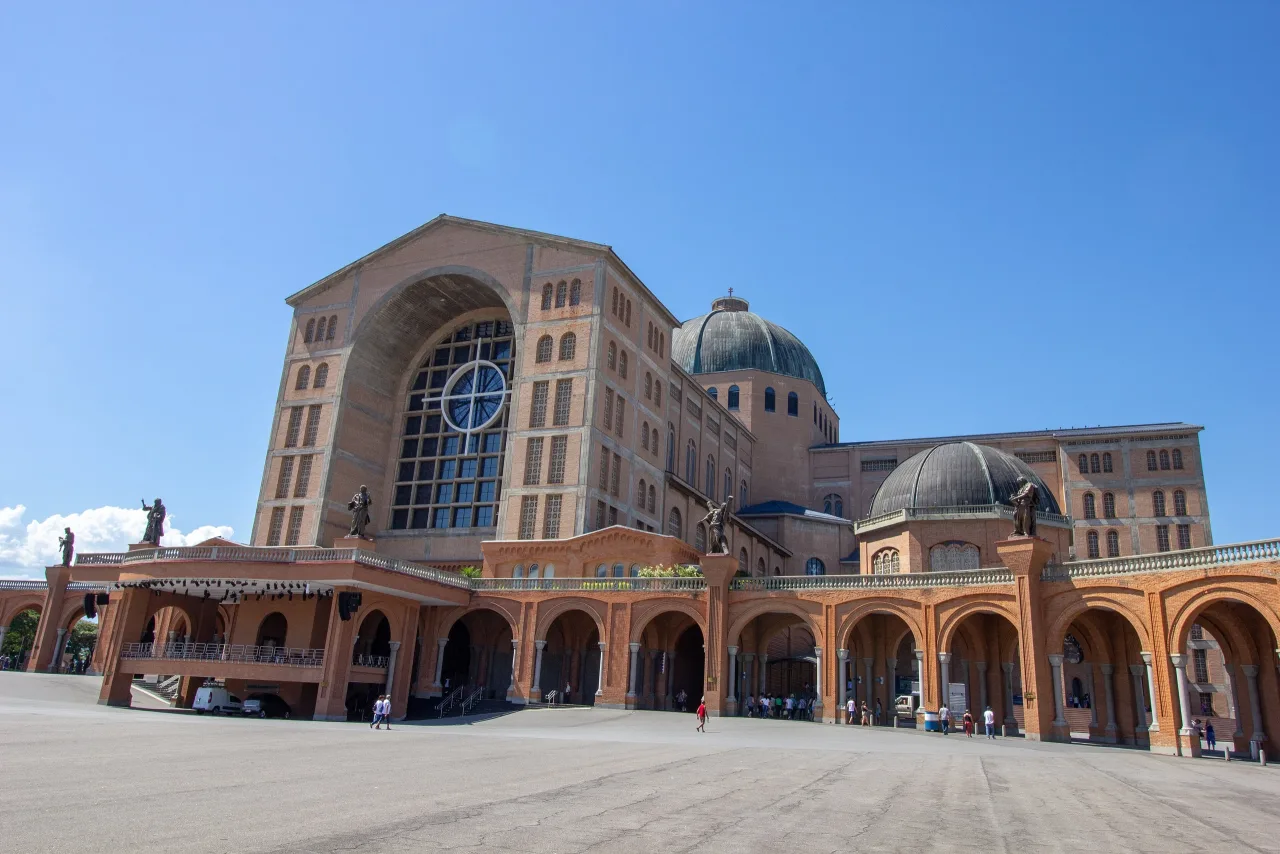
Aparecida cannot be understood by the size of its basilica alone. The small image in the niche came before the national sanctuary, before the nineteenth-century church, and before the city’s name. Give the first morning to the liturgy and to that image. Crossing to the old basilica in the afternoon then becomes a return through the devotion’s public history.
The river deserves a different morning. At Porto Itaguaçu the sanctuary’s account of the fishermen has water and a working landscape around it. From there, prayer can take the form of walking the Rosary. Keep a rest before the separate journey to Morro do Cruzeiro, and leave room to shorten the ascent. Two days are enough to encounter this geography without turning devotion into an endurance exercise.
Day 1
Begin with worship in the National Shrine, then cross to the earlier church after lunch. This order gives the devotion its present life before tracing how its public home grew.
Begin at the National Shrine; build in time to find the appropriate entrance and celebration.
Morning, arranged around Mass
Plan on about 1½ hours to 3 hours
Do not try to understand the basilica all at once. Find the day’s Mass, allow time to settle, and then approach the niche of the original image. The encounter has an unusual proportion: a national assembly and an immense building gathered around a figure small enough to have been taken into a fisherman’s home. Once you have prayed there, the altar and Pastro’s dome can be read as the setting for that assembly rather than as separate sights.
Give your time to Mass, prayer at the niche, and the relation between the altar and the Tree of Life in the dome.
Confession and access to particular chapels follow the current sanctuary program. Leave room for queues.
Pause · Midday
The sanctuary involves more walking and standing than a plan on paper suggests. Stop for food, water, and a seated rest before crossing town. If confession took longer than expected, keep this pause and shorten the afternoon rather than carrying fatigue into the older basilica.
Leave the National Shrine and follow the signed approach to the pedestrian bridge.
After lunch
Plan on about 15 minutes to 25 minutes
The bridge is the hinge of the day. Behind you is the sanctuary that receives today’s crowds; ahead is the church that held the devotion before it outgrew that space. Let the crossing have its own prayer, perhaps a decade for someone unable to travel. Other pilgrims may be fulfilling promises in ways that call for discretion and room to pass.
Give your time to An ordinary, unhurried prayerful crossing.
The roughly 392-meter span does not include every approach. Account for ramps, exposure, and crowds.
Continue from the Passarela into the historic center and the basilica.
Afternoon
Plan on about 30 minutes to 50 minutes
Enter the historic basilica with the morning still in mind. The devotion you have just seen gathered on a national scale was already being received here in the nineteenth century. Sit before looking closely at the main altar and painted interior. This is a chance to remain with the same intention in a smaller church, rather than to begin a new list of things to see.
Give your time to Quiet prayer, then the main altar and the painted interior.
Check the church’s current schedule and respect worship already in progress.
Return without adding another major visit. If a current sanctuary celebration fits, join it; otherwise close with a short prayer of thanksgiving. The river can wait until morning.
Day 2
Go first to the origin landscape, then walk the mysteries of Christ’s life. After a rest and a separate transfer, the Via Sacra can close the outdoor day before your return to the sanctuary.
Arrange your approach to Porto Itaguaçu from the sanctuary area.
Morning, before the heat builds
Plan on about 40 minutes to 1 hour
At the river, recall the three fishermen named in the sanctuary’s account: João Alves, Felipe Pedroso, and Domingos Garcia. The tradition tells of the image’s body and head drawn from the water, followed by an abundant catch. Seeing this landscape after the basilica restores the story’s first scale. Pray in the Chapel of the Miraculous Catch before beginning the Rosary walk.
Give your time to The river, the fishermen’s memorial, and a prayer in the chapel.
The site was revitalized in 2024. The guide’s 2010 photograph documents an earlier riverside view, not today’s built complex.
Begin at the Porto end of the Rosary walk and follow the current signed route toward Cidade do Romeiro.
In passing · Late morning
Follow the devotional walk from Porto toward Cidade do Romeiro. Its twenty scenes set the joyful, luminous, sorrowful, and glorious mysteries along about 1.1 kilometers. Choose a group of mysteries to pray carefully, rather than hurrying to cover all twenty. The sculptures give children and adults a concrete scene at which to pause before moving on.
Pause · Midday
The Rosary walk and Morro do Cruzeiro are separate parts of town, not adjacent sections of one trail. Use the interval for food and a rest, then decide whether the hill is sensible in the day’s conditions. Arrange the transfer without compressing the pause.
Make a separate transfer from the river or sanctuary area to the approach of Morro do Cruzeiro.
Afternoon, if conditions are suitable
Plan on about 45 minutes to 1 h 15 min
The ascent belongs to the Passion. Stop at the stations and give their sequence enough time to become prayer; the summit is not the measure of a successful visit. The fourteen scenes by Adélio Sarro lead toward Pastro’s great cross above the town. If fatigue or weather makes the climb unwise, keep a shorter devotion and return to the sanctuary.
Give your time to The Way of the Cross, with pauses matched to your strength.
The hill is exposed and involves climbing. Verify current access and any cable-car operations before relying on them.
Pause · Late afternoon or evening
End where the pilgrimage began yesterday. You have now seen the river remembered in the image’s story, the church that once received it, and the paths through which devotion enters the town. Return to the niche or join a suitable Mass, leaving a final interval for the people whose intentions you carried here.
Keep the departure simple. Pilgrims who have arrived on the Caminho da Fé may want this final period of thanksgiving more than another walking day.
Geography
Numbered markers follow the day's order. Optional stops appear hollow.
When plans bend
Keep the National Shrine, a real midday rest, and the crossing to the historic basilica. The river and Via Sacra deserve time you do not have; resist turning them into brief vehicle stops.
Give the sanctuary more time and confirm accessible entrances directly. Visit Porto by an appropriate transfer if access suits you, and shorten the Rosary walk. Omit the hill ascent rather than assuming cable-car availability makes the entire visit accessible.
Protect the Mass and the rest periods. Move or shorten outdoor walks, and confirm current arrangements before October 12 and the preceding novena. A slower sanctuary day remains a complete pilgrimage.
Use a few concrete points: the small image, the fishermen and the river, one Rosary scene, and a short prayer. Keep water and rest close at hand, and do not require the full Via Sacra ascent.
My Journey
Save the five principal places in their two-day order, then adjust the plan around current liturgy, weather, and mobility.
You choose the journey it joins before anything is saved.
Editorial responsibility
Researched and editorially reviewed from official Church, shrine, transport, and other reliable sources. Confirm current practical details with the official sources before travel.
The National Shrine’s historical accounts, visitor pages, and sacred-art interpretation inform the itinerary. Its current program governs liturgy and access; mapped site positions distinguish the separate river, center, and hill approaches.
Opening hours, Mass times and access change; each place page above carries its current sources. How Eternal Roam researches and reviews its guides is described in our editorial standards.
Use this for corrections, broken links, missing places, and planning ideas.