
Convento de San José
The convent Teresa founded on August 24, 1562, in the teeth of considerable opposition, as the first house of a reformed Carmel returned to poverty, enclosure and contemplative prayer. Its church of 1607, by Francisco de Mora, gave the order the facade it repeated for a century.
- Location
- Ávila, Spain
- 40.6556° N · 4.6941° W
- Type
- Monastery
- A convent of 1562 with a church of 1607 by Francisco de Mora, whose front became the Carmelite model
- Monastic Tradition
- Discalced Carmelite
- A convent of Discalced Carmelite nuns in the Diocese of Ávila, the first house of the reform, in continuous residence
- Time Needed
- 30 minutes to half a day
The First House
This is where the argument stops being an argument. Teresa had spent years at the Incarnation convinced that Carmel had drifted from its own rule; in 1562 she put a small community into a small house here and made the case in bricks. Everything Discalced, in Spain and eventually everywhere, begins on this spot. It is a modest place and it should be. Poverty was the proposal.
August 24, 1562
Teresa founded San José on August 24, 1562, quietly and at first almost secretly, with the backing of Álvaro de Mendoza, the bishop of Ávila. The house was small, the community was small, and the point was that both should stay so: enclosure kept strictly, no endowments, no distinguished visitors in the parlor, hands at work and the office sung. The city objected, the unreformed Carmelites objected, and the foundation survived. From here Teresa went on to found convent after convent across Spain, and with John of the Cross carried the reform to the friars at Duruelo in 1568. The church came later. It was begun in 1607, after her death, to a design by Francisco de Mora, and its front, two planes with a pediment above and a portico of three arches below, was so widely copied through the seventeenth century that the order adopted it as its model. The convent has been a national monument since 1968, and the community is still here.
The convent of 1562 is plain granite and rubble, patched and extended over four centuries. The church of 1607 is the deliberate piece: a single nave under a sail vault with a dome over the crossing, and a front that reads as a diagram of Carmelite restraint. Inside, the chapel of the Guillamas family keeps its kneeling sepulchral figures, and the old conventual rooms, the kitchen, the refectory, the cloister and the cell shown as Teresa's, survive as the museum route.
Monastic Identity
Discalced Carmelite nuns continue the contemplative life of the first foundation. Confirm current access to the church and designated museum route before arrival; visitor access does not open the living enclosure, and sightseeing must yield to worship. That the first house of the reform is still a praying house of the reform is not a detail. It is the reason to come.
- The convent is 1562 and the church is 1607. What Teresa founded was smaller and poorer than what a visitor walks into.
- This foundation is the answer to the question the Incarnation posed. Visit them in that order if you can.
- The community is still enclosed here, four and a half centuries on. The reform did not become a monument; it became a house.
Do Not Miss
-
01
The founding bell
Rung for the first community in 1562. Small objects carry this place better than large ones, which is exactly the argument the foundation was making.
-
02
The front of the church
Francisco de Mora's design of 1607, two planes with a pediment and a three-arched portico below. It was imitated so widely that the order took it as its model, which is how an idea about poverty ended up as a style.
-
03
The old conventual rooms
Kitchen, refectory, cloister and the cell shown as Teresa's. The scale is the message.
-
04
The Guillamas chapel
Kneeling sepulchral figures of the family who endowed it, in a convent founded on the principle of taking no endowments. The tension is real and it is worth noticing rather than smoothing over.
See all 4 · 1 more
- The Guillamas chapel Kneeling sepulchral figures of the family who endowed it, in a convent founded on the principle of taking no endowments. The tension is real and it is worth noticing rather than smoothing over.
Visit Plans
-
30 Minutes
The church and the museum route.
-
1 Hour
The same with time in the church, and the Guillamas chapel properly looked at.
-
Half Day
Add the Basilica of Santa Teresa, ten minutes away, and walk a stretch of the walls.
How to Visit
-
The Carmelite office, sung by the community
-
Daily Mass in the church
-
An enclosed contemplative life on the poverty and silence Teresa wrote the rule for
Confirm church and museum access before arrival.
- Museum
- Charged admission
- Visitor opening
- Confirm church and museum access directly
- During services
- No visiting
What is open
When visitor access is available, the church and its Guillamas chapel can be visited outside services. Confirm current opening directly.
- There is no visiting during worship. This is stated plainly by the official record and is worth planning around.
The museum of the Discalced Carmelites runs through the old conventual rooms, taking in the kitchen, the refectory, the cloister, the founding bell and the cell shown as Teresa's.
- Confirm the museum’s current opening with the operator. Tourism reception-center hours do not describe this monument.
Discalced Carmelite nuns live here and the enclosure is closed. What is shown is the museum route and the church.
Additional schedule notes
What the convent tradition points out
The staircase of the Christmas 1577 fall
The convent points out the stair on which its tradition places Teresa's fall at Christmas 1577, when she broke her arm.
Given here as the tradition gives it. Accounts of the fall differ, and the injury is remembered in Carmelite devotion rather than fixed by record.
Access
Getting here
Calle Las Madres 4, beyond the eastern walls, about 15 to 20 minutes on foot from the Plaza de la Santa.
- Level cobbled streets for most of the approach.
Tombs, Relics, and Devotional Focus
Relics and Sacred Tradition
- Remembrances of Teresa are kept in the Teresian museum of the Discalced Carmelites, housed in the convent.
Sacred Objects
- The founding bell of the first house of the reform.
- The old conventual rooms: the kitchen, the refectory, the cloister and the cell shown as the saint's.
- The chapel of the Guillamas family, with its kneeling sepulchral figures.
Saints and Founders
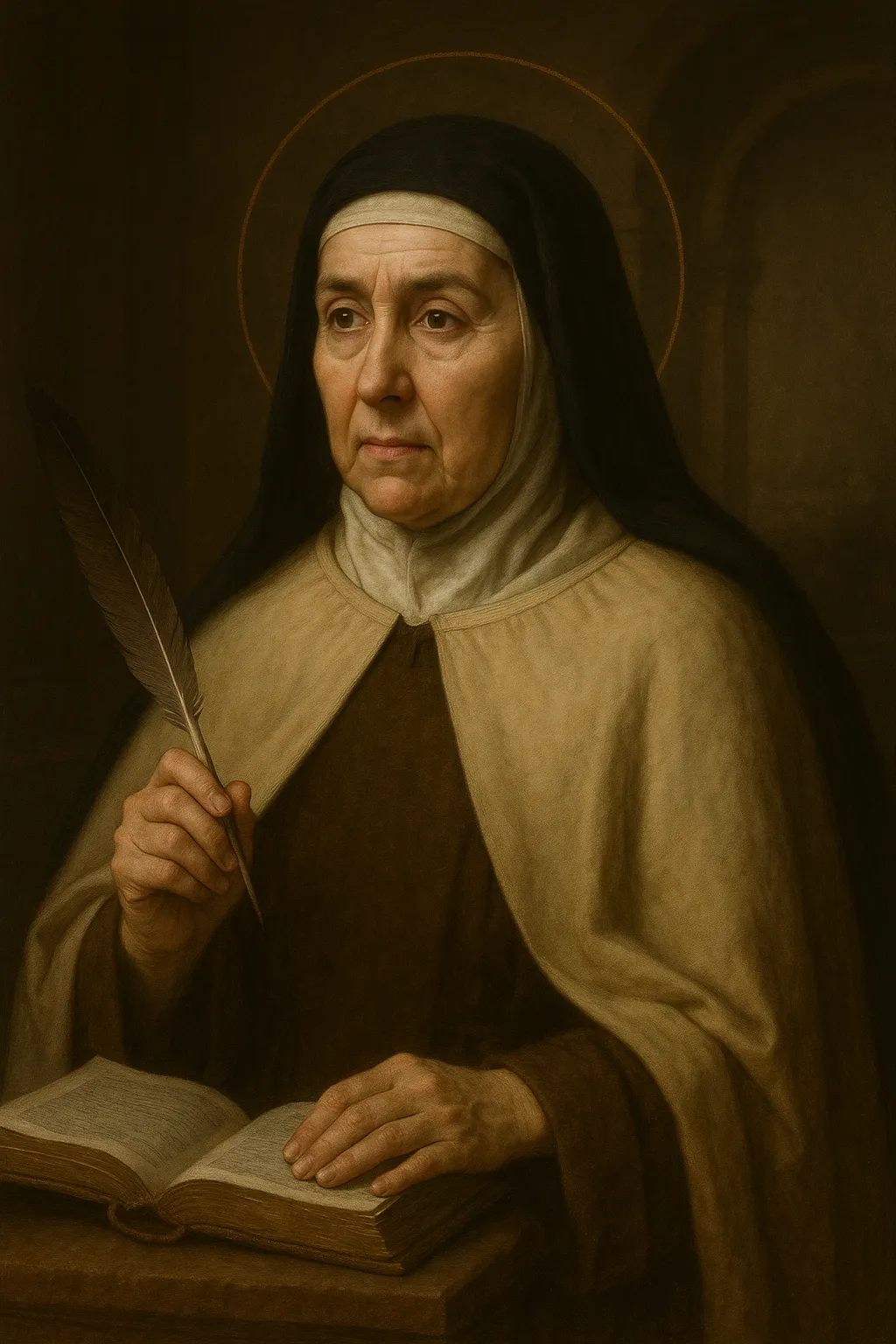
The rest of Teresian Ávila
-
City hub
Ávila
Where this church sits within the wider Catholic geography of Ávila.
-
Carmelite church
Basílica de Santa Teresa de Jesús
Raised over the site of the house where she was born.
-
Carmelite monastery
Monasterio de la Encarnación
The house she left to make this foundation, and returned to as prioress.
-
First house of the friars
Convento de Duruelo
Where the reform reached the friars in 1568, with John of the Cross.
Map
Written from the official Ávila and Castilla y León tourism records for the convent and church. The 1562 foundation and the 1607 church are dated separately, because the buildings a visitor sees are later than the foundation they commemorate. The Christmas 1577 fall is given as the convent tradition gives it.
September 6, 2026