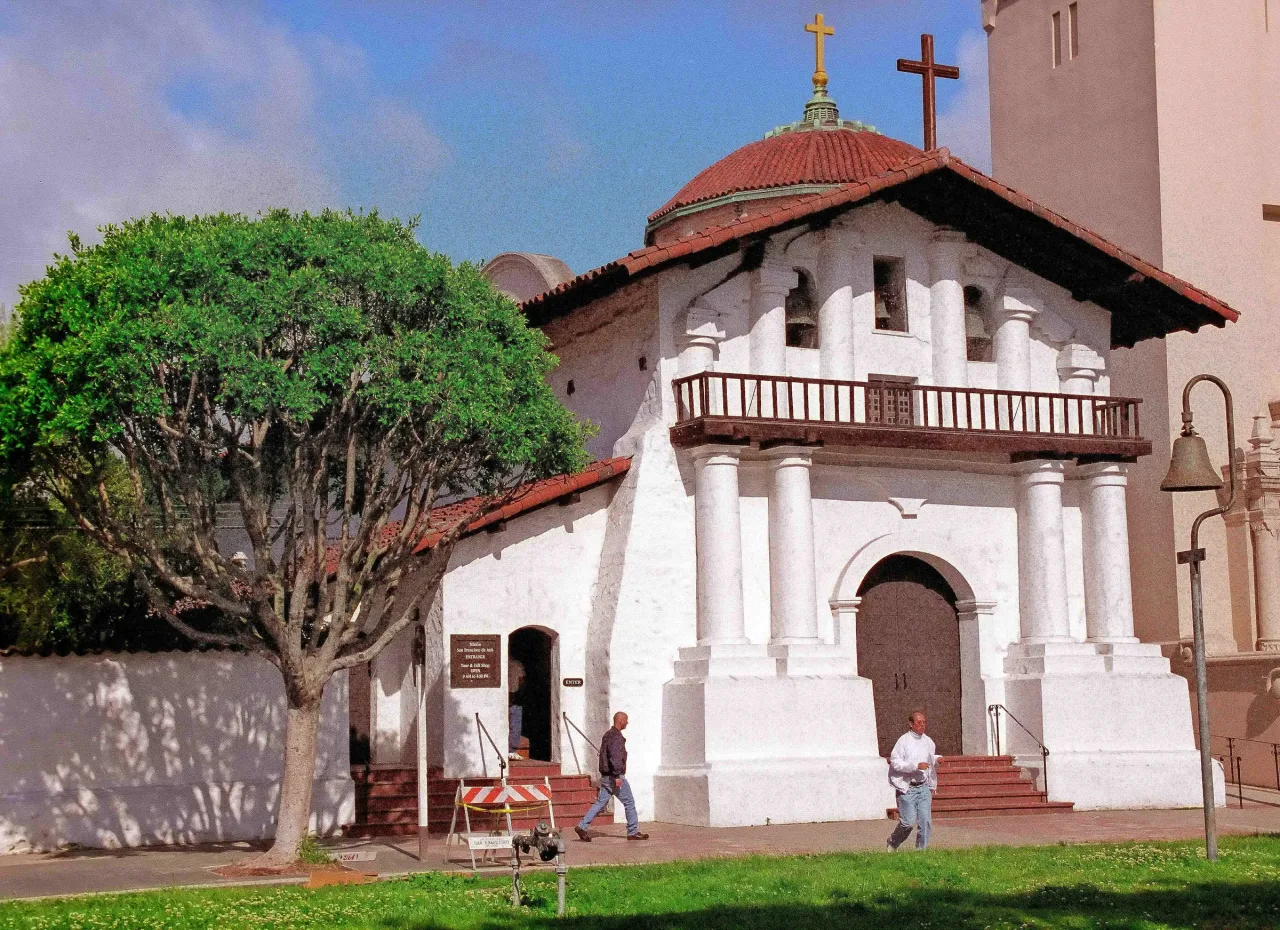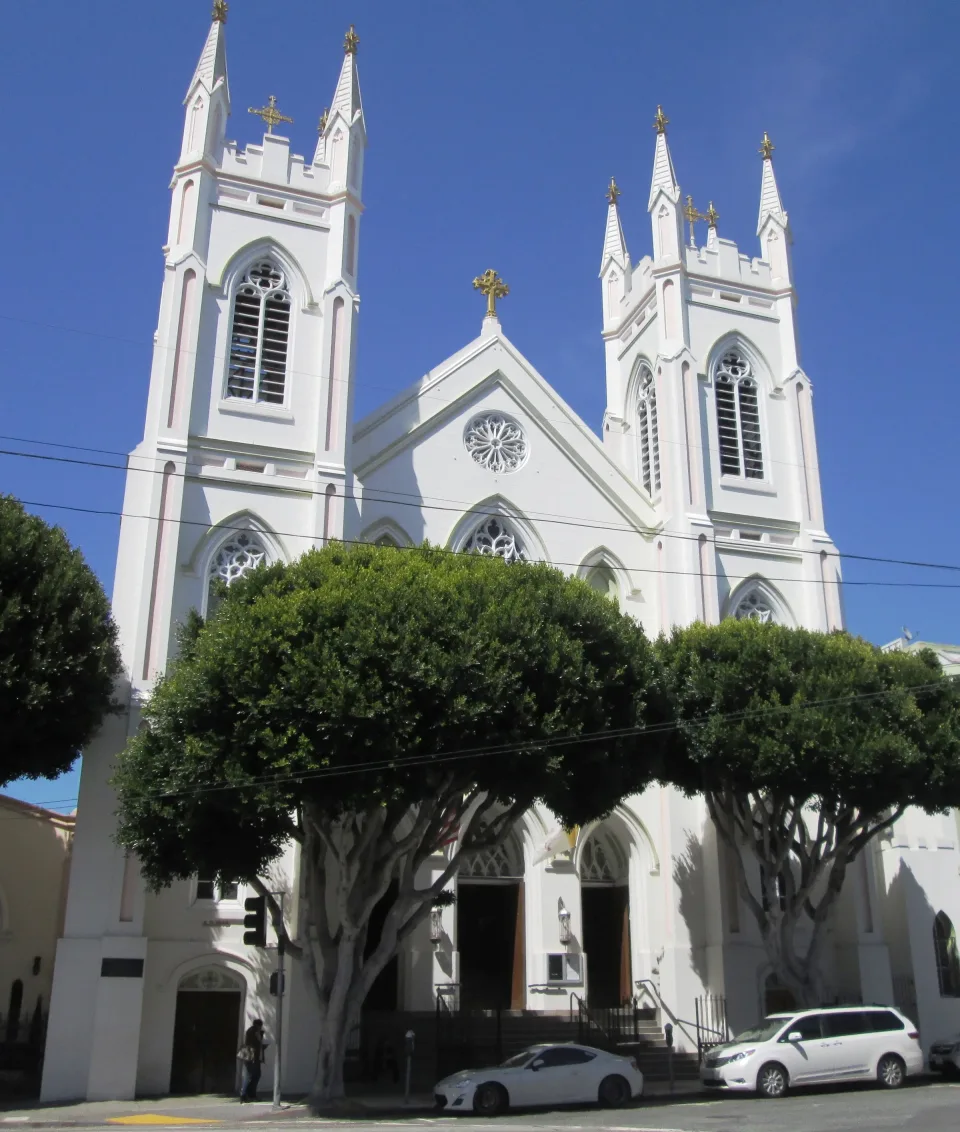
The reconstructed mission chapel
Twentieth-century reconstructionReceive it as a memorial raised on holy ground, not as the building the first pilgrims knew.
St. Raphael Parish and California Office of Historic PreservationA mission founded to heal the sick, reduced to a single pear tree by 1870, and rebuilt in 1949 as the place where the Camino de San Francisco begins.
Pilgrims come here for two reasons. The first is that the Camino de San Francisco begins at this door, and the passport is bought and first stamped inside. The second is older and quieter: this mission exists because people were dying at Mission Dolores.
San Rafael was founded in 1817 not as an outpost but as an infirmary. The sick of the San Francisco mission were brought north across the bay to drier, sunnier country, and the place was named for Raphael, the archangel Catholics have long invoked for healing and for safe journeys. Both meanings are useful to a pilgrim who is about to walk twenty-four miles.
Father Vicente de Sarría founded the asistencia on 14 December 1817, under the care of Father Luis Gil, a friar with some medical training. It was raised to full mission status on 19 October 1822, the twentieth of the twenty-one Alta California missions. It functioned as a mission for only seventeen years.
The buildings, orchards, fields and herds were the work of Coast Miwok people, whose country this was long before the Franciscans arrived. They built, farmed, adapted, left, returned and endured epidemics under a colonial system that pressed them toward settlement and conversion, and their descendants are present in Marin and Sonoma today as the Federated Indians of Graton Rancheria. The mission's own parish records the numbers plainly: 1,873 baptisms in seventeen years.
After Mexican secularization in 1834 the mission emptied. By 1844 it stood abandoned, and John C. Frémont used it as a headquarters during the Bear Flag Revolt. A parish church was raised beside the ruins in 1861, and in 1870 what remained of the mission was cleared away for the growing town. One pear tree from the mission orchard survived. In 1949 Monsignor Thomas Kennedy and a group of supporters built the white chapel that stands here now, on the original site.
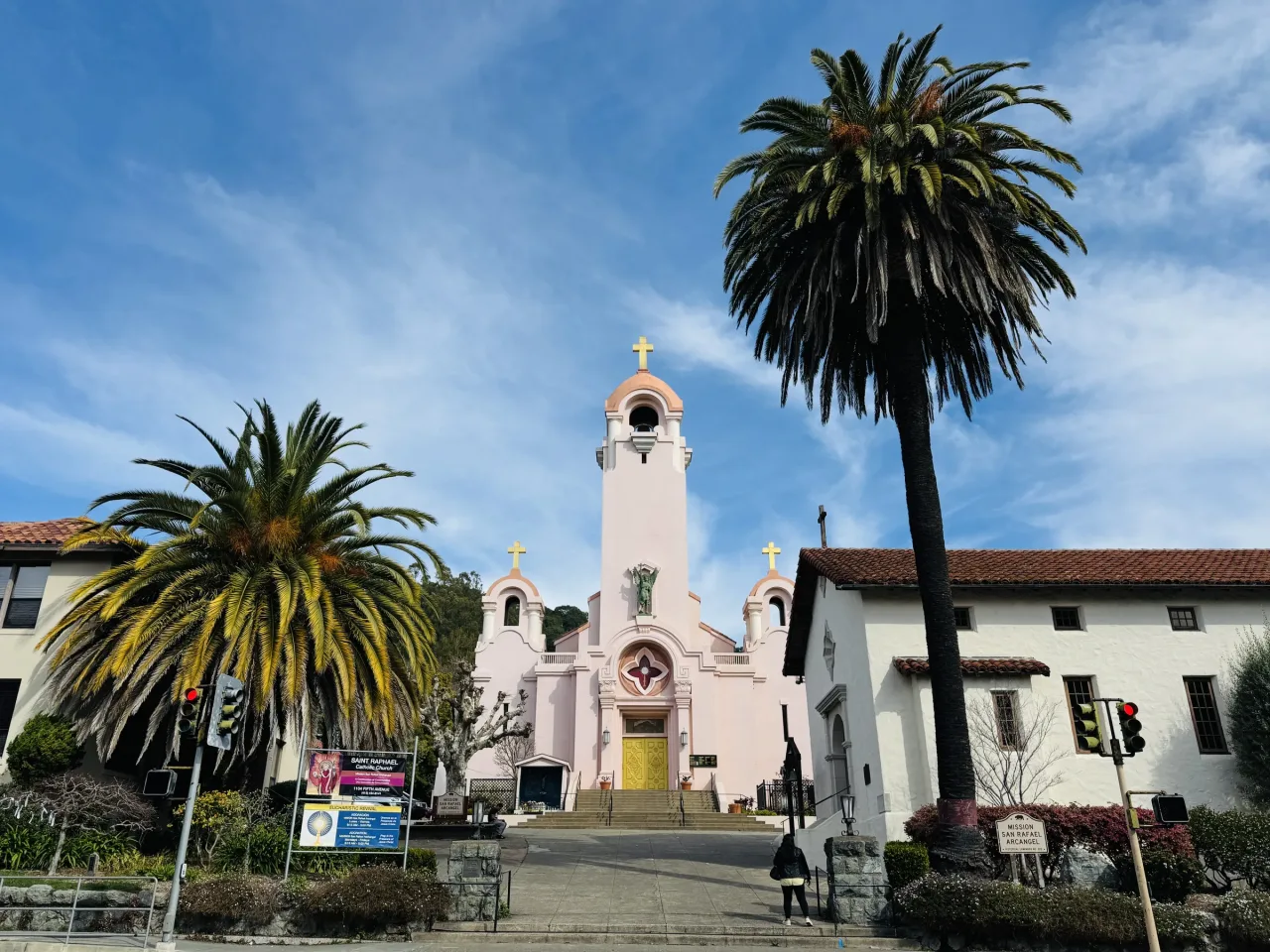
Two buildings share the frontage, and confusing them is the commonest mistake made here. The larger pink church, with the bronze archangel in a niche above its door, is the parish church of St. Raphael, dating from 1919. The smaller white building to its right, with the star window and the wall of three bells, is the 1949 reconstruction of the mission chapel. It reproduces the form of the mission church; it is not the building of 1817, and no part of the original mission survives above ground.
Almost everything worth understanding here depends on knowing what is old, what is rebuilt, and what is simply gone.
A 1949 reconstruction of the mission church, raised on the original site after the last ruins were cleared in 1870.
The 1919 church of St. Raphael, larger and later, and the place where the parish actually worships.
Raphael is the angel of healing and of the journey. The mission was a hospital, and the route starts here.
The one living thing left from the mission orchard, and the only continuous witness on the site.
Founded 14 December 1817 as an asistencia of Mission Dolores
Raised to full mission status 19 October 1822
Original buildings removed in the nineteenth century
Chapel reconstructed on the original site in 1949
This is a working parish before it is a monument, with Sunday Mass in four languages. The mission chapel is small, plain and easy to pray in, which suits the beginning of a pilgrimage better than grandeur would.
Sold at the mission gift shop, which keeps shorter hours than the church. Buy it before you start walking, not after.
The archangel of healing and of travellers, for the sick this mission was founded to serve and for the road ahead.
Read the parish's own account of 1870 and 1949 rather than assuming the chapel is original.
Passport, prayer in the mission chapel, and the grounds, before the first miles south.
Come during gift-shop hours if you need the pilgrim passport, because the shop and the church keep different schedules. Pray in the mission chapel, look for the pear tree, and read the parish's own account of the reconstruction before deciding what you are looking at. Then begin walking south.
Pilgrims are turned away here more often by gift-shop hours than by anything else.
Passport and stamp
Church access
This is a working parish with Sunday Mass in four languages; church access follows the parish schedule rather than visitor hours.
Receive it as a memorial raised on holy ground, not as the building the first pilgrims knew.
St. Raphael Parish and California Office of Historic PreservationPray here for the sick, and for the beginning of a journey.
St. Raphael ParishSource note Traditional attributions are presented as tradition, with documentation named where it exists.
The mother mission this one was founded to relieve, and the end of the Camino de San Francisco.
The Franciscan centre of the route, a day's walk south in North Beach.
The route begins at this door and runs about 24.5 miles south to Mission Dolores. The pilgrim passport is bought and first stamped here.
Official church sources.
September 20, 2026
Use this for corrections, broken links, missing places, and planning ideas.