
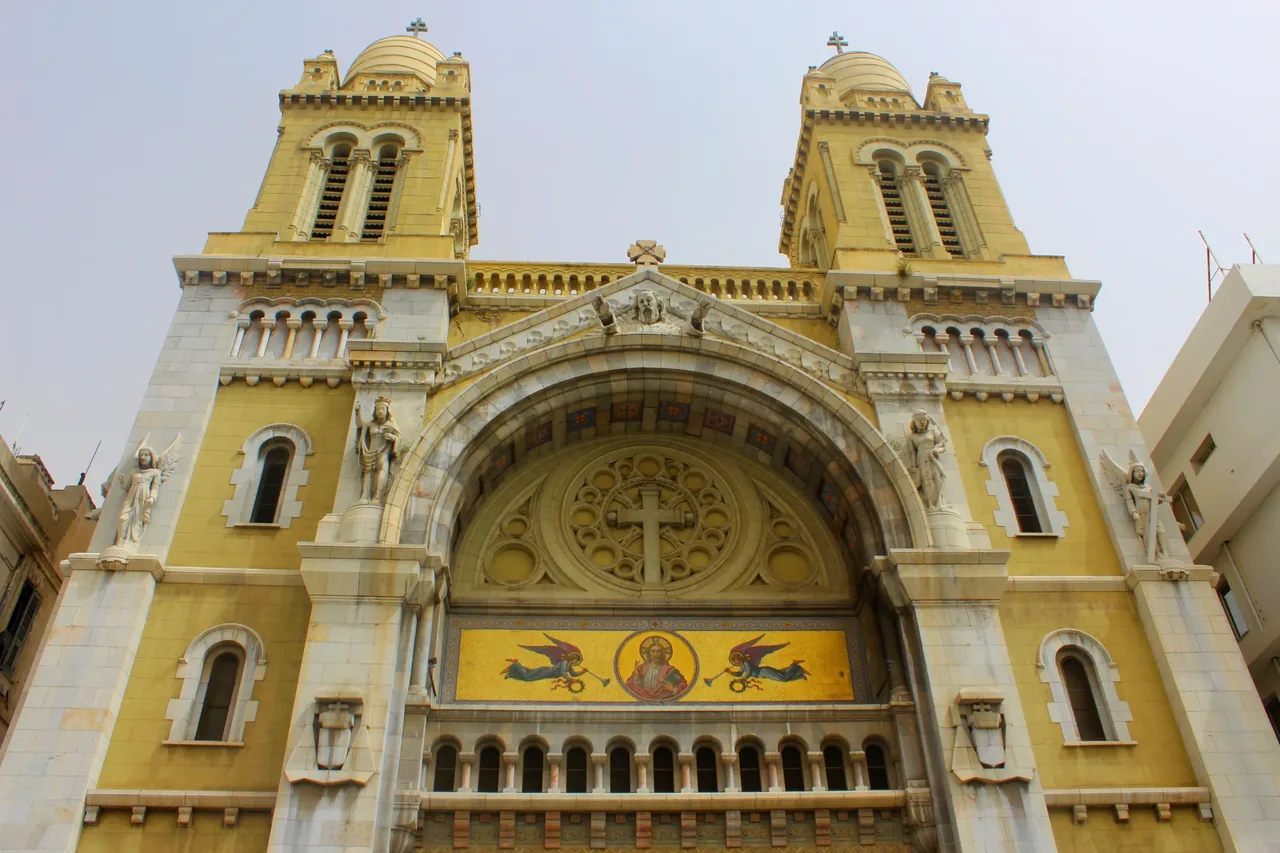
Cathedral of Saint Vincent de Paul and Saint Olive, Tunis
The living cathedral of Tunisia, where the Church that remembers Carthage's martyrs actually gathers.
- Location
- Tunis, Tunisia 36.7992° N · 10.1817° E
- Type
- Catholic cathedral, seat of the Archdiocese of Tunis Late nineteenth-century cathedral on Avenue Habib Bourguiba, completed 1897 with its towers finished in 1910
The other half of Carthage
A day among the ruins of Christian Carthage is incomplete without this. The Church in Tunisia today is small, young and largely made up of sub-Saharan African students, migrants and foreign workers. It is also unmistakably continuous in memory with the Church of Perpetua and Cyprian, and says so in the names it gives its own groups. Come to Mass here and the ancient city stops being an archaeological topic.
A cathedral named for a slave and a martyr
Vincent de Paul was a young priest when, by his own later account, he was captured at sea and sold as a slave in Tunisia. Olive was a girl of Palermo, martyred at Tunis probably in the fifth century and venerated in both cities. The cathedral bears both names. It replaced a hastily built pro-cathedral of 1881, in the years when the cathedral of the diocese was still at Carthage; Cardinal Lavigerie laid its first stone in 1890, three days after consecrating the primatial church on the Byrsa hill. It was inaugurated at Christmas 1897. After Tunisian independence a 1964 agreement between the Republic and the Holy See left this church and a small number of others in the Church's hands while other property passed to the state. John Paul II celebrated Mass here in 1996. The organ has been restored, and in 2021 a small museum-treasury opened inside the building, telling the story of Catholicism in Tunisia from the first centuries to the present.
The cathedral is under the patronage of Saint Vincent de Paul and of Saint Olive, a girl of Palermo martyred at Tunis probably in the fifth century.
Cardinal Lavigerie laid the first stone on May 19, 1890, three days after consecrating the Primatial Cathedral at Carthage.
The church was inaugurated at Christmas 1897; the two towers were finished in 1910.
Pope John Paul II celebrated the Eucharist here during his visit to Tunisia in 1996.
The parish catechism group is named for Saints Perpetua and Felicity and the choir for Our Lady of Carthage.
The parish catechism group is named for Perpetua and Felicity. The martyrs of Carthage are not history here; they are the parish.
This is a working cathedral, not a monument. Mass is celebrated every day, in French through the week, in Arabic on Saturday evening and in Spanish in the crypt once a month. The Blessed Sacrament is exposed for adoration on Tuesdays and Thursdays after Mass. A priest is available for confession for most of the day.
Do Not Miss
-
Mass
The point of the building. Choose the Arabic Saturday evening Mass if you can.
-
Adoration
Tuesday and Thursday after the evening Mass.
-
The museum-treasury
Opened in 2021; the history of the Church in Tunisia from the first centuries to now, in one room.
-
The parish group names
Perpetua and Felicity for the catechism, Our Lady of Carthage for the choir. The martyrs are family here.
- How international and how young the congregation is
- That Mass is celebrated in Arabic as well as French and Spanish
- That the cathedral survives in Church hands because of a 1964 agreement, while most Church property did not
- That this small community keeps the names of the African martyrs in daily use
How to Visit
The cathedral stands at 4 rue d'Alger, on Avenue Habib Bourguiba in central Tunis, a short walk from the TGM terminus for Carthage. Arrange a Carthage day around Mass here or at the Carthage and La Marsa parish. The museum-treasury is worth the time; a free PDF guide to the cathedral is published by the archdiocese.
- Daily Mass, including a Saturday evening Mass in Arabic
- Eucharistic adoration on Tuesdays and Thursdays after Mass
- Confession available through the week
- The memory of the African martyrs carried in the parish's own names
Daily Mass in four languages, in the centre of the city.
The archdiocese publishes Mass and confession times for the cathedral and for every parish and place of worship in Tunisia. Times change; the archdiocese asks that visitors telephone before coming.
- Sunday Mass
- 9.00 and 11.00, in French
- Saturday
- 18.30 in Arabic; second Saturday of the month 17.00 in Spanish, in the crypt
- Weekdays
- 18.30 in French, with adoration after Mass on Tuesday and Thursday
- Confession
- Monday to Saturday 8.00-12.00 and 15.00-19.00; Sunday 8.00-13.00
- Address
- 4 rue d'Alger, 1000 Tunis
Current access
Prayer and custody
Relics, Tombs, Sacred Objects
Tomb and Burial
- No saint is buried here.
Relics and Sacred Tradition
- The archdiocese does not publish a relic claim for the cathedral. A museum-treasury opened in 2021 holds objects from the history of the Church in Tunisia.
Sacred Objects
- The organ, which the archdiocese describes as one of the oldest and finest in Africa
- The museum-treasury opened in 2021
- The crypt, used for Mass on the second Saturday of each month
Connected Saints
Continue Your Pilgrimage
Map
Hero image sourced from Wikimedia Commons (Sami Mlouhi, CC BY-SA 4.0); its Commons description names Independence Square, which the cathedral faces, and the facade is unambiguously the subject. All Mass, confession and history detail from the Archdiocese of Tunis's own parish page, current September 2026.
September 17, 2026
Photo credits
- Hero. Sami Mlouhi, CC BY-SA 4.0, via Wikimedia Commons. Source. CC BY-SA 4.0.