
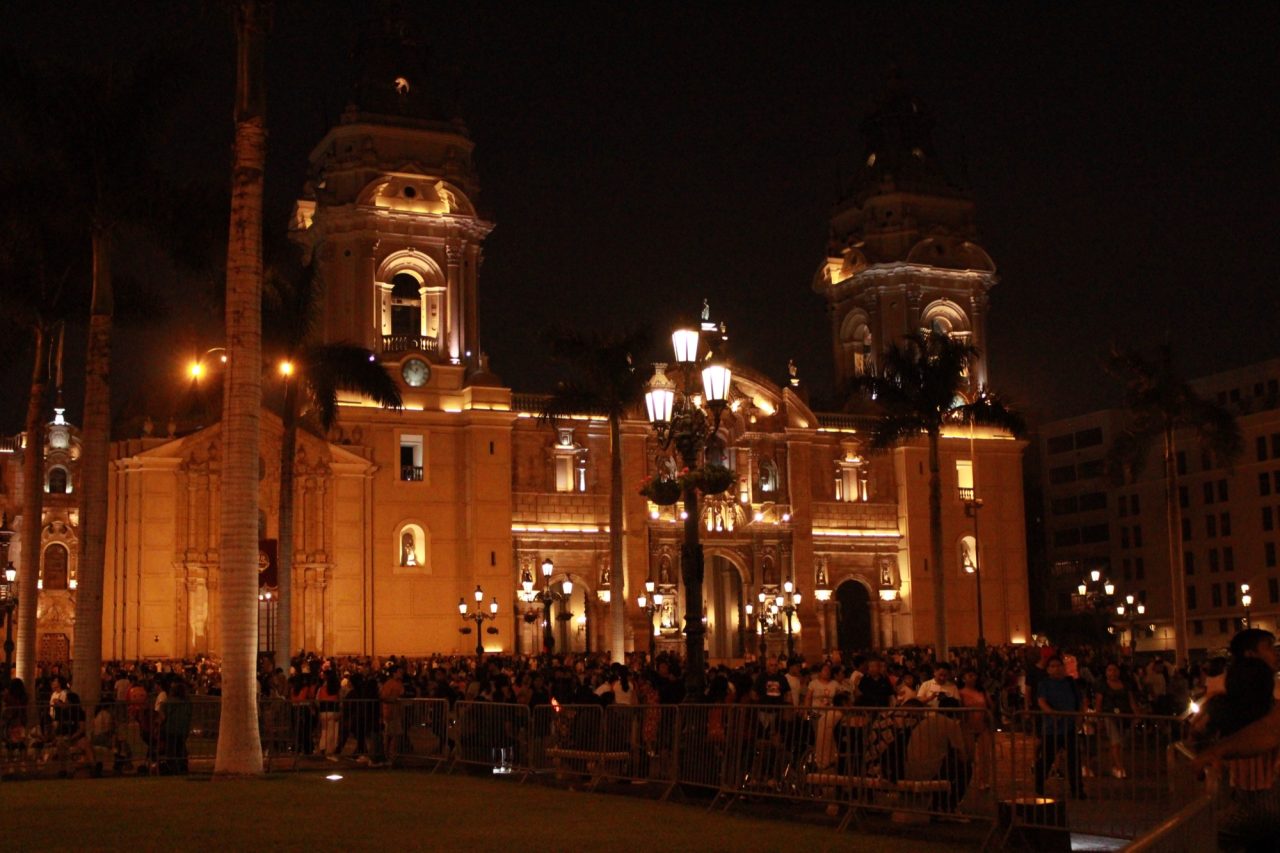
Lima Cathedral
Lima Cathedral stands on the Plaza Mayor at the founding heart of the city, keeping the relics of Saint Turibius of Mogrovejo, a colonial crypt and tombs, and centuries of sacred art.
- Location
- Lima, Peru 12.0468° S · 77.0297° W
- Type
- Roman Catholic cathedral on the Plaza Mayor of Lima A colonial cathedral begun in the sixteenth century, rebuilt after earthquakes, with a Renaissance-into-Baroque facade and carved choir stalls
- Dedication
- Saint Turibius of Mogrovejo and the early Church of Peru
The Cathedral on the Founding Square
Begin here to place the saints of Lima in their city. This is the cathedral of the see that Saint Turibius of Mogrovejo governed, the bishop who confirmed Rose of Lima, and it stands on the square from which the whole colonial city was measured.
The Mother Church of Peru
The Spanish laid out Lima in 1535 around this square, and a cathedral has stood on the site almost from the beginning. Earthquakes brought down its early forms more than once, and the present church, begun in the sixteenth century and repaired across the centuries, carries the marks of that long rebuilding. Its most important early figure is Saint Turibius of Mogrovejo, the second archbishop, a Spanish bishop who crossed his vast diocese on foot and horseback, confirmed the young Rose of Lima, and helped form the early Catholic life of Peru. The cathedral preserves his relics and keeps his memory at the center of the city he served.
The cathedral shows the passage from Renaissance restraint to colonial Baroque, with a stone facade between two towers and an interior of side chapels along the nave. The carved wooden choir stalls are among the treasures of colonial craftsmanship in the Americas. Beneath the church runs a crypt with the tombs of archbishops and colonial figures, and a chapel holds the remains of Francisco Pizarro, the city's Spanish founder.
This is the cathedral of the see that Turibius of Mogrovejo governed as he shaped the early Church of Peru.
The Plaza Mayor outside is the square from which colonial Lima was laid out, ringed by the cathedral and the government palaces.
The colonial art and woodwork gathered here trace four centuries of Catholic Lima.
The cathedral anchors a historic center recognised by UNESCO for its colonial architecture.
Spiritual Significance
For all its art and history, the cathedral is a working church and the seat of the Archbishop of Lima. Pilgrims come less for the tombs of the powerful than to pray before the relics of Turibius of Mogrovejo and to stand where the Church of Peru began.
Do Not Miss
-
The relics of Saint Turibius of Mogrovejo
The shepherd-bishop who confirmed Rose of Lima, venerated in the cathedral he once governed.
-
The carved choir stalls
Among the finest colonial woodwork in the Americas.
-
The crypt and tombs
Archbishops and colonial figures, including the founder's tomb chapel, beneath the church.
-
The Plaza Mayor
The founding square of Lima, ringed by the cathedral and the palaces of the old city.
How to Visit
See the cathedral together with the Plaza Mayor around it, then walk the few blocks to Santo Domingo, where Lima keeps its Dominican saints. The cathedral is the natural first stop in the historic center.
Confirm cathedral and museum hours before you go.
Lima Cathedral is open to visitors most days, often with a small admission for the museum, crypt, and choir, and closes to sightseeing during services. Confirm current hours with the archdiocese, and treat the historic center with normal city awareness.
- Time needed
- About an hour for the cathedral, museum, and crypt.
- Getting there
- On the Plaza Mayor in the historic center; walkable from the other churches of the old city.
- Best time
- Weekday mornings, outside Mass times, for a quieter visit.
Opening and access
In the historic center
Additional schedule notes
Museum, choir, and crypt
A small admission usually covers the religious-art museum, the carved choir, and the crypt beneath the church.
A working cathedral
Sightseeing pauses during Mass; come outside service times or join the liturgy rather than tour through it.
Relics, Tombs, Sacred Objects
Tomb and Burial
- The cathedral preserves relics of Saint Turibius of Mogrovejo, archbishop of Lima, who confirmed Rose of Lima and ordained a generation of the city's clergy.
Relics and Sacred Tradition
- Relics of Saint Turibius of Mogrovejo, long venerated in the cathedral he once served as archbishop.
Sacred Objects
- The carved wooden choir stalls, among the finest colonial woodwork in the Americas.
- The crypt beneath the cathedral, with tombs of archbishops and colonial figures.
- The tomb chapel of Francisco Pizarro, who founded Lima in 1535; his identified remains were placed here after twentieth-century study corrected an earlier mistaken display.
Connected Saints
Continue Your Pilgrimage
Map
Official church sources.
July 21, 2026
Photo credits
- Hero. Bhonyx07 / Wikimedia Commons (CC BY-SA 4.0). Source. CC BY-SA 4.0.
- Inside the cathedral. Tomas Sobek / Wikimedia Commons (CC BY 2.0). Source. CC BY 2.0.