
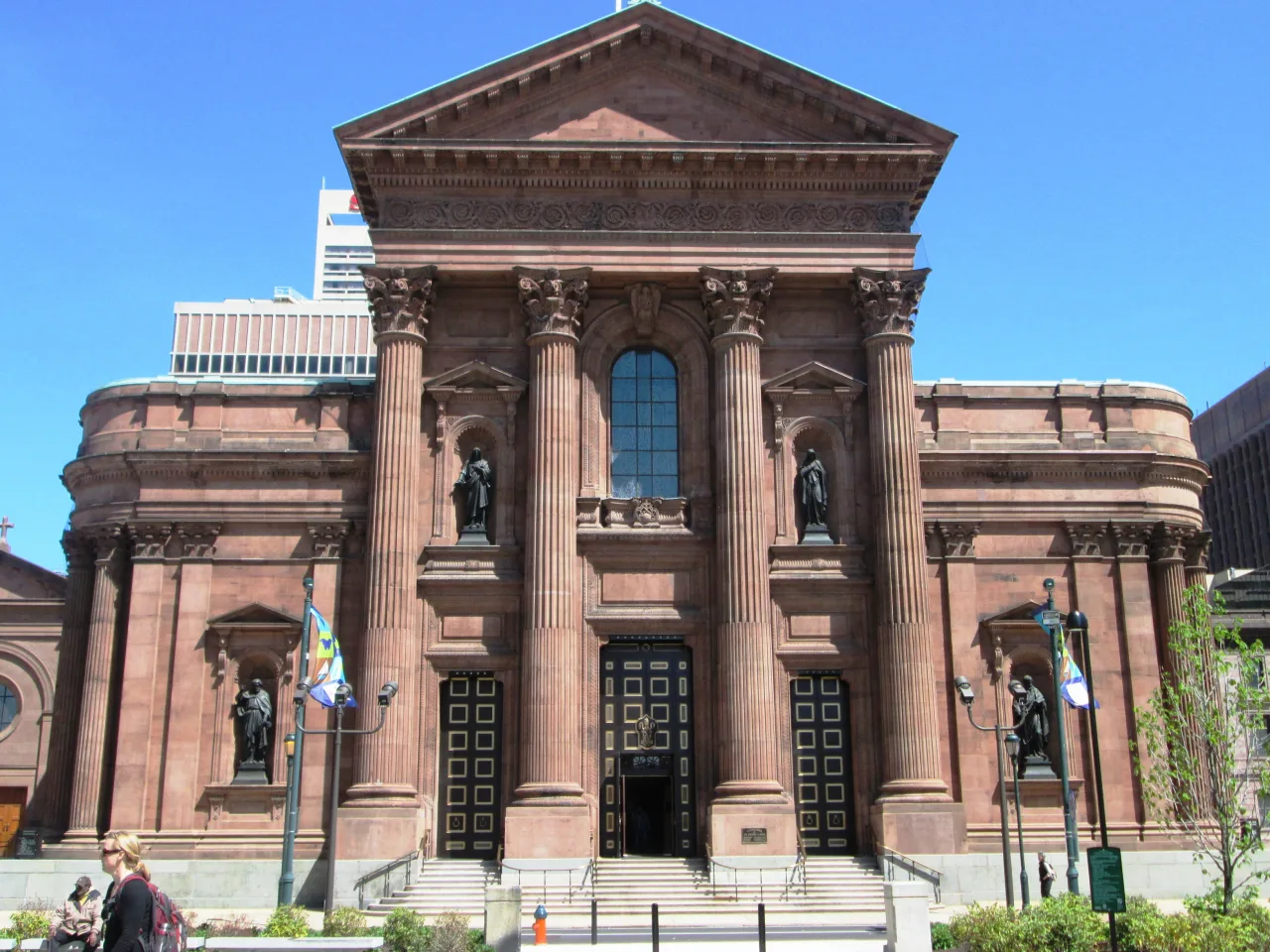
Cathedral Basilica of Saints Peter and Paul
The Cathedral Basilica of Saints Peter and Paul is Philadelphia’s mother church and the resting place of Saint Katharine Drexel.
- Location
- Philadelphia, Pennsylvania, United States 39.9571° N · 75.1697° W
- Type
- Roman Catholic cathedral, minor basilica, and saint’s tomb shrine Neoclassical cathedral with Corinthian portico, great dome, and high clerestory windows
- Dedication
- Saints Peter and Paul
- Time Needed
- 90 minutes to half a day
Philadelphia’s cathedral and a saint’s resting place
Come first for the Church’s worship, then approach Saint Katharine Drexel’s tomb with the concrete burdens of race, education, generosity, and fidelity that marked her vocation.
The immense nave carries the public confidence of a Catholic community tested by nineteenth-century hostility. The small tomb shrine keeps that history from becoming abstraction: one Philadelphia woman gave her inheritance and her life to Christ among Black and Indigenous peoples, and the local Church now keeps vigil beside her bodily remains.
A cathedral raised through trial
Construction began in 1846 and the cathedral opened in 1864. Its high clerestory windows and monumental brownstone walls belong to a period when anti-Catholic violence remained a living memory in Philadelphia. Saint John Neumann served as bishop during the work and helped advance the building before his death in 1860. More than a century later, the cathedral received basilica status and welcomed papal visits from Saint John Paul II and Pope Francis.
The Neoclassical design was modeled in part on San Carlo al Corso in Rome. A broad Corinthian portico, copper dome, long nave, and high windows give the building civic scale while directing the interior toward the altar.
Construction ran from 1846 to 1864, with Saint John Neumann serving as bishop during part of the work.
The cathedral was named a minor basilica in 1976.
Saint John Paul II visited in 1979 and Pope Francis celebrated Mass here in 2015.
Saint Katharine Drexel’s remains were translated from the Bensalem motherhouse in 2018.
Spiritual Significance
This is the cathedral of a living archdiocese. Saint Katharine’s tomb is not a detached memorial but a place of intercession within the Church’s sacramental life.
Do Not Miss
-
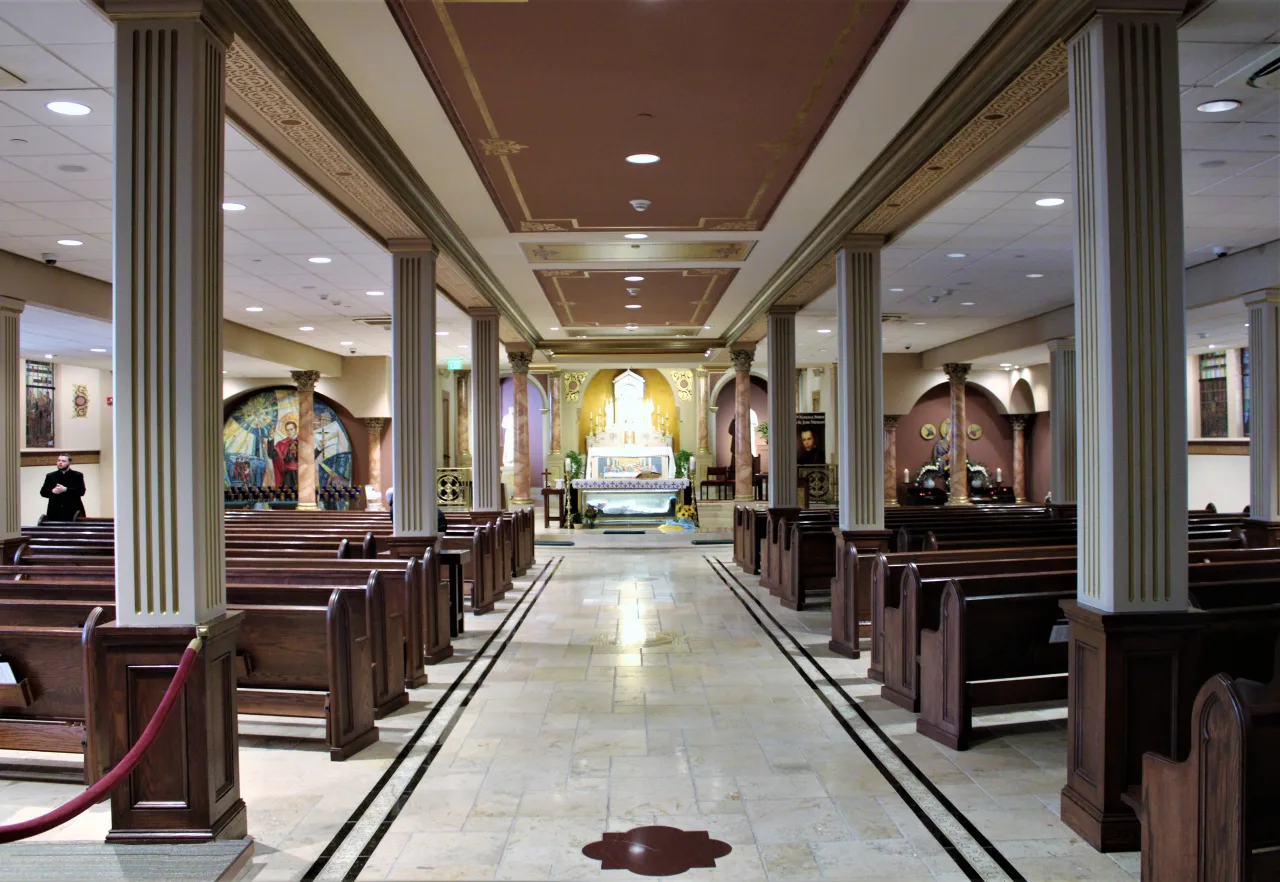
Saint Katharine Drexel’s tomb
Pray beside her bodily remains and remember the communities she served, not only the wealth she surrendered.
-
The cathedral altar and dome
Let the scale lead toward worship rather than architectural spectacle alone.
-
The high windows
Read their height in the context of the anti-Catholic hostility remembered during the cathedral’s construction.
- The contrast between the cathedral’s vast public nave and the intimate tomb shrine
- The Roman influence in the portico, dome, and ordered interior
- How Saint Katharine’s local resting place turns Philadelphia history toward mission
Visit Plans
-
Altar, cathedral, and saint’s tomb
3 ordered stopsBegin in silence before the altar, receive the cathedral as Philadelphia’s mother church, then pray at Saint Katharine’s tomb.
- Begin at Mass or in quiet prayer before the sanctuary.
- Walk the nave and notice the dome, high windows, and Drexel family altar.
- Remain at Saint Katharine Drexel’s tomb for intercession.
-
The mother church at a pilgrim’s pace
3 ordered stopsLet the cathedral’s liturgical schedule govern the visit and give the saint’s tomb more than a passing stop.
- Arrive for confession or Mass if the current schedule permits.
- Receive the architecture and the cathedral’s nineteenth-century Catholic history.
- Close beside Saint Katharine’s tomb with prayer for justice, education, and generous vocation.
How to Visit
Anchor the visit to Mass, confession, or a quiet shrine hour. Confirm the live schedule and any cathedral events before travel. Use the accessible parking-lot entrance if needed.
- Daily and Sunday Mass according to the current cathedral schedule
- Scheduled confession
- Prayer at Saint Katharine Drexel’s tomb
- Archdiocesan liturgies and pilgrim worship
The cathedral and Saint Katharine Drexel shrine keep broad daily hours.
Worship, confession, shrine hours, and special liturgies can change. Use the cathedral’s current pages on the day of travel.
- Address
- 1723 Race Street, Philadelphia, PA 19103
- Time needed
- One to two hours; longer with Mass and confession
- Shrine hours
- Normally open daily from morning through late afternoon or evening; verify the current day
Worship and prayer
- Check holy days and special archdiocesan liturgies.
- Arrive early enough to account for a line or schedule change.
Access
- Worship and special events can restrict movement within the cathedral.
- Confirm parking and transit before setting out.
Relics, Tombs, Sacred Objects
Tomb and Burial
- Saint Katharine Drexel, whose remains were translated here in 2018
Relics and Sacred Tradition
- The bodily remains of Saint Katharine Drexel rest in a tomb beside the Drexel family altar
Sacred Objects
- The tomb and shrine of Saint Katharine Drexel
- The cathedral high altar beneath the dome
- The Drexel family altar near the saint’s tomb
Connected Saints
Continue Your Pilgrimage
-
Saint’s tomb and Redemptorist shrine
National Shrine of Saint John Neumann
Continue from the cathedral Saint John Neumann helped build to the church where his bodily remains are venerated.
-
Marian basilica and Vincentian shrine
Basilica Shrine of Our Lady of the Miraculous Medal
A separate Germantown pilgrimage centered on the Miraculous Medal and the Perpetual Novena.
Map
This page distinguishes cathedral history from the later 2018 translation of Saint Katharine Drexel’s remains and makes no claim that her original Bensalem tomb remains active.
August 24, 2026
Photo credits
- Hero. Beyond My Ken, CC BY-SA 4.0, via Wikimedia Commons. Source. CC BY-SA 4.0.
- Saint Katharine Drexel’s tomb. Pbritti, CC BY-SA 4.0, via Wikimedia Commons. Source. CC BY-SA 4.0.