
St. Scholastica
The sister of Benedict, remembered for a love of God that, the tradition says, could do more than rules.
She was able to do more because she loved more.
Pope Saint Gregory the Great, Dialogues, Book II (c. 593), recounting Scholastica's last meeting with Benedict Well-attested
Twin sister of Saint Benedict and a foundress of Benedictine women's monastic life
Scholastica is honored as the twin sister of Saint Benedict and as a foundress of Benedictine monastic life for women. Almost everything known of her comes from a single, tender story in the Dialogues of Pope Saint Gregory the Great, written about fifty years after her death.
According to Gregory the Great, Scholastica was Benedict's sister, consecrated to God from her early years, and she lived a monastic life near her brother's monastery at Monte Cassino. Each year the two would meet once, in a house outside the monastery, to spend a day speaking of the things of God.
At their last meeting, Gregory recounts, Scholastica begged Benedict to stay through the night and continue their holy conversation. When he refused, unwilling to break his own rule by being absent overnight, she bowed her head in prayer, and a sudden violent storm made it impossible for him to leave. Benedict protested, and Gregory comments that "she was able to do more because she loved more."
Three days later, Gregory says, Benedict saw his sister's soul rise to heaven in the form of a dove. He had her body brought to the tomb he had prepared for himself, so that, as Gregory writes, those whose minds had always been one in God should not be separated in body. Her feast is kept on February 10.
Scholastica stands at the beginning of Benedictine women's monasticism and is patron of Benedictine nuns and sisters. Her story, brief as it is, has long been read as a witness that love can reach further than law, and that the contemplative life of women shares fully in the Benedictine inheritance.
A life, in years and approximate ages.
-
c. 480BirthBirth at NursiaScholastica is born, by tradition the twin sister of Benedict, at Nursia in central Italy. Tradition holds that she was dedicated to God from her early years.
-
c. 530Adult lifeMonastic Life near Monte CassinoScholastica leads a community of consecrated women near her brother's monastery at Monte Cassino. Once a year the two meet to spend a day speaking of God.
-
c. 543Late in lifeThe Last MeetingAt their final meeting, Scholastica prays that Benedict stay through the night, and a sudden storm prevents his leaving. Gregory comments that she could do more because she loved more.
-
c. 543DeathDeath and Burial with BenedictThree days after their last meeting, Gregory says, Benedict sees his sister's soul rise as a dove. He has her buried in the tomb he had prepared for himself, so that they should not be parted in death.
-
8th century ADAfter deathContested Relic TraditionsIn the centuries after her death, sites in France as well as Monte Cassino come to preserve traditions of Scholastica relics. The traditions differ and remain disputed to this day.
Dates are approximate where the surviving record is traditional or incomplete.
One place where this witness remains visible.
Subiaco Monasteries
The valley where Benedict first lived as a hermit and monk, the seedbed of the monastic life that Scholastica shared.
Contested relic traditions, documented plainly.
According to Gregory the Great, Scholastica was buried with Benedict at Monte Cassino, where she is venerated to this day. Sites in France, including Le Mans and Juvigny-sur-Loison, also preserve traditions of Scholastica relics, and the traditions differ. Pilgrims most often honor her at Monte Cassino, alongside her brother.
More than one site preserves a claim, without a settled consensus.
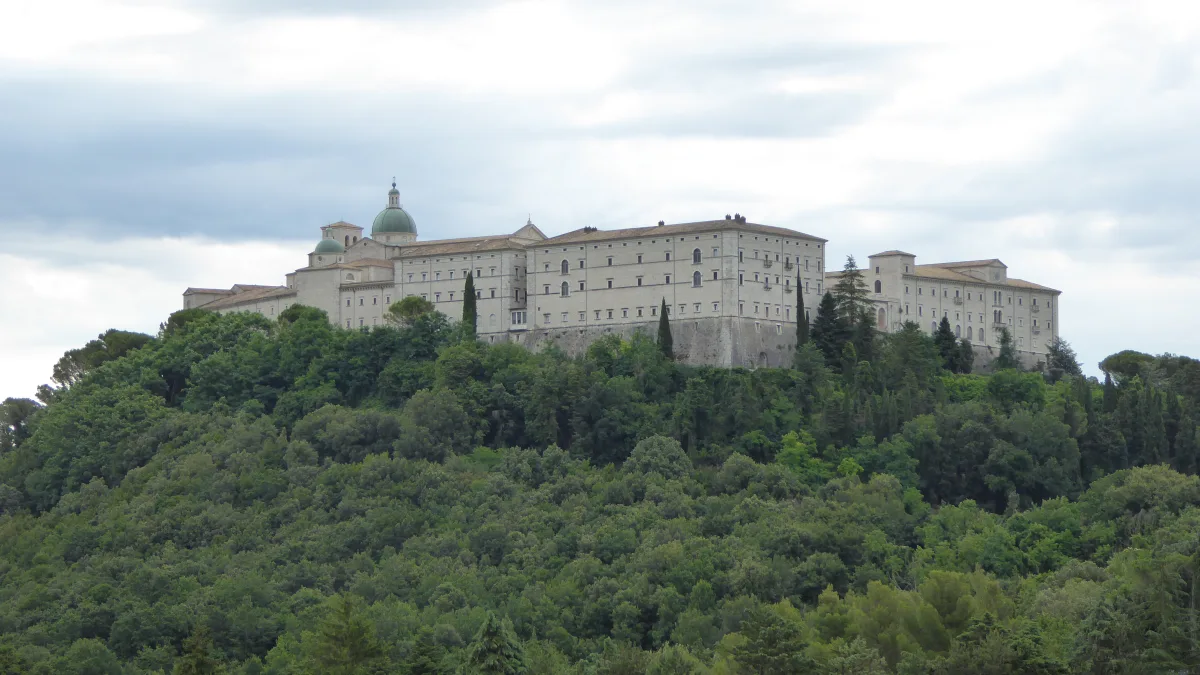
Abbey of Monte Cassino
The great abbey founded by Benedict, where the tradition holds that Scholastica was buried alongside her brother. Pilgrims venerate the two together beneath the high altar of the basilica.
- Tomb of Saints Benedict and Scholastica, by tradition, beneath the high altar
The abbey was rebuilt after its destruction in 1944; the tomb shrine of Benedict and Scholastica lies in the crypt and basilica.
Kindred witnesses
-
Saint Benedict
Her twin brother, the father of Western monasticism, with whom she is traditionally venerated at Monte Cassino. -
Saint Gregory the Great
The pope whose Dialogues preserve the only early account of her life. -
Saint Hildegard of Bingen
A later Benedictine woman whose visionary and monastic life flowered from the tradition Scholastica helped begin.


Kept on February 10.
February 10 is the feast of Saint Scholastica, kept across the Benedictine world. Her day falls close to her brother Benedict's and is honored especially in monasteries of Benedictine women.
Monte Cassino, where Gregory says she was buried with Benedict, is the heart of her devotion. Subiaco, where Benedict first lived as a monk, is a natural companion site in the same region of Lazio.
How the Benedictine world holds Scholastica
Scholastica is remembered as the sister of Benedict and as the first of the Benedictine women. Her memory is held by the abbey where tradition places her burial beside her brother, and by the contemplative life under his Rule that women have followed ever since.
-
The tradition she begins
The Benedictine women
The contemplative women's life lived under Benedict's Rule, for which Scholastica is honored as the first mother; Benedictine nuns across the world still look to her.
-
Tomb tradition
Monte Cassino Abbey
The abbey her brother founded, where tradition holds that the two are buried together beneath the high altar; pilgrims most often honor Scholastica here, alongside Benedict.
Careful contextMonte Cassino venerates Scholastica with Benedict, while sites in France, among them Le Mans and Juvigny, also claim her relics. The traditions differ and are named rather than reconciled.
Almost everything known of Scholastica comes from a single chapter of Pope Saint Gregory the Great's Dialogues, written within living memory of Monte Cassino. Her relics are venerated at Monte Cassino, while sites in France also preserve Scholastica relic traditions; the traditions differ, and are named here rather than settled.