
St. Augustine of Canterbury
Prior of a Roman monastery, sent by Pope Gregory the Great to the English in 596, who founded the see of Canterbury and the Church of the Anglo-Saxon kingdoms.
They came, Bede writes, bearing a silver cross for their banner, and the image of our Lord and Saviour painted on a board, and singing the litany.
Bede, Ecclesiastical History of the English People, I.25 (731) Well-attested
The Roman monk Gregory the Great sent to Kent, and the first Archbishop of Canterbury
Augustine did not bring Christianity to Britain; it had reached the Roman province centuries before him, and the British Church lived on in the west. His mission was to the English, the pagan peoples who had settled the east of the island. Sent from Rome by Pope Gregory the Great, he landed in Kent in 597 with some forty companions, won the hearing of King Æthelberht, and founded at Canterbury the see from which the Church of the English kingdoms grew.
Nothing certain is known of his birth or early life. He was prior of the monastery of Saint Andrew on the Caelian Hill in Rome, which Gregory had founded in his own family house, when the pope chose him in 596 to lead a mission to the English. On the road through Gaul the monks lost heart, and Augustine went back to Rome to ask that they be excused. Gregory sent him on with a letter of encouragement, dated July 23, 596.
In 597 they landed on the Isle of Thanet. Bede, writing in the next century from Canterbury's own records, says that King Æthelberht met them in the open air, wary of any spell they might cast indoors, and that they came to him carrying a silver cross and an image of Christ painted on a board, singing the litany. The king was cautious but generous. He gave them a house in Canterbury, and they worshiped in the old church of Saint Martin, where his Frankish queen Bertha, already a Christian, used to pray.
The king was baptized within a few years; Bede gives no date, and later tradition places it at Pentecost 597. Augustine went back to Gaul to be consecrated bishop, at Arles according to Bede, and Gregory wrote to the patriarch of Alexandria that more than ten thousand English had been baptized at Christmas. In 601 new monks came from Rome with the pallium for Augustine and with Gregory's counsel: to purify the old temples rather than destroy them, and to keep what was good in English custom.
At Canterbury he restored a church built in Roman times and dedicated it to Christ, the origin of the cathedral, and founded a monastery outside the walls that would bear his name. He met the bishops of the British Church, first at a place Bede calls Augustine's Oak, but they would not accept him or Roman usage, and no union came of it. In 604 he consecrated Mellitus for the East Saxons in London and Justus for Rochester.
He died on May 26, probably in 604, and was buried beside the abbey church he had begun, its own church not yet consecrated. His relics were later brought inside, and in the eleventh century they were translated into the new Norman church. The abbey was surrendered to Henry VIII in 1538 and pulled down, and his tomb was lost with it. The ruins, the cathedral and Saint Martin's now stand together as a World Heritage Site.
Augustine's mission was small, slow and often frustrated, but it fixed the see of Canterbury and tied the English Church to Rome. Bede, who told its story, called Gregory the apostle of the English; Augustine was the man who went. The Church keeps his memorial on May 27, and in England it is a feast.
A life, in years and approximate ages.
-
Before 596Prior of Saint Andrew's, RomeAugustine is prior of the monastery Gregory founded in his family house on the Caelian Hill.
-
596Sent to the EnglishPope Gregory the Great sends him with some forty monks. When they falter in Gaul, Gregory sends them on with a letter dated July 23, 596.
-
597Landing in KentThe monks land on the Isle of Thanet. King Æthelberht hears them in the open air and gives them a house in Canterbury.
-
597Consecrated bishopAugustine is consecrated bishop in Gaul, at Arles according to Bede. At Christmas, Gregory reports, more than ten thousand English are baptized.
-
601The pallium from RomeNew monks arrive with the pallium for Augustine and Gregory's counsel for the young English Church.
-
604Sees at London and RochesterHe consecrates Mellitus for the East Saxons in London and Justus for Rochester, the first sees beyond Canterbury.
-
May 26, c. 604Death at CanterburyAugustine dies and is buried beside the church of his monastery outside the city walls.
-
1538After deathThe abbey surrenderedSaint Augustine's Abbey is surrendered to Henry VIII; its church is demolished and his tomb lost.
Dates are approximate where the surviving record is traditional or incomplete.
4 places where this witness remains visible.

San Gregorio Magno al Celio
The church stands on Gregory's family house, which became the monastery of Saint Andrew. Augustine was its prior when he was sent to the English in 596.
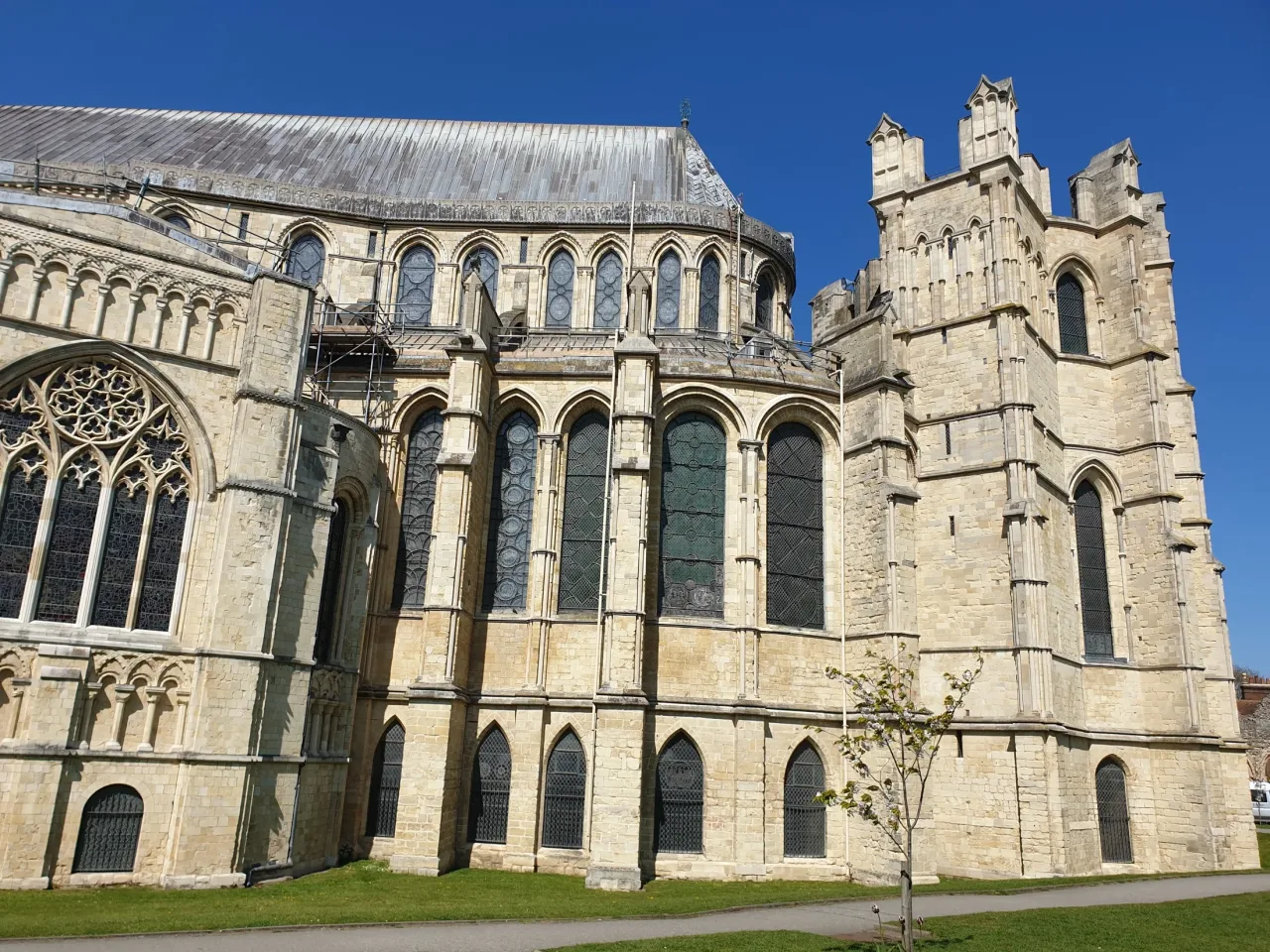
Canterbury Cathedral
Augustine set his see here and, Bede records, restored a church from Roman times and dedicated it to Christ. The present cathedral rises on that foundation.
St Martin's Church, Canterbury
The church where Queen Bertha prayed, and where the mission first met to sing, to say Mass, to preach and to baptize.
St Augustine's Abbey, Canterbury
The monastery he founded outside the walls, where he was buried. The ruins and the site of the early archbishops' tombs are in the care of English Heritage.
A tomb lost with its abbey.
Augustine was buried at the monastery of Saints Peter and Paul outside the walls of Canterbury, the abbey that later took his name, and his relics were brought into its church and translated again after the Norman rebuilding. When the abbey was surrendered to Henry VIII in 1538 and its church demolished, his tomb was lost. No major relic is known to survive. The site of the tomb can be seen among the ruins, now in the care of English Heritage.
The tradition does not preserve a public relic site with confidence.
Kindred witnesses
-
The pope who sent him
Saint Gregory the Great
Gregory chose him from his own monastery of Saint Andrew, sent him to the English in 596, and guided the mission by letter. -
Martyr archbishop of his see
Saint Thomas Becket
Archbishop of Canterbury five centuries later, killed in the cathedral that grew from Augustine's foundation.


Showing 2 of 3 authored connections with full saint guides.
Kept on May 27.
The Church keeps Augustine's memorial on May 27; May 26, the day of his death, belongs to Saint Philip Neri. It is an optional memorial in the General Roman Calendar and a feast in England.
At Canterbury, walk from the cathedral to the ruins of his abbey and on to Saint Martin's, the church where the mission first prayed. The Augustine Camino, a modern walking route through Kent, remembers his arrival in 597.
Photo credits
- San Gregorio Magno al Celio. Livioandronico2013, CC BY-SA 4.0, via Wikimedia Commons. Source. CC BY-SA 4.0.
- Canterbury Cathedral. Canterbury Cathedral, Canterbury - geograph.org.uk - 6126876. Christine Matthews, CC BY-SA 2.0, via Wikimedia Commons. Source. CC BY-SA 2.0.