
Arriving from Paris
Trains from Paris Saint-Lazare take about an hour and a half. If you come and go in a day you will lose the Donjon and probably Saint-Ouen. Rouen is worth the night, and the square is a different place before the market fills it.
Guide · Rouen
Rouen holds the hardest part of the story, and most of the buildings it happened in are gone. Telling what survives from what commemorates is the whole discipline of this day.
The argument
Two false accounts compete over Rouen: that the Catholic Church burned Joan and later changed its mind, and that the Church had nothing to do with it. Neither is defensible. She was condemned by an ecclesiastical tribunal of churchmen operating inside an English-controlled political order, while she remained in English custody, and after the court judged her relapsed she was handed to secular authority and executed. In 1456 a papally authorized court declared that condemnation null. A day in Rouen should be able to hold both halves of that without flinching.
Day 1
Follow the process in the order it happened and refuse every comfortable simplification on the way.
This is not the tower she was held in. Her prison tower no longer survives, and the distinction is the single most common error told about Rouen.
In passing · Thirty minutes, from about 09:30
The surviving keep of the castle of Philip Augustus, and the one substantial piece of the custodial geography still standing. Joan was brought here during the process and threatened with torture.
Keep the two apart in your head. The fabric is genuine; the museum inside it is modern interpretation and says so.
In passing · Ninety minutes, late morning
Remains of the Officialité room here are associated with the pronouncement of the 1431 condemnation and with the proceedings of 1456, which makes this the one place where both the sentence and its annulment can be spoken of on the same ground. The Historial, opened in the twenty-first century, occupies authentic archiepiscopal fabric.
The accounts describing pressure from her guards over the male dress come from testimony gathered a quarter of a century later, not from the 1431 record. That is worth holding in mind rather than repeating as settled fact.
In passing · Thirty minutes, before lunch
It was in the cemetery beside this abbey, on May 24, 1431, that Joan abjured before a crowd, facing immediate burning. Within days she had withdrawn it and resumed male dress, and the court declared her relapsed.
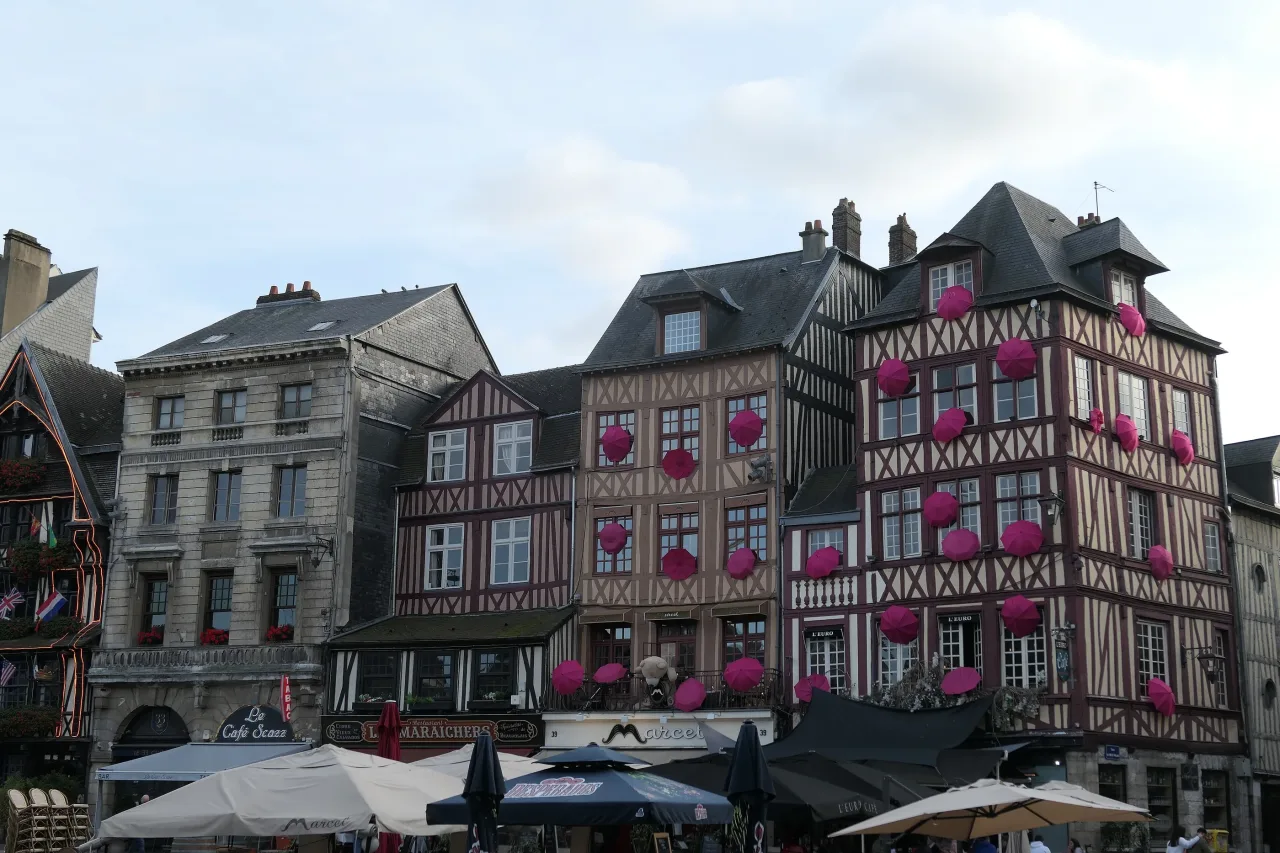
The market and the restaurants unsettle some pilgrims. Executions were held in market places because that is where the people were, and the square is still doing what it did.
About ninety minutes, early afternoon
This is the exact place and almost nothing you can see was here. She was brought to this square on May 30, 1431, having been handed to secular authority, and asked for a cross to be held before her. Her remains were destroyed so that nothing could be gathered and venerated, which is why she has no tomb and why no authenticated bodily relic of hers is generally accepted as surviving anywhere.
Whose life this is Saint Joan of Arc
Priority: The archaeological enclosure first, then the memorial cross, then the glass inside the modern church.
If you are here at the end of May, the commemoration of her feast on May 30 is kept in this city and is the right day to be in it.
About ninety minutes, late afternoon
Finish where the Church in this city now honors her. The cathedral was not a site of the interrogation and it is not a memorial to the trial, which is exactly why it works as an ending: a diocese that has carried the memory of a nullified sentence and a canonized saint in the same streets for a century, in a building that is one of the great Gothic churches of France on its own account.
Priority: The west front from the parvis, then the ambulatory and the crypt. Say the prayer here that the square makes you want to say.
Geography
Numbered markers follow the day's order. Optional stops appear hollow.
When plans bend
Trains from Paris Saint-Lazare take about an hour and a half. If you come and go in a day you will lose the Donjon and probably Saint-Ouen. Rouen is worth the night, and the square is a different place before the market fills it.
The Vieux-Marché and the cathedral, in that order, and walk between them rather than taking a tram. Those two hold the death and the vindication between them, which is the minimum honest version of this day.
Joan's feast is kept in the city and by the Archdiocese of Rouen, and it falls on the anniversary of her death. Confirm the program with the archdiocese. It is the one day of the year when the square is not primarily a market.
Read a selection of the 1431 interrogation before you come rather than after. Her answers under questioning are the reason any of this geography matters, and no plaque in Rouen will give them to you.
My Journey
Donjon, archiepiscopal precinct, Saint-Ouen, the Vieux-Marché and the cathedral, which is the order the process took.
You choose the journey it joins before anything is saved.
Editorial responsibility
Researched and editorially reviewed from official Church, shrine, transport, and other reliable sources. Confirm current practical details with the official sources before travel.
The account of the trial follows the 1431 record and the 1455 to 1456 nullification proceedings, with the Catholic reading taken from Benedict XVI's General Audience of January 26, 2011, including his treatment of Joan's appeal to the Pope. Site authenticity, in particular the distinction between the surviving Donjon and the lost prison tower, follows the French heritage record and the City of Rouen. Current observance is described from the Archdiocese of Rouen.
Opening hours, Mass times and access change; each place page above carries its current sources. How Eternal Roam researches and reviews its guides is described in our editorial standards.
Use this for corrections, broken links, missing places, and planning ideas.