
Guide · Orléans

Joan of Arc in Orléans

Orléans is the one place on Joan's road where what happened has never stopped being commemorated, and where the Church is still inside the observance rather than beside it.

  • 1 day
  • Four places in a compact old center, all within twenty minutes on foot of each other
  • Reviewed September 2026

The argument

The shape of these days

Orléans is usually told as a battle. It is better told as a thanksgiving. Joan entered the city on April 29, 1429, the siege was lifted on May 8, and what the city chose to repeat every year afterwards was not the assault but the Te Deum. A pilgrimage day here should follow that choice, which also keeps the page from becoming a festival program.

What this guide leaves out, on purpose

  • Hôtel Groslot. A handsome Renaissance building often shown to visitors on Joan itineraries. It postdates her by more than a century and has no place in her life. It is left out deliberately rather than by oversight.
  • The full siege perimeter. The bastilles and the Tourelles are largely under the modern city and the river. Walking the perimeter is a military-history exercise, and this is a pilgrimage day.
  • The Fêtes program in detail. The city and the diocese publish the annual program, which changes. This guide points at the liturgy and does not mirror a schedule that will be out of date.

Day 1

The thanksgiving, not the battle

Take the cathedral for the public memory and the Marian church for the older one, in that order.

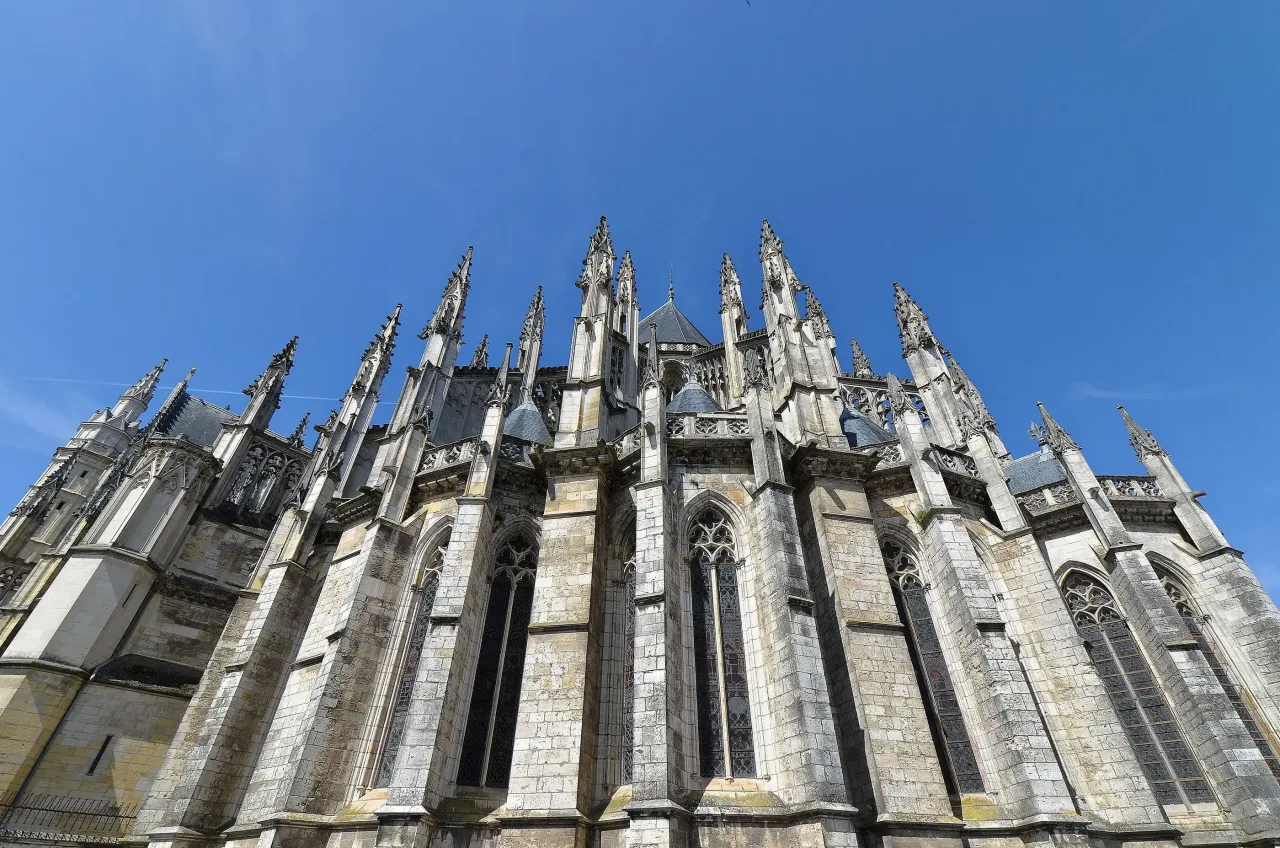
  • Spend ten minutes outside at the chevet before you go in. It is the only substantial fabric here with a claim on 1429.
  • About three kilometers on foot across the day, all of it flat and in the old center.
  • See this day on the map
  1. If you are here in the first week of May, check the diocesan program before you plan the morning; the cathedral is given over to liturgy and ceremony.

  2. In passing · Arrive by about 10:00

    Arriving from Paris

    Trains from Paris Austerlitz reach Orléans in a little over an hour, and the cathedral is fifteen minutes from the station on foot. Nothing in this day needs a car.

  3. Almost nothing else you can see was standing in 1429. Huguenot forces destroyed the church in 1568 and rebuilding ran into the nineteenth century.

  4. About ninety minutes, from mid-morning

    Cathédrale Sainte-Croix d'Orléans

    Start with the public memory. Joan entered the city on April 29, 1429 and the siege broke on May 8, and what Orléans has repeated almost every year since is the thanksgiving rather than the fighting. The Mass and procession that carry the religious part of the Johannine days still happen in this building, which makes it the only place on the whole route where the event is annually and liturgically alive.

    Whose life this is Saint Joan of Arc

    Give your time to The chevet from outside first, then the nineteenth-century Joan windows in the nave aisles. Read them as a city's memory rather than as evidence.

  5. The present building is a twentieth-century rebuilding after the bombardment of 1940. We do not claim Joan entered this fabric, only that this devotion is the one she and the city shared.

  6. Half an hour, early afternoon

    Église Notre-Dame-des-Miracles, Orléans

    Then the older memory. Orléans prayed to Our Lady under this title before the siege, during it and after it, and attributed its deliverance to her as much as to any soldier. Joan's own piety was strongly Marian. Half an hour here restores the proportion that a morning among ceremonial windows can distort.

    Give your time to The venerated image, and the visible join between the medieval belfry and the rebuilt body of the church.

  7. Say that plainly to yourself on the way in and the visit becomes useful rather than disappointing.

  8. In passing · Forty minutes, mid-afternoon

    Maison Jeanne d'Arc

    A reconstruction on the site of the house where Joan lodged during the siege, rebuilt after wartime destruction and now a museum and research center. It is worth an hour as interpretation, and it is not the medieval house.

  9. Finish on the water rather than in another interior. The day has had enough interiors.

  10. Pause · Late afternoon

    The Loire, and where the bridge was

    The Tourelles stood at the bridgehead on the south bank and the fighting of May 7 turned there. The medieval bridge is gone and the ground has moved, so this is a place to stand and read rather than a monument to visit.

When plans bend

Adapting these days

During the Johannine celebrations

The first week of May is the reason to come and the hardest time to come. The program is published each year by the city and the diocese, and the two are not the same document. If you must choose, choose the Mass and the procession over the parade. Book accommodation months ahead, and expect the cathedral to be closed to general visiting for long stretches.

As a day from Paris

Trains from Paris Austerlitz take a little over an hour, which makes this comfortable as a long day trip. Leave early enough to be at the cathedral by mid-morning and you will still have the Loire at the end of the afternoon.

If you only have three hours

The cathedral and Notre-Dame-des-Miracles, in that order, and skip the rest. Those two hold the argument of the day between them, and the walk between them is ten minutes.

Adding this to the full route

Orléans sits between Vaucouleurs and Reims in chronology but not in geography, and the efficient traveling order puts it after the Meuse valley and before Reims. Give it a full day rather than a morning.

My Journey

Make these days your own

Cathedral first for the public memory, then Notre-Dame-des-Miracles for the older Marian one, and finish at the river.

  • 2 places across 1 days, each in the day and order the guide gives it
  • The days arrive already built; reorder them, move a place, or drop one whenever you like
  • Works without an account, in this browser

You choose the journey it joins before anything is saved.

Editorial responsibility

How this guide was prepared

Prepared by
Eternal Roam Editorial
Responsible editor
Luke Gordon, Eternal Roam
Last reviewed
September 2026
Verification
Desk researched

Researched and editorially reviewed from official Church, shrine, transport, and other reliable sources. Confirm current practical details with the official sources before travel.

Chronology follows the 1431 trial record and the 1455 to 1456 nullification testimony; the Catholic reading follows Benedict XVI's General Audience of January 26, 2011. Current observance is described from the Diocese of Orléans and Orléans Métropole. The annual observance schedule changes from year to year; confirm it with the diocese before travel.

Opening hours, Mass times and access change; each place page above carries its current sources. How Eternal Roam researches and reviews its guides is described in our editorial standards.

Photo credits
  1. Guide hero: Joan of Arc in Orléans. Orléans (Loiret) - Cathédrale Sainte-Croix - Chevet. Photo: Patrick, CC BY-SA 2.0, via Wikimedia Commons. Source. CC BY-SA 2.0.
  2. Day 1, photo 1: The nave was rebuilt from the end of the sixteenth century onward. The Joan windows in the aisles are of the nineteenth. Orléans (Loiret) - Cathédrale Sainte-Croix - Nef. Photo: Patrick, CC BY-SA 2.0, via Wikimedia Commons. Source. CC BY-SA 2.0.
  3. Day 1, photo 2: Medieval belfry at the left, twentieth-century rebuilding at the right. The join is visible from the street. Photo: Peter17, CC BY-SA 4.0, via Wikimedia Commons. Source. CC BY-SA 4.0.