
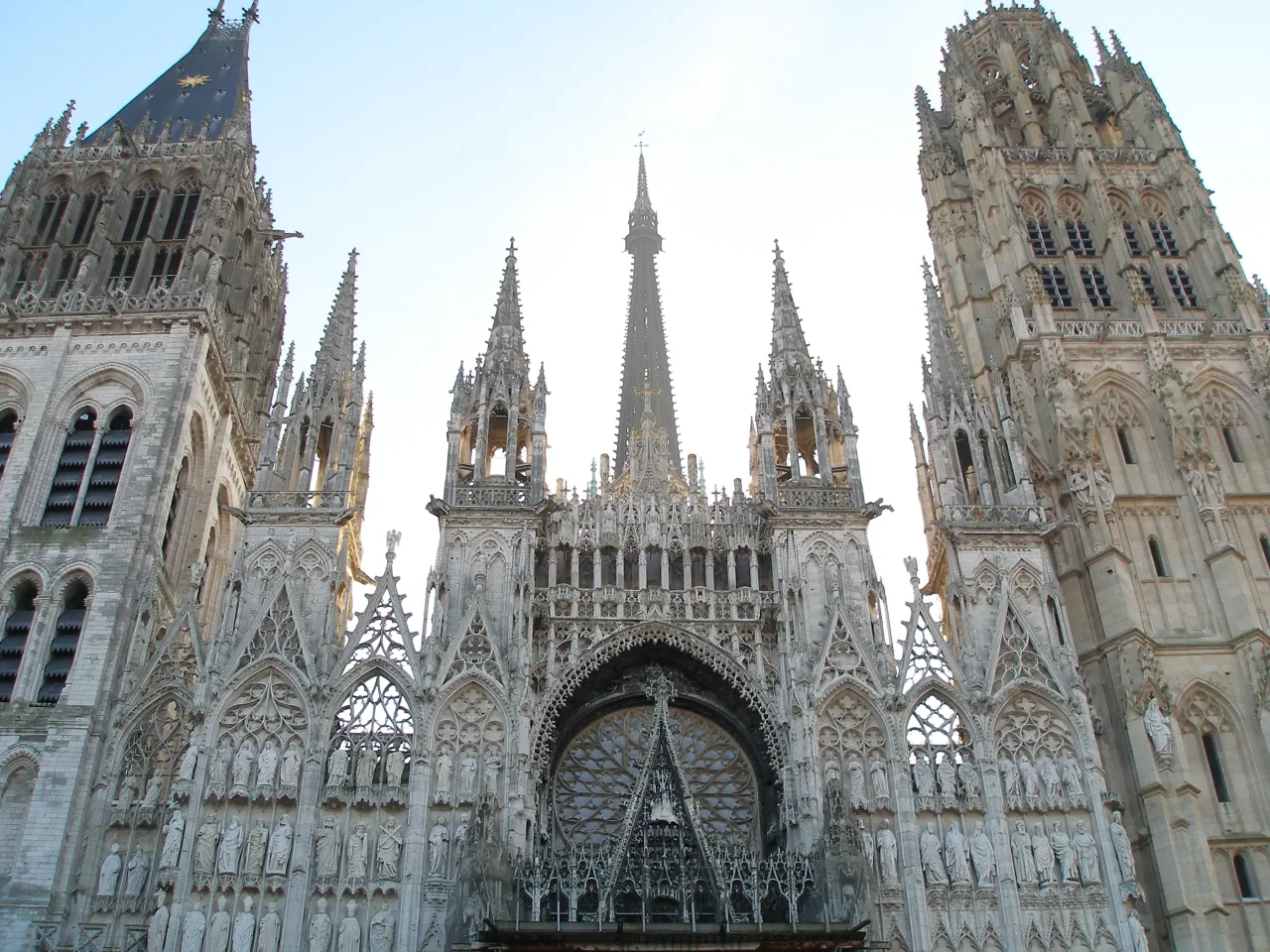
Cathédrale Notre-Dame de Rouen
The metropolitan cathedral of Rouen, built and rebuilt across four centuries and restored after heavy war damage. It was not the site of Joan's interrogation or her execution, but it is where the Church in Rouen commemorates her now, and it is one of the major Gothic churches of France in its own right.
- Location
- Rouen, France 49.4401° N · 1.0948° E
- Type
- Cathedral Gothic across many campaigns, from the early thirteenth century through the flamboyant west front of the fifteenth and sixteenth centuries, with a nineteenth-century cast-iron spire and extensive restoration after severe damage in the Second World War
- Dedication
- Our Lady
The Cathedral of the City That Tried Her
Rouen is a city with an uncomfortable Catholic memory, and the cathedral is where that memory is now held liturgically.
It is also, independently, a building worth a day: a west front so intricate that Monet spent two winters painting nothing else, two towers that refuse to match, and a crypt older than almost anything above it. A Joan pilgrim who treats this as a footnote to the Vieux-Marché will miss the more interesting thing, which is a local church commemorating a saint its own predecessors condemned.
What Happened Here, and What Did Not
It is worth being exact. Joan was held in the castle, and much of the questioning in 1431 took place there. The remains of the Officialité room in the archiepiscopal precinct are associated with the pronouncement of the condemnation and with the proceedings of 1456. The execution was in the Vieux-Marché. The cathedral was the archbishop's church in a diocese whose see was then vacant, and the trial proceeded under Pierre Cauchon, Bishop of Beauvais, sitting on borrowed territory. What the cathedral holds today is the commemoration: Joan is honored here on May 30, and the Archdiocese of Rouen has for a century carried the memory of a nullified sentence and a canonized saint in the same city. Fidelity to the Church does not require disguising the injustice of 1431, and the Church in Rouen does not attempt it.
A cathedral of many campaigns. The nave and choir are thirteenth century, the west front is flamboyant work of the fifteenth and sixteenth centuries, the Tour Saint-Romain and the Tour de Beurre are centuries apart in date and unmatched in design, and the central spire is a nineteenth-century cast-iron replacement. The building was hit repeatedly in the Second World War and much of what stands has been restored.
Spiritual Significance
Large, cold, and much visited, but the ambulatory chapels are quiet at almost any hour and the crypt is quieter still. Come in the morning. For a pilgrim following Joan, this is the place in Rouen to say the prayer that the Vieux-Marché makes you want to say and does not quite give you room for.
Do Not Miss
-
The west front
Flamboyant work of the fifteenth and sixteenth centuries, and the subject of more than thirty paintings by Monet.
-
The two unmatched towers
The Tour Saint-Romain and the Tour de Beurre were built centuries apart and were never meant to agree.
-
The crypt
The remains of the eleventh-century church beneath the choir, and the oldest fabric on the site.
-
The heart of Richard the Lionheart
In the ambulatory, a reminder that this cathedral's history is far longer than its Johannine connection.
-
What did not happen here
The 1431 questioning was largely in the castle and the condemnation was pronounced in the archiepiscopal precinct. The cathedral's Joan connection is the commemoration kept here now.
How to Visit
Give the west front twenty minutes from the parvis, then go in and walk to the ambulatory before anything else. The Vieux-Marché is about ten minutes west, and the archiepiscopal precinct with the Historial Jeanne d'Arc is immediately beside the cathedral.
- Daily Mass and the cathedral office
- Metropolitan liturgies of the archdiocese
- Commemoration of Saint Joan of Arc around her feast on May 30
- Confession and adoration in the ordinary cathedral pattern
An open metropolitan cathedral in the center of Rouen.
- Address
- Place de la Cathédrale, 76000 Rouen
- Archdiocese
- Archdiocese of Rouen
- Joan relationship
- Current Catholic commemoration, not a site of the 1431 proceedings
- Time needed
- About ninety minutes
- Before you go
- Confirm hours and Mass times with the archdiocese. Access is restricted during major liturgies
Visiting
- A summer projection program is run on the west front in the evenings and changes how the parvis works after dark.
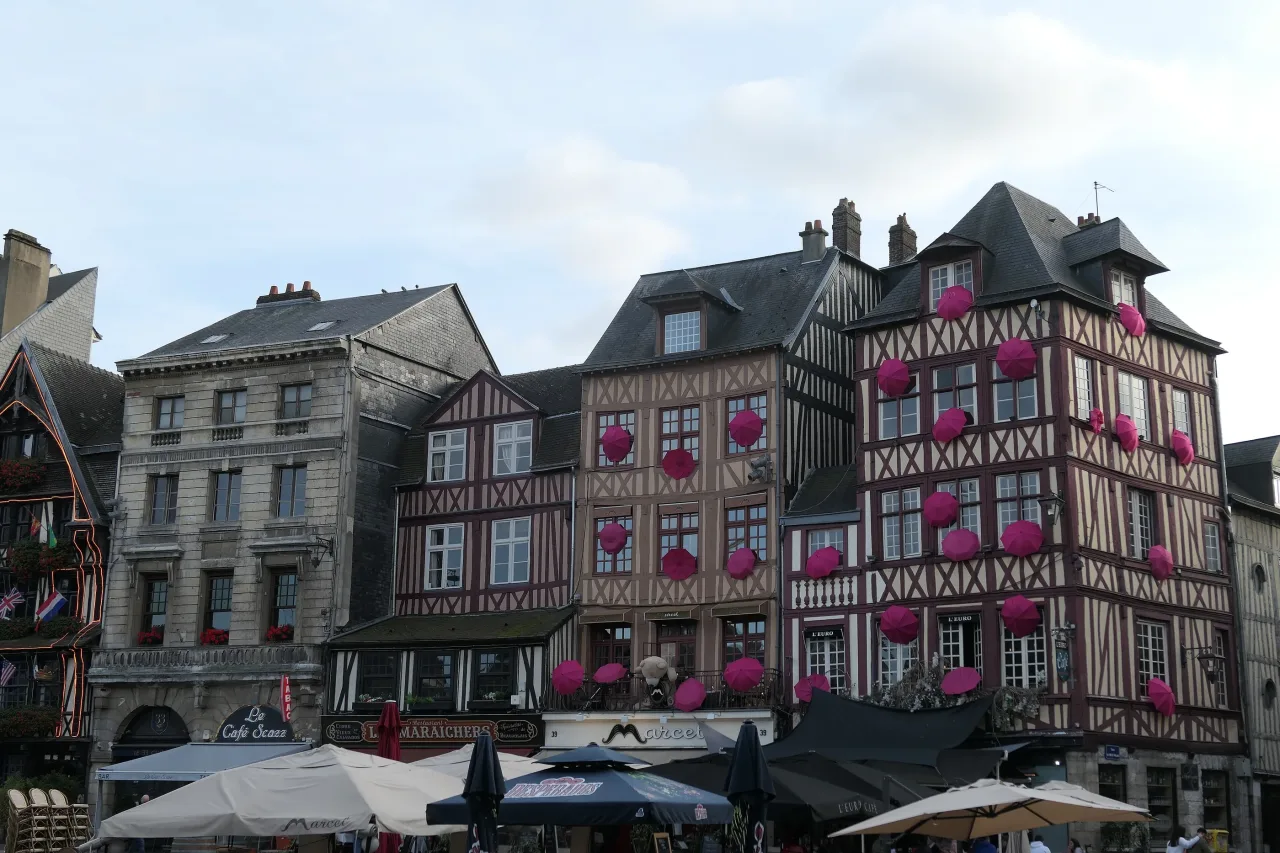
- The Place du Vieux-Marché is about ten minutes west on foot.
Relics, Tombs, Sacred Objects
Tomb and Burial
- Archbishops and dukes of Normandy are buried here. Joan of Arc is not; she has no tomb anywhere.
Relics and Sacred Tradition
- The cathedral holds no relic of Joan of Arc. It preserves the tomb containing the heart of Richard I and the tombs of the dukes of Normandy, which belong to a much older layer of the building's history.
Sacred Objects
- The flamboyant west front, painted repeatedly by Monet.
- The Tour de Beurre and the Tour Saint-Romain, which do not match and were built centuries apart.
- The tomb of the heart of Richard the Lionheart, in the ambulatory.
- The crypt of the eleventh-century church beneath the choir.
The rest of the Rouen geography
Map
The cathedral matters to a Joan pilgrimage for what happens in it now rather than for what happened in it in 1431. The interrogation sessions took place largely in the castle, and the condemnation was pronounced in the archiepiscopal precinct rather than in the cathedral itself.
September 2, 2026
Photo credits
- Hero. Facade de la Cathédrale de Rouen au matin. Photo: Rouennais, CC BY-SA 3.0, via Wikimedia Commons. Source. CC BY-SA 3.0.