
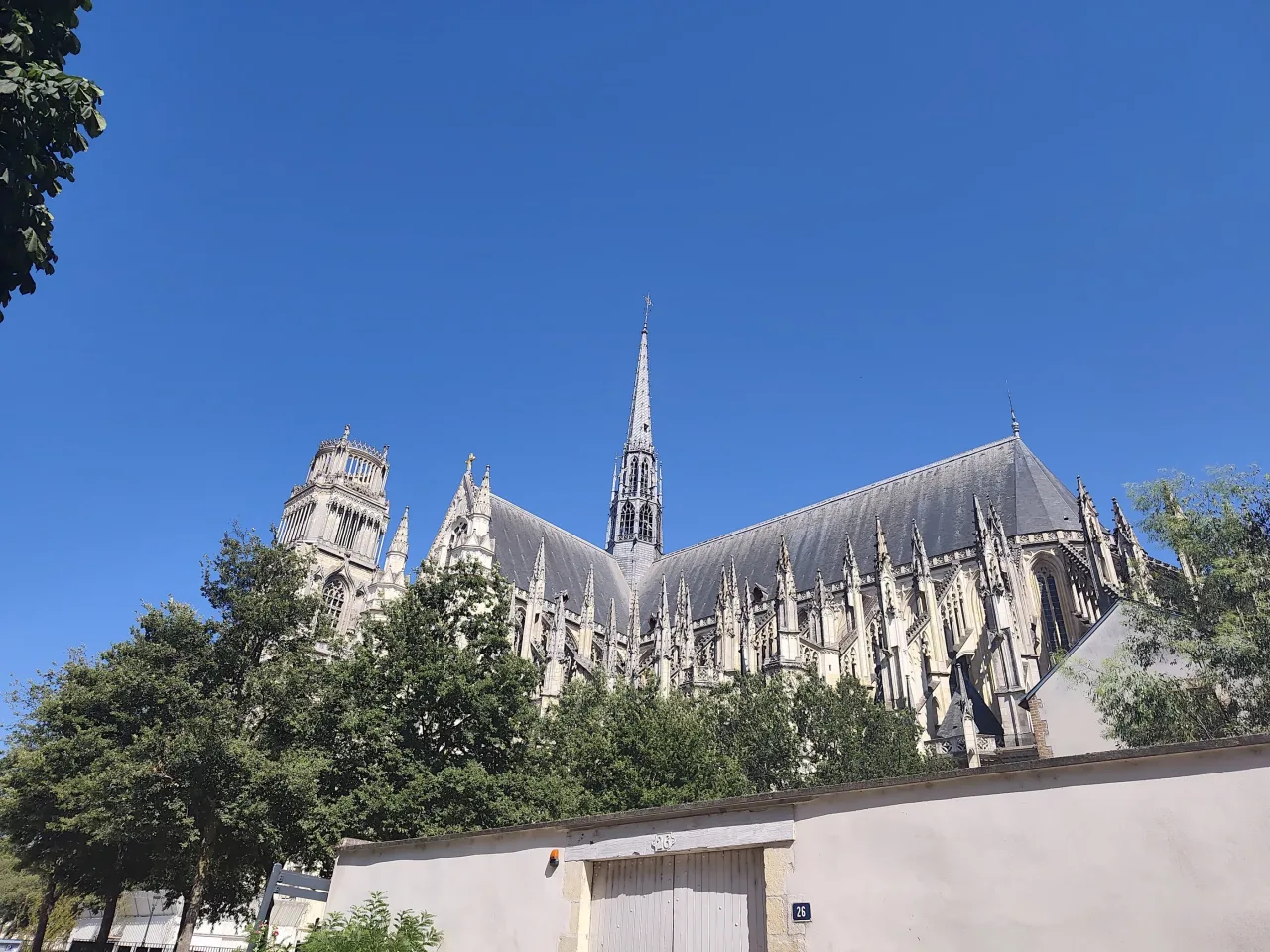
Cathédrale Sainte-Croix d'Orléans
Sainte-Croix is the cathedral of Orléans and the Catholic center of the city's memory of Joan of Arc. She entered the city on April 29, 1429 and the siege was lifted on May 8. Those dates are still kept here every year with Mass and procession. Most of the building was raised after 1568 and is not what she saw.
- Location
- Orléans, France 47.9019° N · 1.9104° E
- Type
- Cathedral A thirteenth-century Gothic chevet surviving from the medieval church, with nave, transepts and west front rebuilt in Gothic style from the end of the sixteenth century through to the nineteenth
- Dedication
- The Holy Cross
A City That Still Keeps the Date
Orléans is the one place in the Joan geography where what happened has never stopped being commemorated.
The city has marked the lifting of the siege almost every year since the fifteenth century, through revolutions and wars and the long secularisation of French public life, and the Church is still inside that observance rather than beside it. Come to the cathedral to see a liberation turned into a liturgy. That is a different and better thing than a battlefield.
Twenty-Nine April to Eight May, 1429
Orléans had been under siege since the previous October and its fall would have opened the Loire. Joan entered the city on April 29, 1429 with a relief convoy. Over the following days the bastilles ringing the city were taken one by one, and on May 8 the English lifted the siege and withdrew. Joan was seventeen, had been examined by theologians at Poitiers before she was trusted with any of it, and was wounded during the fighting. What she did immediately afterwards is the part that matters for a cathedral record: she went to church. The thanksgiving, not the assault, is what Orléans chose to remember, and the annual observance that grew out of it has been kept ever since. The cathedral she entered was largely destroyed by Huguenot forces in 1568. Rebuilding in Gothic style began under Henry IV and continued into the nineteenth century, which is why the church now standing is a seventeenth to nineteenth-century building wearing medieval clothes, with a thirteenth-century chevet at its east end.
A long Gothic cathedral whose west front and towers are eighteenth-century Gothic revival, whose nave and transepts were rebuilt from the end of the sixteenth century onward, and whose chevet is genuinely thirteenth-century work. The Joan of Arc windows in the nave aisles are a nineteenth-century cycle.
Spiritual Significance
Outside the first week of May the cathedral is a working diocesan church and quiet with it. In early May it becomes the center of a city. The Johannine celebrations combine civic ceremony with Catholic liturgy, and the Mass and procession that mark May 8 are the part a pilgrim should aim for. Come for the liturgy rather than the parade if you have to choose.
Do Not Miss
-
The chevet
Thirteenth-century work and the part of the church with the strongest claim on what Joan entered in 1429.
-
The Joan windows
A nineteenth-century cycle of her life in the nave aisles, from Domrémy to Rouen. Devotional art, not documentary evidence.
-
The eighth of May
The lifting of the siege has been marked here almost every year since the fifteenth century, and the Mass and procession are still the heart of it.
-
What is not medieval
The nave, transepts and west front were rebuilt after Huguenot forces destroyed the church in 1568. Knowing that changes what you look at.
-
La Pucelle
The great bell of the cathedral carries her name and rings for the Johannine days.
How to Visit
Give the chevet ten minutes from outside before going in, since it is the only substantial fabric with a claim on 1429. Then walk the nave aisles for the windows. The Maison Jeanne d'Arc, a reconstruction on the site of the house where she lodged, is a short walk away and is honest about being a reconstruction.
- Daily Mass and the cathedral office
- The Johannine celebrations at the beginning of May, including the Mass and procession that mark the lifting of the siege on May 8
- Confession and adoration in the ordinary cathedral pattern
- Episcopal liturgies of the diocese
An open working cathedral, at its fullest in the first week of May.
- Address
- Place Sainte-Croix, 45000 Orléans
- Diocese
- Diocese of Orléans
- Johannine days
- The celebrations fall around April 29 to May 8 each year
- Time needed
- About an hour, longer during the Johannine days
- Before you go
- Confirm Mass and procession times with the diocese. Access is restricted during major liturgies
Visiting
- During the Johannine days at the start of May the building is given over to liturgy and ceremony and general visiting is limited.
- The Maison Jeanne d'Arc, a reconstruction on the site of the house where she lodged, is a short walk from the cathedral.
Relics, Tombs, Sacred Objects
Tomb and Burial
- Bishops of Orléans are buried in the cathedral. Joan of Arc is not; she has no tomb anywhere.
Relics and Sacred Tradition
- The cathedral holds no bodily relic of Joan of Arc. No authenticated first-class relic of hers is generally accepted as surviving, and nothing shown in Orléans should be understood as one.
Sacred Objects
- The Joan of Arc windows in the nave aisles, a nineteenth-century cycle of her life from Domrémy to Rouen.
- The thirteenth-century chevet, the oldest surviving part of the church.
- The bell known as La Pucelle.
The rest of the Joan geography

Map
The cathedral of Orléans is dedicated to the Holy Cross, not to Joan of Arc. Most of what stands was rebuilt after the Huguenot destruction of 1568, so a pilgrim looking for the church Joan entered in 1429 will find the chevet and little else. The Joan windows in the nave aisles are nineteenth-century. The current Johannine observance in the city is genuinely both civic and Catholic.
September 2, 2026
Photo credits
- Hero. Cathédrale Sainte-Croix d'Orléans (28132). Photo: U4you, CC BY-SA 3.0, via Wikimedia Commons. Source. CC BY-SA 3.0.
- A Gothic Nave of the Seventeenth Century Onward. Orléans (Loiret) - Cathédrale Sainte-Croix - Nef. Photo: Patrick, CC BY-SA 2.0, via Wikimedia Commons. Source. CC BY-SA 2.0.
- The Oldest Thing Standing. Orléans (Loiret) - Cathédrale Sainte-Croix - Chevet. Photo: Patrick, CC BY-SA 2.0, via Wikimedia Commons. Source. CC BY-SA 2.0.