
Dunfermline Abbey and Saint Margaret's Shrine
Margaret founded a church at Dunfermline around 1070, was buried in it in 1093, and was venerated here for three centuries. The nave her son built still stands, and so does the base of the shrine that held her, out in the open air behind the east wall.
- Location
- Dunfermline, Scotland 56.0714° N · 3.4615° W
- Type
- Abbey
- Dedication
- The Holy Trinity
The queen's church and the shrine that outlasted her relics
Dunfermline is where Margaret's life, death, and veneration all happened, and it is the only place a pilgrim can stand on the actual footprint of Scotland's medieval royal shrine.
It also asks for honesty. The abbey is Presbyterian now, the shrine was stripped at the Reformation, and the relics that made it a destination are gone or unidentified. What remains is more particular than a reliquary: the Romanesque nave her son raised over her foundation, the marked stone base where pilgrims once knelt, and a Catholic parish a few minutes' walk away that still keeps a relic venerated as hers. Read together, they show what happened to Scottish Catholic devotion rather than concealing it.
A queen's foundation, a national shrine, and what the Reformation left
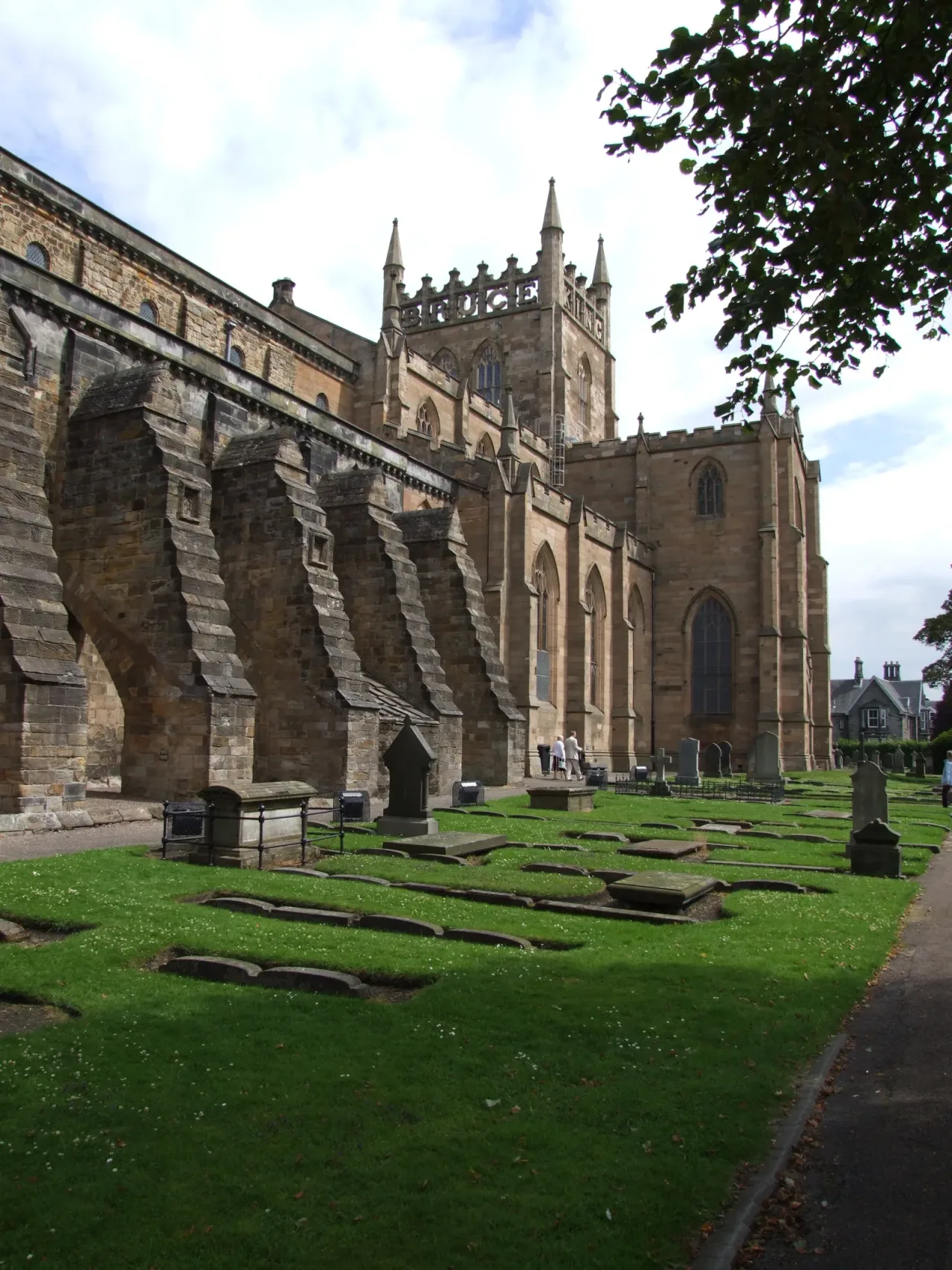
Margaret was an Anglo-Saxon princess who came to Scotland after the Norman conquest and married Malcolm III. Around 1070 she founded a church at Dunfermline, and her support for worship, her care for the poor, and her work to reform Scottish practice shaped the royal center that grew around it. She died in 1093 and was buried here. Her son, who ruled as David I, raised the house to abbey status in 1128, brought its first abbot from Christ Church, Canterbury, and built the Romanesque nave that still stands. After her canonization, on June 19, 1250 her remains were taken up and placed in a reliquary at a shrine east of the high altar, where they drew Scottish pilgrims until the Reformation. Monastic life ended in 1560. The nave survived because the parish kept using it, and the choir did not: the present parish church, designed by William Burn and opened for worship in 1821, stands on the site of the medieval chancel and transepts. A skeleton identified as Robert the Bruce was found on the site in 1818, during the work that cleared the ground for it, and was reburied beneath the new church.
The nave is the reason to come. It is David I's twelfth-century Romanesque work, with heavy carved cylindrical piers, and it reads as a complete medieval interior. Attached to its east end is a wholly different building: William Burn's parish church, opened in 1821, whose tower carries the words KING ROBERT THE BRUCE cut into the stone parapet. Beyond that church, in the roofless ruins of the Lady Chapel at the far east end, is the stone base of Saint Margaret's shrine, open to the sky. Around the complex lie the monastic ranges and the remains of the royal palace rebuilt for James VI, in the care of Historic Environment Scotland.
Spiritual Significance
The abbey church belongs to the Church of Scotland and holds regular worship; the medieval remains and the shrine base are a heritage site. Catholic pilgrims come as guests to both. The shrine base is not an altar and is not enclosed, so pray there quietly and without setting anything on it. For Mass and for veneration of a relic, the Catholic Memorial Church of Saint Margaret on East Port is the place to go.
Do Not Miss
-
The base of Saint Margaret's shrine
In the roofless Lady Chapel ruins at the far east end, open to the sky. Medieval Scotland came here on pilgrimage; the stone base is what the Reformation left of it.
-
The Romanesque nave
Built by Margaret's son David I over the church she founded. Its heavy carved cylindrical piers carry a complete medieval interior.
-
The tower parapet of Burn's church
KING ROBERT THE BRUCE is cut into the stone in letters large enough to read from the graveyard. A skeleton identified as his was found on the site in 1818 and reburied beneath the church.
-
The palace and monastic ranges
The monastic ranges and the royal palace rebuilt for James VI show how much of Dunfermline's life was arranged around the abbey.
- Where the medieval building stops and the nineteenth century starts. The nave is David I's; the church east of it opened in 1821.
- That the shrine base is outdoors and unroofed. The choir that once covered it is gone.
- How plain the shrine base is. Nothing about it announces what it held, which is part of what the Reformation was for.
- The carving on the nave piers, cut deep into the stone and largely undamaged.
Visit Plans
-
Margaret's church and shrine
3 ordered stopsThe nave her son built, and the shrine base out in the open behind the east wall.
- The Romanesque nave
- The 1818 parish church and the Bruce tower
- The base of Saint Margaret's shrine, outside the east wall
-
Saint Margaret at Dunfermline
5 ordered stopsThe abbey complex, then the two places in the town that carry Margaret's devotion today.
- The Romanesque nave
- The 1818 parish church and the Bruce tower
- The base of Saint Margaret's shrine, outside the east wall
- The monastic ranges and palace ruins
- The Catholic Memorial Church of Saint Margaret, East Port, if open
How to Visit
Hours and admission differ between the parish church and the Historic Environment Scotland areas. Check both custodians before traveling, and ask locally how the shrine base is currently reached. Two nearby places complete the visit and are not part of the abbey: Saint Margaret's Cave, traditionally identified as a place where she withdrew to pray, and the Catholic Memorial Church of Saint Margaret on East Port, which keeps a relic venerated as her shoulder bone. Both have their own opening arrangements, so confirm each before setting out.
Check both custodians before traveling to the shrine setting.
The active church and heritage areas can follow different schedules.
Abbey and heritage access
- Historic Environment Scotland currently lists the abbey nave as open and the palace ruins as closed for conservation. The active abbey church has its own visiting and worship schedule.
- Heritage admission and booking can change.
- Historic surfaces and level changes remain; consult the current access guide.
Connected Saints
Scotland's eastern shrine road
Map
Margaret's burial here in 1093 and the 1250 translation of her relics to a shrine east of the high altar are documented. What survives on the site is the stone base of that shrine. Her relics were dispersed after the Reformation and have never been securely traced since, and the relic kept at the Catholic Memorial Church is venerated as hers rather than authenticated.
August 14, 2026