
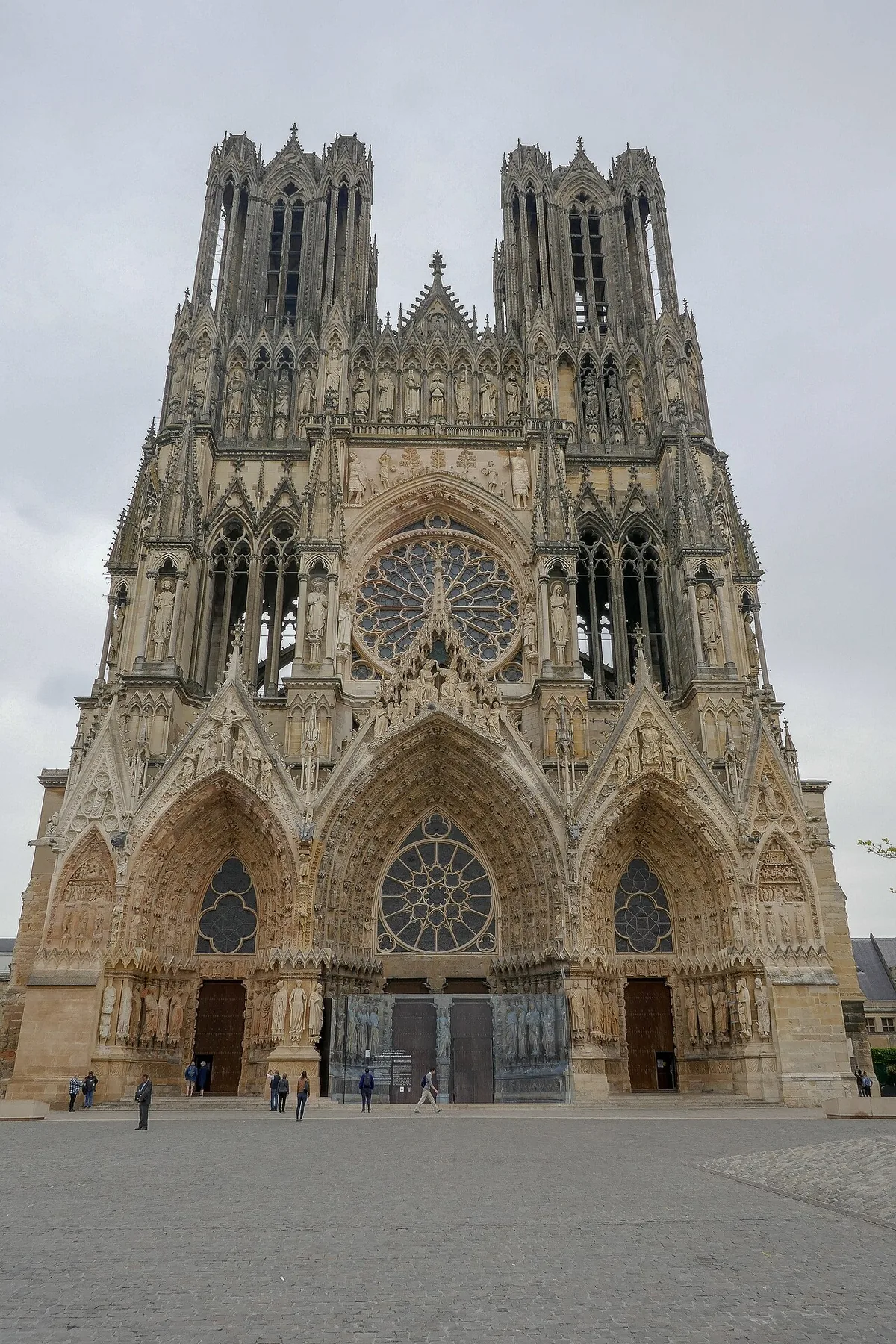
Cathédrale Notre-Dame de Reims
Reims is where the kings of France were crowned, and one of the supreme achievements of Gothic architecture and sculpture. Charles VII was crowned here on July 17, 1429, ten weeks after the siege of Orléans was lifted, with Joan of Arc present. The cathedral is far larger than that single day.
- Location
- Reims, France 49.2539° N · 4.0342° E
- Type
- Cathedral High Gothic of the thirteenth century, with a west front of three deep portals, a gallery of kings and one of the great sculptural programs of medieval Europe, restored after severe damage in the First World War
- Dedication
- Our Lady
The Coronation Church of France
Reims would be one of the two or three churches in France worth crossing a country for even if Joan of Arc had never existed.
The west front carries a sculptural program that changed European art, the interior is a single clear thirteenth-century thought held for a hundred and fifty meters, and the building has been the setting for the making of kings since the early Middle Ages. Come for the cathedral. The coronation of 1429 is then something that happened inside it rather than the reason it exists.
Seventeen July 1429
Joan had told the Dauphin's court, and the theologians who examined her at Poitiers, that her mission had two parts: to relieve Orléans and to bring Charles to Reims for his consecration. The first was accomplished on May 8. The march north through hostile territory that summer was the second, and on July 17, 1429 Charles VII was crowned and anointed in this cathedral. Joan was present, and stood near him with her banner. What made the day matter was not military. A French king was not fully a king until he had been anointed at Reims with the chrism kept here, and Joan had insisted on the sacramental act rather than the strategic one. Everything after this point in her life is decline: the failed attack on Paris in September, capture near Compiègne in May 1430, and Rouen. The coronation is the top of the arc, and it happened in this room.
High Gothic of the thirteenth century. The west front carries three deep portals, a rose set within the wall above them and a gallery of kings across the top; the sculpture inside the portals includes the Annunciation and Visitation groups and the smiling angel that has become the emblem of the city. German artillery set the cathedral on fire in 1914 and the damage was immense. The long restoration that followed is why some of what stands is replacement work, and the axial chapel now holds windows by Chagall.
Spiritual Significance
The cathedral holds its scale without coldness, which is rare. It is a working metropolitan church with daily Mass, and the best hour to be in it is early, before the coaches, when the light is still coming through the west rose. Pilgrims following Joan should resist arriving as if this were a Joan monument. Stand in the nave first and let it be a cathedral.
Do Not Miss
-
The west front
Three deep portals, a gallery of kings and a sculptural program that changed European art. Give it time from the parvis before going in.
-
The smiling angel
On the north portal of the west front, and the emblem of the city. It was shattered in 1914 and reassembled.
-
The nave
A hundred and fifty meters of a single thirteenth-century idea, held without wavering.
-
The Chagall windows
In the axial chapel, of the twentieth century, and a reminder that this cathedral has kept commissioning rather than only conserving.
-
The coronation, correctly dated
Charles VII was crowned here on July 17, 1429 with Joan present. The statues of her in and around the cathedral are nineteenth-century memorials.
How to Visit
Take the west front from the parvis before entering, and give it real time. Inside, walk the length once without stopping and then come back. The Palais du Tau stands beside the cathedral and holds much of the coronation material; check its current visitor status before counting on it.
- Daily Mass and the cathedral office
- Metropolitan liturgies of the archdiocese
- Confession and adoration in the ordinary cathedral pattern
- Pilgrim and diocesan groups received through the year
An open metropolitan cathedral in the center of Reims.
- Address
- Place du Cardinal Luçon, 51100 Reims
- Archdiocese
- Archdiocese of Reims
- Joan relationship
- The coronation of Charles VII on July 17, 1429, at which Joan was present
- Time needed
- Ninety minutes for the cathedral, longer with the Palais du Tau
- Before you go
- Confirm hours and Mass times, and the current visitor status of the Palais du Tau, before traveling
Visiting
- Access is restricted during major liturgies and during the summer sound and light program on the west front.
- Paris to Reims takes well under an hour by high-speed rail, which makes the cathedral feasible as a long day from the capital.
Relics, Tombs, Sacred Objects
Tomb and Burial
- Archbishops of Reims are buried in the cathedral. Joan of Arc is not buried here or anywhere; she has no tomb.
Relics and Sacred Tradition
- The cathedral holds no relic of Joan of Arc, and none is claimed. Its Marian and royal associations, and the memory of Saint Remigius who baptized Clovis at Reims, are the older devotional threads here.
Sacred Objects
- The sculpture of the west front, including the Annunciation and Visitation groups and the angel known as the smiling angel.
- The great west rose and the glazed triforium.
- The Chagall windows in the axial chapel, of the twentieth century.
- Nineteenth-century memorial statuary of Joan of Arc, which commemorates the coronation rather than dating from it.
The rest of the Joan geography
Map
The coronation of Charles VII on July 17, 1429 is one relationship among many and is described precisely rather than allowed to take the building over. The Joan statuary in and around the cathedral is nineteenth-century memorial work and is labeled as such. The cathedral was gravely damaged in the First World War and much of what a visitor sees has been restored.
September 2, 2026
Photo credits
- Hero. Photo: The Crazy Tourist, CC BY-SA 4.0, via Wikimedia Commons. Source. CC BY-SA 4.0.
- The Rose Above the Door. Cathédrale Notre-Dame de Reims 3. Photo: Odrade123, CC BY-SA 3.0, via Wikimedia Commons. Source. CC BY-SA 3.0.