
The reliquaries of Saints Louis and Zélie Martin
Relics of canonized saintsPublic veneration in the crypt
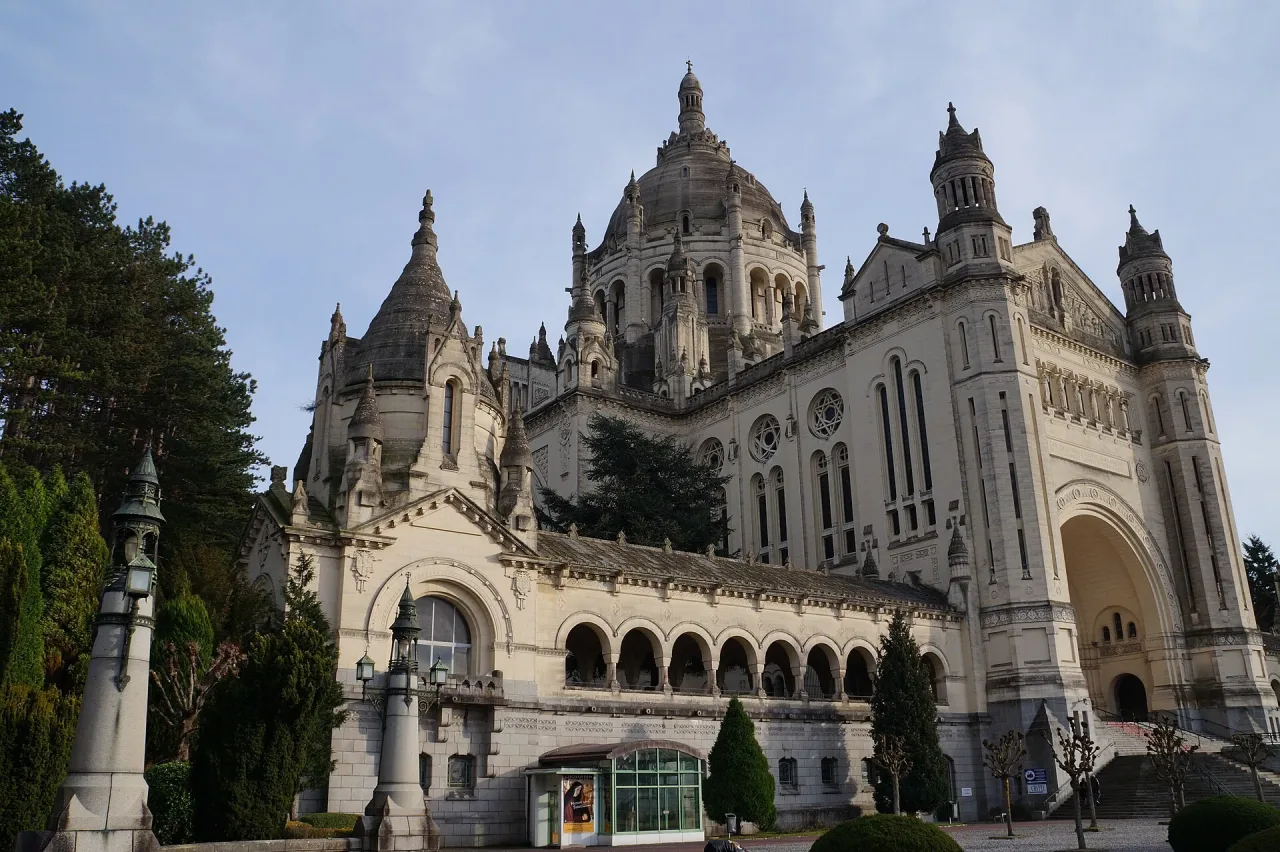
Sanctuary of LisieuxThe Basilica of Sainte-Thérèse was raised on the hill above Lisieux after her canonization in 1925: begun in 1929, blessed in 1937, consecrated in 1954, and one of the largest churches built anywhere in the twentieth century. Her parents' relics are venerated in the crypt.
Come here for what happened after Thérèse died, which is a real part of her story and not a lesser one. A Carmelite nun who left no public work and died at twenty-four was canonized twenty-eight years later, and within four more years a basilica for three thousand pilgrims was rising over her town. The building is the measure of that. Go down into the crypt as well, because the relics of her father and mother are there, and Lisieux is the only place where a whole household is venerated together.
Thérèse died in the Carmel on September 30, 1897 and was buried in the town cemetery. Story of a Soul went out the following year, and the devotion grew faster than anyone had planned for. She was beatified in 1923 and her relics were carried to the Carmel chapel; she was canonized on May 17, 1925. A basilica was proposed at once. Local clergy hesitated, Pope Pius XI did not, and the architect Louis-Marie Cordonnier was chosen after an earlier Paris design was judged inadequate. The foundation stone was laid on September 30, 1929. Cardinal Pacelli, soon to be Pius XII, blessed the building on July 11, 1937, and it was consecrated on July 11, 1954. The crypt was finished in marble and mosaic by 1958. In 2015 Louis and Zélie Martin were canonized together in Rome, and their relics rest in that crypt.
Romano-Byzantine, on a Latin cross plan with a dome at the crossing, a free-standing campanile, and a broad terrace of steps climbing to the west front. Cordonnier's brief was sightlines: three thousand people, no columns in the way.
The basilica is where Lisieux does things at scale, the feasts, the great pilgrimages, the crowded Sundays of the season. It is not where the intimacy of Thérèse is found; that is at the Carmel and at Les Buissonnets. Coming here first and the town afterwards gets the emotional order wrong, and most pilgrims do it anyway because the station is close.
Thérèse's parents were canonized together in 2015, the first married couple canonized together in modern times. Their reliquaries are venerated in the crypt, which makes this the one place where three saints of a single household are honored together.
Pierre Gaudin's work covers the walls and vaults. It is twentieth-century art made deliberately on medieval terms, and it is the reason the interior does not feel like a concert hall.
Four and a half thousand square meters, a hundred and four meters long, and a dome ninety meters above the floor, planned so that three thousand pilgrims could see the altar with nothing in the way.
Fifty-one bells, including a bourdon of nine tonnes. If you are in Lisieux when they ring, stop and listen rather than walking on.
Thérèse never saw this building. She died in 1897 and the foundation stone was laid in 1929, four years after her canonization. Her own life happened in the town below.
The visit almost everyone makes: the great nave, then down to the crypt and the relics of her parents.
The same visit with time for the mosaics and, when it is open, the lift to the dome gallery.
Ten minutes on foot from the station, uphill at the end. Take the terrace steps, give the nave a few minutes, then go down to the crypt. Leave the dome for a second visit unless the day is clear.
Visiting
Prayer and liturgy
Access
The dome gallery is reached by lift and opens daily through July and August in the early afternoon, with reduced and variable opening from September.
A wax diorama museum of Thérèse's life opens daily in July and August apart from Sunday mornings, with variable hours across the rest of the year.
Confessions are heard through the morning and afternoon from Monday to Saturday, and on Sunday morning.
The feast of Saint Thérèse falls on October 1, and the sanctuary keeps a season of celebrations around it. Expect crowds and a fuller liturgical schedule.
Public veneration in the crypt
Sanctuary of LisieuxPublic veneration
Sanctuary of LisieuxNot applicable
Sanctuary of LisieuxSource note Traditional attributions are presented as tradition, with documentation named where it exists.
Three saints of one family are honored in this building, and two of them are in the crypt.
Written from the Sanctuary of Lisieux, which administers the basilica, with the Wikimedia image provenance given in the credits. The basilica is dated and described as a building raised after Thérèse's canonization, so that no reader mistakes it for a place she knew.
August 5, 2026
Use this for corrections, broken links, missing places, and planning ideas.