
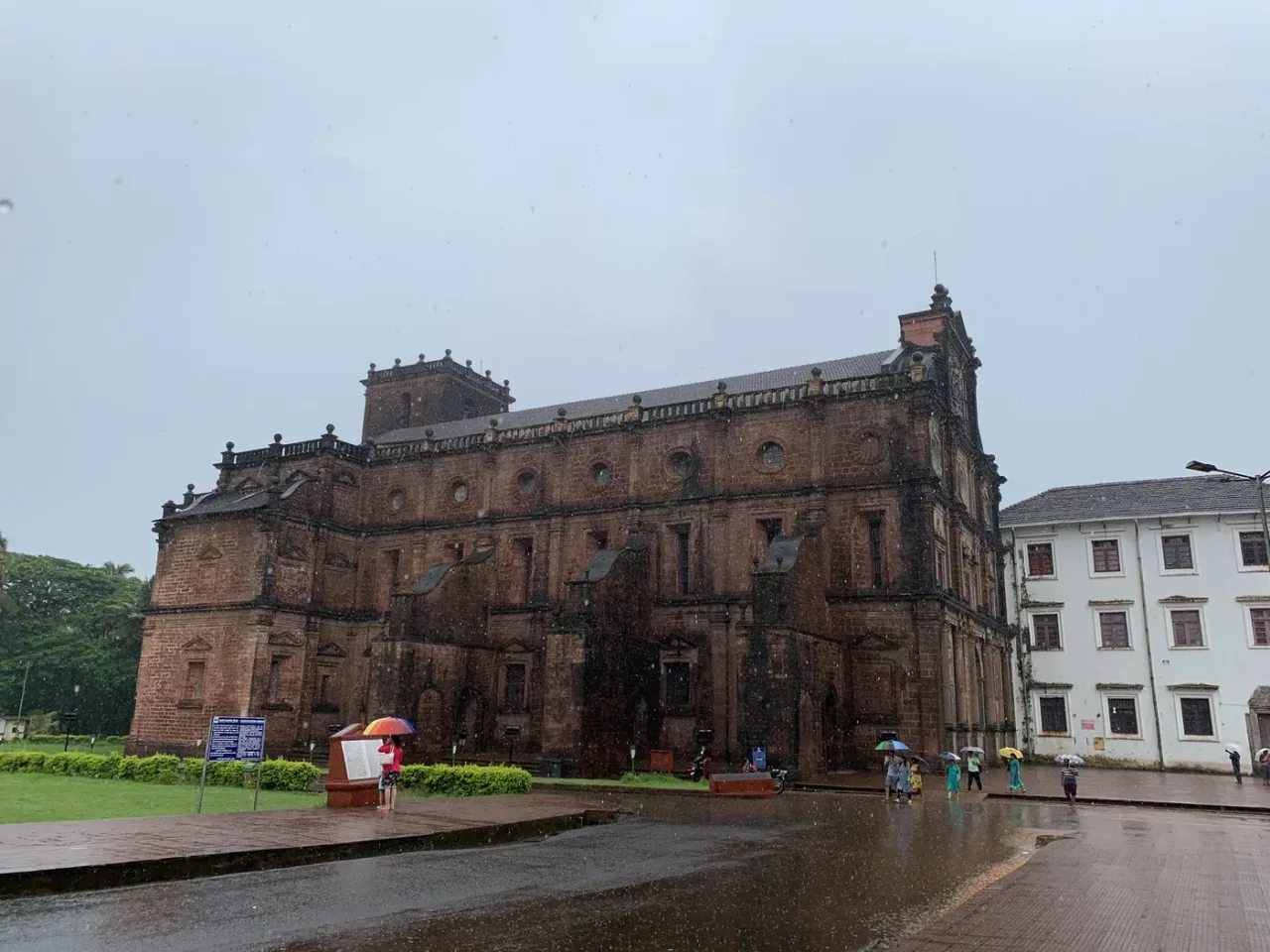
The body of Saint Francis Xavier
Saint's body
Archdiocese of Goa and Daman
The church at Old Goa where the sacred remains of Francis Xavier are venerated in a silver casket, raised on a marble monument in the chapel off the south transept. After his death on Shangchuan Island in 1552, his remains were brought to Goa through Malacca.
Francis Xavier spent ten years leaving. He sailed from Lisbon in 1541, reached Goa in 1542, and from then on kept moving east: the fishery coast, Malacca, the Moluccas, Japan in 1549, and finally a small island off the Chinese coast where he waited for permission to enter the mainland and did not get it. He died there in December 1552, still short of where he was going. Everything he began in Asia has a place attached to it somewhere else. This is the one place that holds him. His body was brought back along the route he had traveled outward, and it is here, in the city he had used as a base, that the movement stops.
Xavier died on Shangchuan Island on December 3, 1552 and was buried there. His remains were taken to Malacca in 1553 and received in Goa at the College of St. Paul in 1554. Bom Jesus had not yet been built: work began in 1594 and the church was consecrated in 1605. After his canonization in 1622, the relics were transferred to Bom Jesus in 1624. They were later moved within the church to the chapel now bearing his name. The present silver casket, made by Goan silversmiths, was completed in 1637. The marble and bronze monument beneath it came from Florence, a gift of Cosimo III de’ Medici, and was installed in 1698. The casket, its supporting monument and the sacred remains are distinct.
The plan is a simple cross: one long nave, a transept, a main altar, two chapels, a sacristy, and a choir loft. The interior is about eighty feet long, and the scale registers as smaller than the reputation suggests. The main altar is dominated by a figure of the Infant Jesus beneath the symbol of the Trinity, with Saint Ignatius Loyola above; that dedication is where the name Bom Jesus comes from, and it is worth noticing that the church is not named for the saint buried in it. The facade is the part most often misread. It is carved Bassein basalt set against laterite, and the laterite was originally covered in lime plaster and whitewashed. A Portuguese restorer, Baltazar Castro, stripped the plaster in the 1950s to expose the bare stone. Conservators have argued since that the decision was ideological rather than architectural and that it left a porous stone exposed to monsoon rain. What a visitor sees today is a restoration choice from within living memory, not a sixteenth-century intention.
Four things explain most of what you are looking at.
It is dedicated to the Infant Jesus. Xavier was buried in it seventy years after his body reached Goa, and nineteen years after the church was finished. The tomb is in a chapel off the transept, not on the main axis.
The laterite was plastered and whitewashed for three and a half centuries. The plaster was removed in the 1950s. Conservators consider the exposure a cause of ongoing weathering.
Body into the church in 1624, silver casket in 1637, Florentine mausoleum under it in 1698. Nothing about the arrangement is original to the burial.
Old Goa was the capital of Portuguese India. The churches stand in what is otherwise open ground, which is why the site reads as a group of monuments rather than a parish quarter.
Four things about this church are true at once. It is a working Catholic church with Mass and a Jesuit rector. It is the tomb of the patron of Goa, called Goencho Saib in Konkani, and the devotion attached to him here is local and continuous rather than something staged for visitors. It is a protected monument whose fabric is the responsibility of a government agency rather than the Church. And it sits in a city that no longer exists as a city: Old Goa was the capital of Portuguese India, held around two hundred thousand people in the sixteenth century, and was progressively abandoned after cholera and malaria epidemics. The churches are what remain of it. The register of a visit shifts depending on which of the four you have come for, and the site does not resolve the tension for you.
Not at eye level, and not meant to be. Stand back in the chapel and look up. This is what a pilgrim sees on an ordinary day.
Foggini's scenes from Xavier's missions, carved in Florence by a sculptor who had never been to Asia.
The church's actual dedication, beneath the symbol of the Trinity, with Saint Ignatius above. Xavier's companion and superior stands over the altar; Xavier lies off to the side.
Reached by the corridor beside Xavier's chapel, through a carved wooden door into a vaulted room ending in an apse.
Carved dark basalt shipped from Bassein set against local laterite. Once you see the two materials you can read the whole front.
The length of the nave, the main altar, and the chapel where Xavier lies.
Give the basilica enough time for prayer at Xavier’s shrine, the nave and its principal altar, with Mass if the confirmed program allows. The seventeenth-century casket and its later marble monument are distinct works.
Enter the nave and turn toward the Chapel of St. Francis Xavier on the right as you face the main altar. The silver casket is raised above the chapel floor. Give yourself time to pray for missionaries, the Church in Asia and those far from home. Allow about 60–90 minutes for the basilica and shrine, longer if attending Mass or waiting in a pilgrim queue. Ask the rector’s staff about worship and access before fixing the rest of your day.
When to come
Dates that meaningfully change the experience of this place.
December 3 In 11 days
Why go
Goa keeps the feast of its patron at the basilica that holds his body, after a solemn novena. Masses begin before dawn, the principal Mass draws many thousands, and pilgrims come from across India, some walking from their homes in prayer.
What changes
Spiritually the fullest day here, and not the one to choose if you want a quiet visit.
Details vary by year. Check the official source (opens in a new tab).
Ordinary shrine veneration, the annual feast and a solemn exposition have different arrangements. Confirm access for your travel date.
Preparing for pilgrimage
Source note Traditional attributions are presented as tradition, with documentation named where it exists.
One saint carries this church, and the reason to come is that his body is here.
Jesuit institutional history and cathedral parish reporting distinguish Xavier’s permanent shrine at Bom Jesus from the temporary 2024–25 exposition. The silver casket and the marble monument beneath it are separate works.
October 12, 2026
Use this for corrections, broken links, missing places, and planning ideas.