

Basilica of the Uganda Martyrs, Namugongo
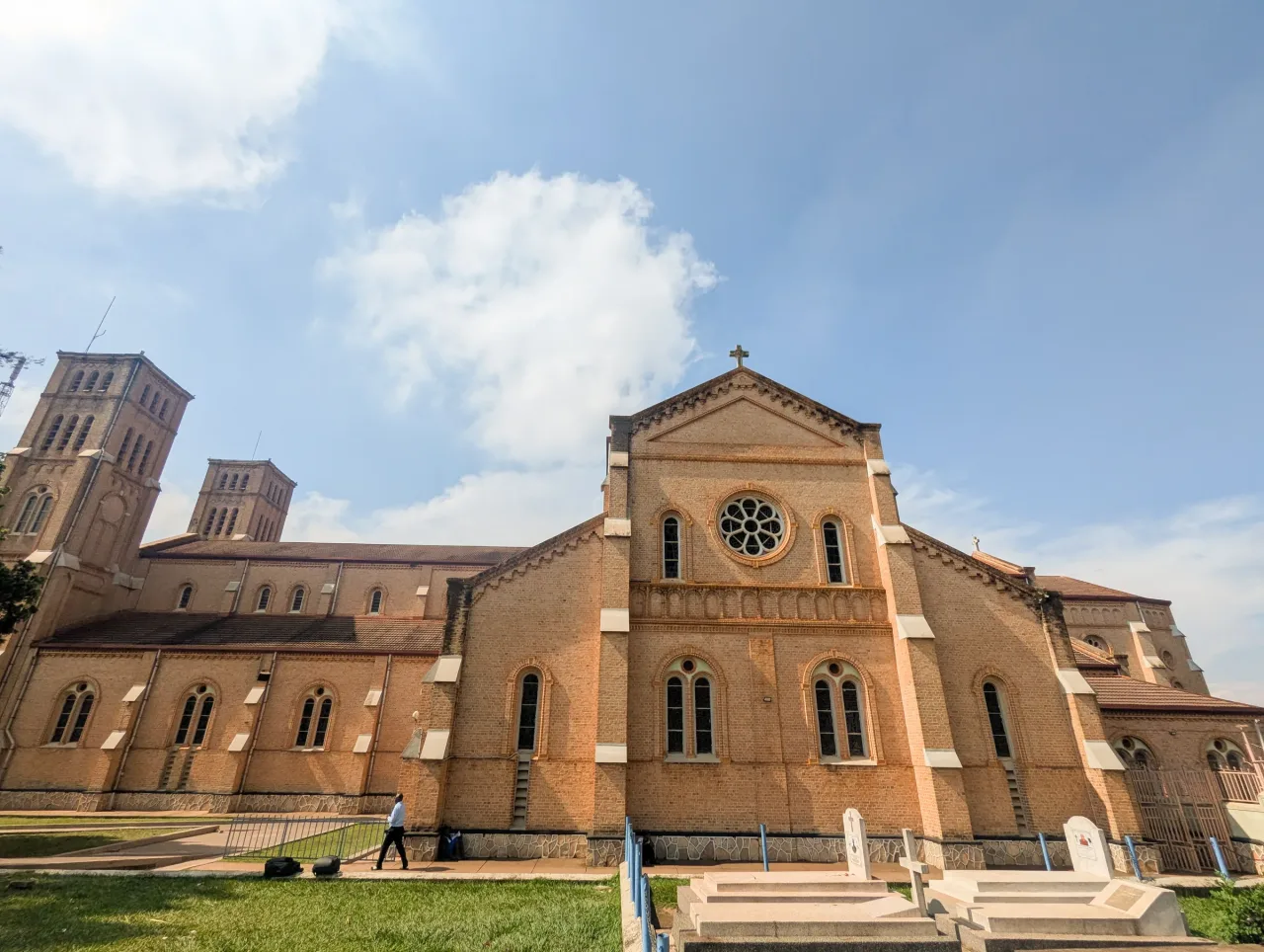
The Catholic basilica at Namugongo, in Kira Municipality east of Kampala, built where St. Charles Lwanga was killed on June 3 1886, and the principal shrine of the twenty-two Catholic Uganda Martyrs.
- Location
- Namugongo, Uganda 0.3853° N · 32.6514° E
- Type
- Minor basilica and parish shrine of the Archdiocese of Kampala
- Dedication
- The Uganda Martyrs; the parish is dedicated to Our Lady Queen of Martyrs
Where the road of 1886 is still prayed
Come here to honor St. Charles Lwanga and companions, to ask their intercession, and to celebrate the Eucharist on the ground of their martyrdom. Namugongo is a living shrine, the culmination of a Catholic sacred geography that begins at Munyonyo. Come to pray, to keep June 3 if you can, and to remember that thirteen of the twenty-two were killed here, not all of them.
Twenty-two Catholic martyrs, and a hill
The persecutions of 1885–1887 took place in the political and religious world of the Buganda royal court: rapid evangelization, Catholic and Anglican missions, anxiety about foreign influence, court politics, and demands the Christian converts believed they could not obey. Paul VI's 1964 canonization letter is explicit that the pages resisted the kabaka's obscene invitations and would rather die than violate the law of God. That is part of the witness. It is not the only cause of the persecution, and it does not exhaust who the martyrs were.
On October 18 1964 Paul VI canonized Charles Lwanga, Matthias Mulumba Kalemba, and twenty companions. That is twenty-two Catholic saints. Benedict XV had beatified them on June 6 1920. Their feast is June 3. The same 1964 letter divides them by death: thirteen were taken to Namugongo hill and burned on June 3 1886; nine were killed by spear or other means in other places. St. Charles Lwanga, head of the royal pages, was separated for a ritual execution and burned apart from the others. The shrine identifies the present altar with that spot.
They did not all walk from Munyonyo together, and they were not all killed here. St. Joseph Mukasa Balikuddembe belongs to the earlier persecution of 1885. St. Andrew Kaggwa was killed at Munyonyo. St. Matthias Mulumba died elsewhere. Namugongo is the culmination of the principal 1886 journey, not a single pyre for the whole twenty-two.
Anglican Christians were martyred in the same persecutions. Paul VI said at the canonization that he did not wish to forget those who, belonging to the Anglican confession, met death for the name of Christ. He honored them again at Namugongo in 1969. Francis, celebrating Mass at this Catholic shrine on November 28 2015, remembered the Anglican martyrs whose deaths for Christ testify to an ecumenism of blood. Their shrine at Namugongo is a different place, further east. Do not collapse the two lists.
Paul VI came here on August 2 1969 to honor the martyrs and to bless the altar of the sanctuary then being raised. John Paul II celebrated Mass here on February 7 1993 and announced the shrine's elevation to a minor basilica; the apostolic letter Inter apostolicam of April 28 1993 identifies this church as built where St. Charles Lwanga suffered martyrdom. Francis came as a pilgrim on November 28 2015.
The basilica is a circular church about forty-two meters in diameter. The shrine describes its form as inspired by a traditional hut, with twenty-two seamless-steel pillars, each for one of the Catholic martyrs, and a steel-and-glass dome rising from the roof. Seating is on the order of a thousand; the grounds and Martyrs Lake are what hold the great June congregations. Construction of the present shrine began in 1967 under Cardinal Emmanuel Nsubuga; the shrine names ROKO Construction and the architect Justus Dahinden. It was opened on June 3 1975 by Cardinal Sergio Pignedoli. Paul VI had already blessed the altar in 1969, while the sanctuary was still being raised.
How to pray at Namugongo.
Begin with the martyrs, not with the roof.
Thirteen, not twenty-two
The 1964 letter is clear. Thirteen were killed on this hill on June 3 1886. The other nine died in other places. Keep that distinction. It honors the dead more than a single pyre would.
The altar
The shrine identifies the altar with the place of St. Charles Lwanga's martyrdom and venerates a relic as his. Approach it in prayer.
The Anglican shrine is another place
Francis named an ecumenism of blood. He did not make the two shrines one site. If you visit both, keep the distinction obvious.
Spiritual Significance
The still point is the altar associated with Charles Lwanga's martyrdom. Pilgrims pray before a first-class relic of St. Charles Lwanga, venerated in glass at the front of the mahogany altar according to the shrine tradition. Relics of Charles Lwanga, Matthias Mulumba, and the two later blesseds of Paimol are also kept at the archbishop's chapel at Lubaga, and may be brought to the lake for large Masses. Come to Mass if you can. Come to ask the martyrs' intercession. If you are here around June 3, understand that ordinary visitor conditions do not apply.
Do Not Miss
-
The altar
The shrine associates it with St. Charles Lwanga's martyrdom. Pray there before you photograph the roof.
-
The relic the shrine tradition identifies as St. Charles Lwanga
The shrine places a first-class relic in glass at the front of the altar. Pray before it as the shrine presents it.
-
Mass, if it is being offered
This is a parish shrine. Confirm the current schedule. June 3 is not an ordinary Sunday.
- That the roof is circular, and that the shrine itself relates the twenty-two pillars to the Catholic martyrs.
- That Anglican Namugongo is a different shrine, further east.
- That Munyonyo is where the 1886 ordeal began, and this is where it was completed for those killed here.
Visit Plans
An ordinary visit is an hour or two: enter, approach the altar, pray, attend Mass if it is being offered, walk the grounds. Around June 3 the place becomes a different order of pilgrimage. Pair Namugongo with Munyonyo the same day only by vehicle, and only if you are not traveling on the feast itself.
How to Visit
Namugongo is in Kira Municipality, Wakiso District, about eleven kilometers from Kampala as the shrine measures it, northeast of the city. It is part of greater Kampala pilgrimage geography, not central Kampala. The Catholic basilica is this place; the Anglican shrine is distinct. Drive from Kampala, or join a parish pilgrimage. Confirm current Mass with the shrine. The parish offices are open Monday to Friday; the pilgrims' office is open daily. Do not treat the office hours posted on the website as the hours the basilica itself is open. June 3 is a national pilgrimage. Do not expect parking, easy vehicle access, or an ordinary Mass list that day.
June 3 is the great pilgrimage. Confirm Mass with the shrine.
The shrine publishes office hours and a pilgrims' office. Those are not the same as basilica opening hours. Confirm liturgies with the shrine before you travel.
- Feast
- June 3, St. Charles Lwanga and companions
- Pilgrims' office
- Daily 08:30–18:00, as listed by the shrine
- Parish offices
- Monday to Friday 08:30–17:00; not basilica hours
- June 3
- Ordinary access does not apply
Prayer and liturgy
- Confirm times at ugandamartyrsshrine.org.ug or with the shrine before traveling.
- June 3 is the feast of St. Charles Lwanga and companions and the great East African pilgrimage to this ground. Do not expect an ordinary Sunday.
Visiting and access
- The website's 'open time' 08:30–17:00, Saturday and Sunday closed, is the parish office, not shrine access. The pilgrims' office is listed daily 08:30–18:00.
- The Catholic basilica is this site. The Anglican shrine at Namugongo is a distinct place further east.
- Dress modestly. Photography inside a working church follows local notice. June 3 is not a photo call.
Additional schedule notes
June 3
Uganda Martyrs Day fills the grounds. Ordinary parking, vehicle access, and schedules do not apply.
- Come with a parish or organized pilgrimage if you can. Do not plan a same-day spontaneous drive as if it were an ordinary Tuesday.
- The Martyrs Lake is where the shrine holds the largest Masses, including papal Masses. The shrine describes water collected by pilgrims. Receive that as a devotion, not as a declared miracle.
Continue Your Pilgrimage
-
City hub
Kampala
Where this church sits within the wider Catholic geography of Kampala.
-
Basilica
Uganda Martyrs Basilica, Munyonyo
South of Kampala, on the lake. The royal court of May 1886, where the condemned began the road toward this hill.
-
Cathedral
St. Mary's Cathedral Lubaga
The cathedral of Kampala, west of the center. The living Church that grew from the martyrs' witness. Not an execution site.

Map
Canonical Catholic group is the 22 of 1964. Shrine '24' includes Blesseds Daudi Okelo and Jildo Irwa (Paimol, 1918). Charles Lwanga has only a thin saint shard; no saint_slugs. Hero is Tusk media aerial 1920px — honest width debt vs 2400. Riffins reece 'Namugongo shrine' file is a museum tableau, unused.
September 17, 2026
Photo credits
- Hero. Tusk media / Wikimedia Commons (CC BY-SA 4.0). Source. CC BY-SA 4.0.
- Mass in the round. Z thomas / Wikimedia Commons (CC BY 4.0). Source. CC BY 4.0.