
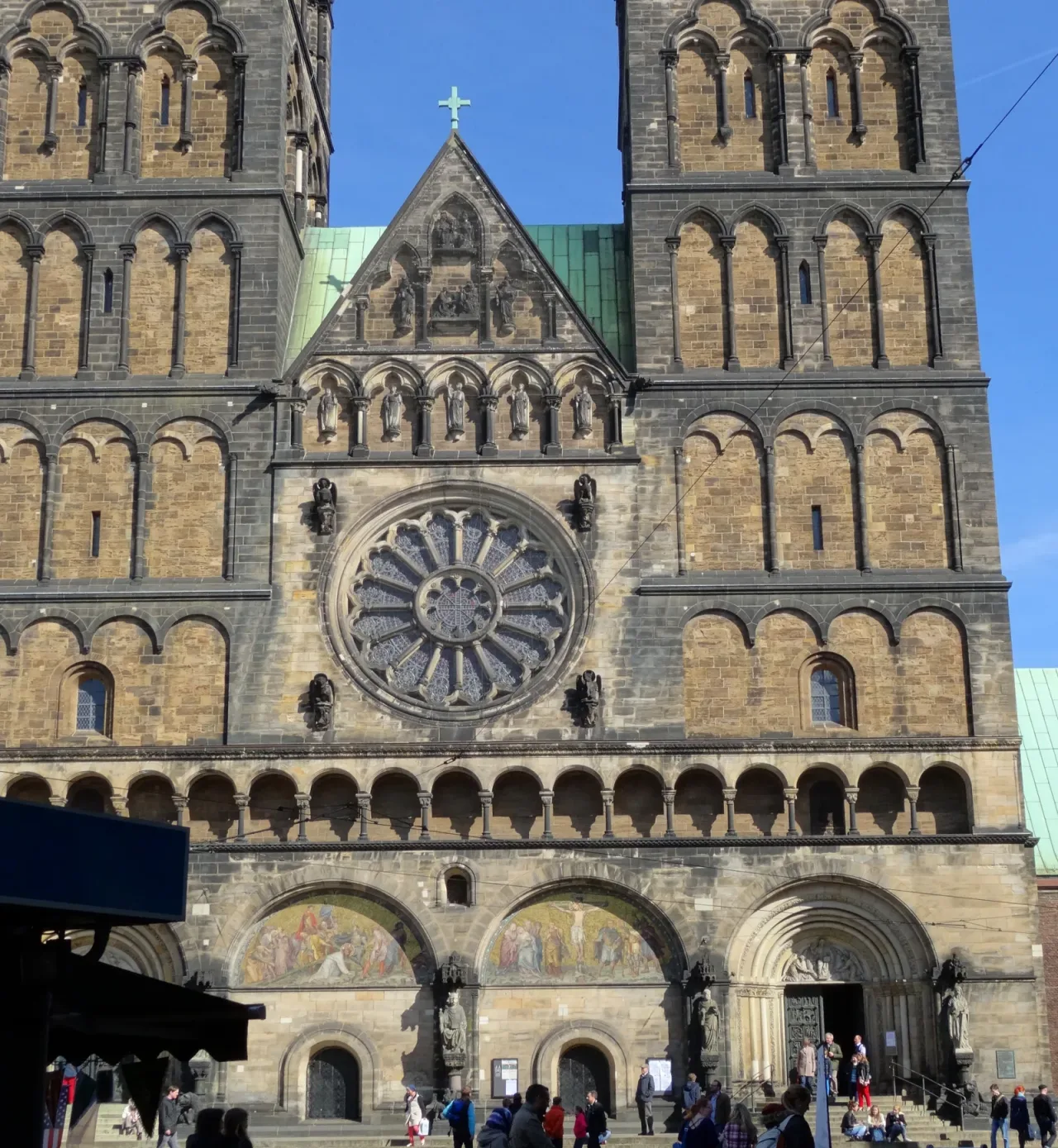
Saint Peter's Cathedral, Bremen
Bremen is the see Saint Willehad founded in 789 and the base from which Saint Ansgar began the northern mission again after Danish raiders destroyed Hamburg. The church standing over that ground today is Lutheran and largely later, but its two crypts remain the oldest Christian rooms in the city.
- Location
- Bremen, Germany 53.0754° N · 8.8084° E
- Type
- Cathedral
- Dedication
- Saint Peter
The northern mission rebuilt from Bremen
Two saints organized the Christian north from this site, and the ground beneath the present cathedral still carries the evidence.
Willehad, an Anglo-Saxon sent to preach among the Saxons, was consecrated bishop in 787 and raised his first church here in 789. Ansgar, remembered as the apostle of the North, governed from Bremen from 848 until his death in 865, after raiders burned Hamburg and destroyed the mission base he had built there. Bremen is where that work was taken up again. A Catholic pilgrim comes here for the history of a mission rather than for a shrine. The medieval veneration of both saints was broken at the Reformation and the cathedral has been Protestant for four centuries. What remains is the site itself, an unusually legible record of how the Church in northern Europe was first organized, and a crypt full of the bishops who carried it.
From Willehad's first church to Ansgar's renewed mission
Willehad was consecrated bishop in 787 and raised a small church in 789 on the Domdüne, the sandy rise above the Weser where the cathedral still stands. He died that same year and was buried in the church he had built. A successor later moved his body into the stone church that replaced it, and the account of the miracles reported at his grave was written by Ansgar. Willehad's first church did not survive the Saxon rising and was gone before 805. Ansgar dedicated a pre-Romanesque hall church on the site around 860. Fire destroyed that building in 1041, and Bremen rebuilt on a far larger scale as a three-aisled Romanesque pillar basilica with two crypts and a choir at each end. That plan still governs the cathedral. Vaulting and the twin western towers followed from about 1250, side chapels came in the fourteenth century, and in the sixteenth the north side was rebuilt as a late Gothic hall with net vaulting. The Reformation and then the Thirty Years' War closed the cathedral outright from 1532 to 1547 and again from 1561 to 1638. The south tower fell in 1638 and took eight bells down with it. Lutherans reopened the building and furnished it in their own manner. Bombing damaged it in 1945, and the restorations of 1888 to 1901 and of the 1970s account for much of what a visitor now sees.
The two crypts are the reason to come, and both are eleventh-century. The cathedral dates the eastern crypt to around 1042 and it holds the graves of close to ninety bishops and archbishops of the see Willehad founded, which is the most direct contact the building offers with its Catholic centuries. The western crypt keeps the Romanesque relief of Christ in majesty holding the keys and a book, which the cathedral calls its oldest surviving stone image, and a thirteenth-century bronze font carried on four lion riders. The congregation still baptises there. Above ground, the twin towers built between 1215 and 1253 rise some 89 meters over the market square, and the sixteenth-century net vaulting on the north side sits against the Romanesque core without hiding it.
Spiritual Significance
The Dom is a Lutheran congregation within the Bremische Evangelische Kirche and holds regular services. Catholic visitors come as guests. Willehad's relics were lost at the Reformation and the cathedral claims neither his nor Ansgar's today. Pray for the mission both men served and for the unity of the Church that sent them, and leave the relic question where the evidence leaves it.
Do Not Miss
-
The eastern crypt and its bishops' graves
The cathedral dates it to around 1042. Close to ninety bishops and archbishops of the see Willehad founded are buried here, which is the building's closest surviving contact with its Catholic centuries.
-
The Christ in majesty in the western crypt
A Romanesque relief of Christ holding the keys and a book, which the cathedral calls its oldest surviving stone image.
-
The bronze font on four lion riders
Thirteenth-century, in the western crypt, and still the font the congregation baptises at.
-
The seam on the north side
Sixteenth-century net vaulting meets the Romanesque core without disguising it, which is the clearest place to read how often this cathedral was rebuilt.
- How much older the crypts feel than the church above them. Both are eleventh-century; the vaulting overhead is nearly two centuries later.
- That the eastern crypt is a bishops' burial ground rather than a shrine. The names run through the centuries when this see was Catholic.
- That the two western towers are not the same age. The southern one fell in 1638, taking eight bells with it, and the west front was only completed as a matching pair during the restoration of 1888 to 1901.
- How little of the medieval furnishing survived the two long closures of the sixteenth and seventeenth centuries.
Visit Plans
-
The two crypts
3 ordered stopsThe oldest Christian ground in Bremen, taken in the order the cathedral was built.
- The west front from the market square
- The western crypt: Christ in majesty and the bronze font
- The eastern crypt and the bishops' graves
-
The first bishops of Bremen
6 ordered stopsThe same path, slowed down, with the nave, the north-side vaulting, and the cathedral museum added.
- The west front from the market square
- The nave and the Romanesque core of 1041
- The western crypt: Christ in majesty and the bronze font
- The eastern crypt and the bishops' graves
- The late Gothic net vaulting on the north side
- The Dom Museum, when open
How to Visit
Give the crypts more time than the nave. The Bleikeller, a cellar of eight preserved bodies beneath the nave, has been the cathedral's most visited room for three hundred years; it is a curiosity of local history with no connection to the saints or to Christian burial, and a pilgrim can skip it without loss. Museum, tower, and Bleikeller access are arranged separately from general church entry, so confirm each on the official cathedral site before traveling.
Let worship and current cathedral access set the schedule.
Opening, museum, tower, and event access can change.
Cathedral access
- General church entry, museum access, and tower access may follow different arrangements.
- Contact the cathedral for current step-free routes.
Map
Building dates follow the cathedral's own history pages. No bodily relic of either saint is preserved here: Willehad's were lost at the Reformation, and the cathedral claims none today. The Dom is a Lutheran congregation and holds regular worship.
August 14, 2026
Photo credits
- Hero. BremerDom Westfassade. Godewind / Wikimedia Commons. Source. CC BY-SA 3.0.