
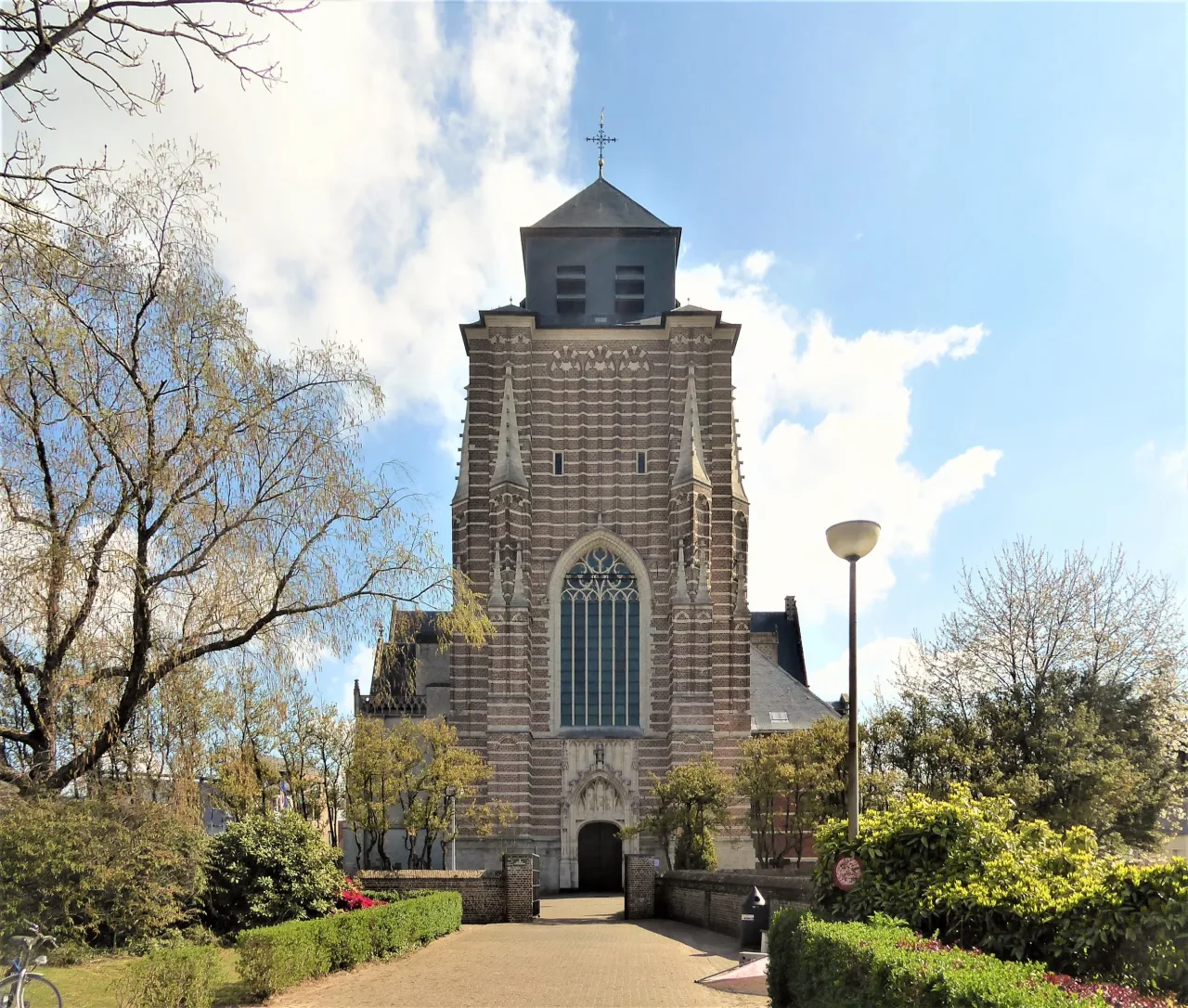
Sint-Dimpnakerk
A Gothic pilgrimage church in the Kempen where the relics of Saint Dymphna are kept, and where a medieval pilgrimage of the mentally ill turned into a way of living that Geel has not given up.
- Location
- Geel, Belgium 51.1626° N · 5.0022° E
- Type
- Catholic parish church and pilgrimage church in the Diocese of Antwerp Demer Gothic: a three-aisled cruciform basilica of white sandstone and brown ironstone, built from 1349 over more than two centuries, with a west tower that was never finished
- Dedication
- Dedicated to Saint Dymphna, whose relics and those of Saint Gerebernus are kept here
- Time Needed
- 30 minutes to 2 hours
The church that could not hold its own pilgrims
Come because of what happened here after the praying. Geel drew the mentally ill from across Europe to Dymphna's grave, and built a sickroom against the tower so they could stay the nine days their novena required. It was never big enough. The families of Geel took the rest into their houses, and seven hundred years later about a hundred families still do. The church is where that begins and where it is still explained: the relics above the old high altar, the carved retable that tells the medieval story, and the plain brick building outside the door that ran out of room.
A grave, a pilgrimage, and a town that improvised
The building is not the first here. An ancient grave at Geel and the veneration around it come before any written account of the saint, and the present church was begun in 1349, when the pilgrimage was growing fast. It took more than two centuries to build and was never finished: the west tower still stops short of the height its builders intended. Fire took part of it in 1489, the iconoclasm of 1566 stripped the statues from the portal, the French regime closed and nearly sold it in 1799, and the liberation fighting of September 1944 damaged it badly. It was restored between 1950 and 1952. Through all of that the relics stayed and the pilgrims kept coming, and what they came for was not architecture. They came because Dymphna was held to help people whose minds were failing them, and they came in numbers the church could not house.
Demer Gothic, which is the regional manner: white sandstone and brown ironstone laid in bands, so the whole church is striped. It is a three-aisled cruciform basilica with a crossing tower and a heavy west tower, the choir ringed by five radiating chapels. Inside, the piers carry the same banding into the arcade, and the crossing arch holds a Last Judgement painted about 1500 and restored more than once. Against the south side of the tower stands the Ziekenkamer, a seventeenth-century block of red brick with white stone dressings, its gable stones cut anno 1683 and 1949.
The building tells you it was not big enough.
Three things to find, in this order. The last one is outside, and it is the one that changed how a town lives.
Look up, above the retable
The relics are in a neo-Gothic shrine set in the niche above the carved retable on the old high altar, not in a tomb you can stand beside. These are the relics Geel has venerated for as long as there are records of it.
Read the retable like a strip
The oak retable of 1515 was made for people who could not read. The flight by boat, the king on horseback, the pursuit and the killing are all there in sequence. It is the medieval account in wood, and it is worth knowing that it is an account, made eight hundred years after the events it shows.
Go outside and find the Ziekenkamer
The plain brick building against the tower is the point of the whole place. Pilgrims lodged there for their nine days. When the cells filled, the families of Geel took the others home, and never stopped.
Five of the works here are on the Flemish Masterpieces list.
Radiocarbon dating of femurs from the medieval reliquary placed them between the end of the seventh century and the third quarter of the ninth, centuries older than the written account that explains them.
The Ziekenkamer against the tower is where Geel's household care began: when it filled, the town's families took the overflow.
Geel's family-care tradition entered UNESCO's Register of Good Safeguarding Practices in 2023.
The pilgrims who could not be fitted into the sickroom beside the tower were taken into Geel's houses instead. Seven hundred years later they still are.
This is a church about accompaniment rather than cure. The devotional record here is not a list of healings; it is a town that made room. That is a harder and more durable thing to have done, and it is the reason a pilgrim should come with a name in mind rather than an expectation.
Do Not Miss
-
The relics above the old high altar
In a neo-Gothic shrine in the niche above the 1515 retable, with the relics of Saint Gerebernus.
-
The Dymphna retable of 1515
Attributed to Jan van Wavere of Antwerp. More than two hundred carved figures telling the legend.
-
The Ziekenkamer
Outside, against the tower. The seventeenth-century sickroom where the nine-day novena was kept.
-
The ciborium behind the high altar
A late-Gothic canopy of white stone, holding a wooden relic chest with fragments of the two sarcophagi.
- The banding of white sandstone and brown ironstone, carried from the outside walls into the piers
- How plain the Ziekenkamer is next to the church, and how much more of the story it holds
- That the tower stops short: the building was never finished
Visit Plans
-
The relics, the retable, and the sickroom
4 ordered stopsPray at the old high altar under the shrine, read the retable beneath it, then go out and stand in front of the Ziekenkamer, which is where the rest of the story happened.
- The relics in the niche above the old high altar
- The Dymphna retable of 1515
- The ciborium behind the high altar
- The Ziekenkamer against the tower
-
Come on the pilgrimage day and stay for both prayers
4 ordered stopsOn the first Wednesday of the month from May to October the parish keeps a pilgrimage day that opens and closes with prayer in the church. Those two moments are open to anyone; the rest of the day has to be booked in advance.
- The opening prayer in the church
- The relics and the retable
- The Ziekenkamer, and the Gasthuismuseum if it is open
- The closing prayer
How to Visit
The church follows Geel's tourist season. From April through September it is open free to visitors on Tuesday to Sunday afternoons; through the winter it opens only on the first two days of November and by appointment. It is also open half an hour before every service, which is the reliable way in outside season. If you can choose a date, choose the first Wednesday of a month between May and October, when the parish keeps a pilgrimage day that opens and closes with prayer in the church and is open to anyone.
- Mass on Wednesday evening at 18:30 and Sunday morning at 09:30
- A monthly pilgrimage day on the first Wednesday of the month, May through October, opening and closing with prayer in the church
- Prayers said in English, French or German when pilgrims make themselves known before a service begins
- Feast-day and vigil times differ from the ordinary pattern; the parish calendar is the place to check
A seasonal church. For half the year you need an appointment.
This is a working parish that opens to visitors on the town's tourist season, not a museum with year-round hours. Outside the season the reliable way in is a service, or an appointment made through the parish. Everything below is published by the parish itself.
- Address
- Sint-Dimpnaplein 15, 2440 Geel
- April to September
- Tuesday to Sunday, 14:00 to 17:00, free. In 2026 the parish lists four exceptions: May 2, May 20, May 23 and September 24.
- October to March
- Open on November 1 and November 2, 14:00 to 17:00, and otherwise only by appointment through the parish contact form.
- Services
- Mass on Wednesday at 18:30 and Sunday at 09:30. The church opens half an hour before every service.
- Getting there
- Geel station is about 40 minutes to an hour from Antwerp; the church is a little over a kilometer away, roughly a twenty-minute walk.
Before setting out
- Outside the season, a Wednesday evening or Sunday morning Mass is the simplest way in, since the church opens half an hour beforehand.
- From Brussels expect about an hour and a half and usually a change; the direct trains are peak-hour services on weekdays only.
- Check current times with the Belgian railways before you build a day around a connection.
If you are coming as a pilgrim
- Every other activity on that day requires booking in advance, individually or as a group.
- This is the one date in the calendar built for exactly the person this church is for.
- Say so at the door rather than afterwards.
- Arrange it well in advance through the parish contact form.
- This is hospitality offered by the parish, not the psychiatric family-care program, which is a professional service and not a visitor experience.
The rest of Dymphna's Geel
- Gasthuisstraat 1, 2440 Geel. Check its own opening hours; they are not the same as the church's.
- The parish suggests combining the two, and tourism Geel arranges guided visits.
Relics, Tombs, Sacred Objects
Tomb and Burial
- Saint Dymphna, whose relics are kept in a neo-Gothic shrine in the niche above the old high altar. The tradition holds that she was buried where the church now stands.
- Saint Gerebernus, her companion, whose relics are kept with hers, although most of them were taken to Xanten in the Middle Ages.
Relics and Sacred Tradition
- The relics of Saint Dymphna and Saint Gerebernus, in a neo-Gothic shrine standing in the niche above the Dymphna retable of 1515.
- A silver shrine made by Willem Jacques of Antwerp in 1612, with a silver foot added by Wierik Somers III in 1716, carried in the Dymphna procession.
- Fragments of the two stone sarcophagi in which the bodies are said to have been found, kept in a wooden relic chest inside the Gothic ciborium behind the high altar.
- A monstrance holding a jawbone of Saint Gerebernus.
Sacred Objects
- The Saint Dymphna retable of 1515, attributed to Jan van Wavere of Antwerp, carved with the story of her life and death
- The neo-Gothic shrine in the niche above it, holding the relics
- The late-Gothic ciborium of white stone behind the high altar, with its painted panels of about 1550
- The Passion retable of about 1490 to 1500, from a Brussels workshop
- The white stone Apostle retable of the second half of the fourteenth century, which stood on the high altar until the Dymphna retable replaced it
- The Last Judgement painted on the crossing arch at the end of the fifteenth century
- The Renaissance tomb of a lord of Geel and his wife, in marble and alabaster, designed by Cornelis Floris de Vriendt in 1554
Map
One record covers the church, the relics above the old high altar and the Ziekenkamer against the tower, which are one visit. It follows the parish of Geel, the Flanders Heritage Agency inventory and the operator of the family-care program rather than English-language devotional sources, which are unreliable on this church. Three separate objects circulate in the literature and are deliberately kept apart here: the neo-Gothic shrine in the niche above the retable, which the parish and Open Churches both say holds the relics and which is what a visitor sees; the silver shrine of 1612 by Willem Jacques with a foot of 1716 by Wierik Somers III, which is the processional shrine; and the medieval wooden reliquary whose contents were radiocarbon dated, which the published study locates at the Gasthuismuseum. The record does not merge the third with the wooden relic chest the heritage inventory describes inside the ciborium behind the high altar, because no source ER can cite states that they are the same object. The record does not assert that the dated bones are Dymphna's, does not give her a birth or death year, and does not publish confession, accessibility or photography information the parish does not state.
September 9, 2026
Photo credits
- Hero. Chris06, CC BY-SA 4.0, via Wikimedia Commons. Source. CC BY-SA 4.0.
- The relics, above the retable. FrDr, CC BY-SA 4.0, via Wikimedia Commons. Source. CC BY-SA 4.0.
- The Ziekenkamer. Shari Hermans, CC BY-SA 4.0, via Wikimedia Commons. Source. CC BY-SA 4.0.
- The nave. Chris06, CC BY-SA 4.0, via Wikimedia Commons. Source. CC BY-SA 4.0.
- The retable, in detail. Gelenaar, CC BY-SA 4.0, via Wikimedia Commons. Source. CC BY-SA 4.0.