The leaning nave piers
Romanesque structureNot a devotional object; the structural puzzle of the building
Galician heritage sources · Cathedral of Santiago visitor programSanta María a Real do Sar is the twelfth-century collegiate church beside the river Sar, the most complete Romanesque interior in Santiago after the cathedral, and the one whose nave piers visibly lean.
Come because it is the one place in Santiago where you can stand inside a twelfth-century church that has not been Baroqued over, and because the interior does something no photograph prepares you for: the piers lean, hard, in both directions, and the building has been held up by enormous later buttresses for three hundred years. It is a twenty-minute walk out of the old town and it empties the crowds off you completely.
Munio Alfonso, a canon of the cathedral, founded a community here in 1136, the first house of Augustinian canons in Galicia. The church they built is Romanesque of the mid-twelfth century, basilical, three-aisled, with tall arcades carried on heavy piers, and it was raised on low riverside ground that floods. In the seventeenth and eighteenth centuries the north wall was propped with flying buttresses so massive that they swallow the surviving wing of the medieval cloister. Whether the lean of the piers came from the ground, from a builder's error, from the ambition of the aisle height, or from intention, has never been settled. The church was raised to collegiate status in the sixteenth century and has been in continuous use throughout.
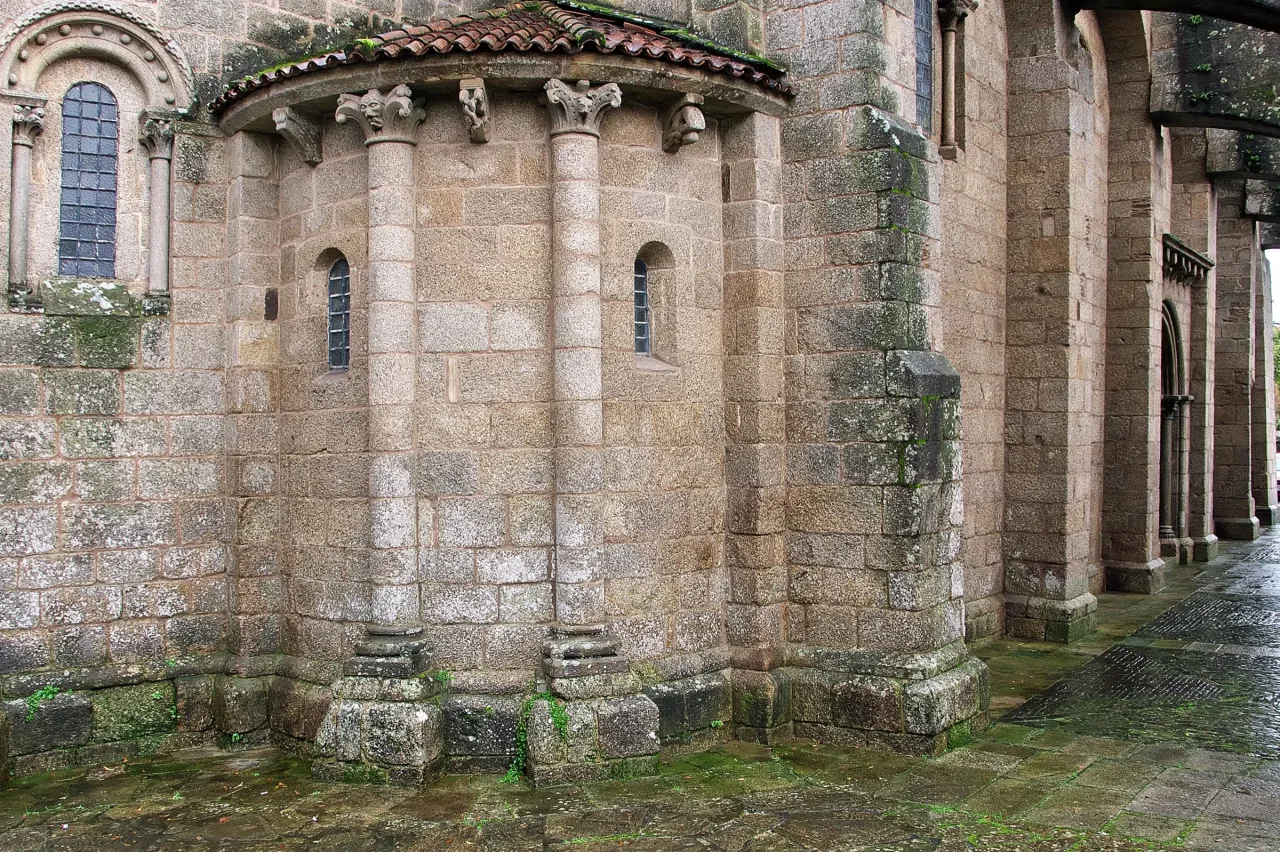
Twelfth-century Romanesque, three aisles, tall arcades on markedly inclined piers, with colossal seventeenth and eighteenth-century flying buttresses along the north side and one surviving wing of the medieval cloister.
Founded in 1136 by Munio Alfonso, a former canon of the cathedral, as the first Augustinian community in Galicia.
After the cathedral, it preserves more of its original Romanesque structure than any church in Santiago.
The great flying buttresses along the north wall were added in the seventeenth and eighteenth centuries to keep the building standing.
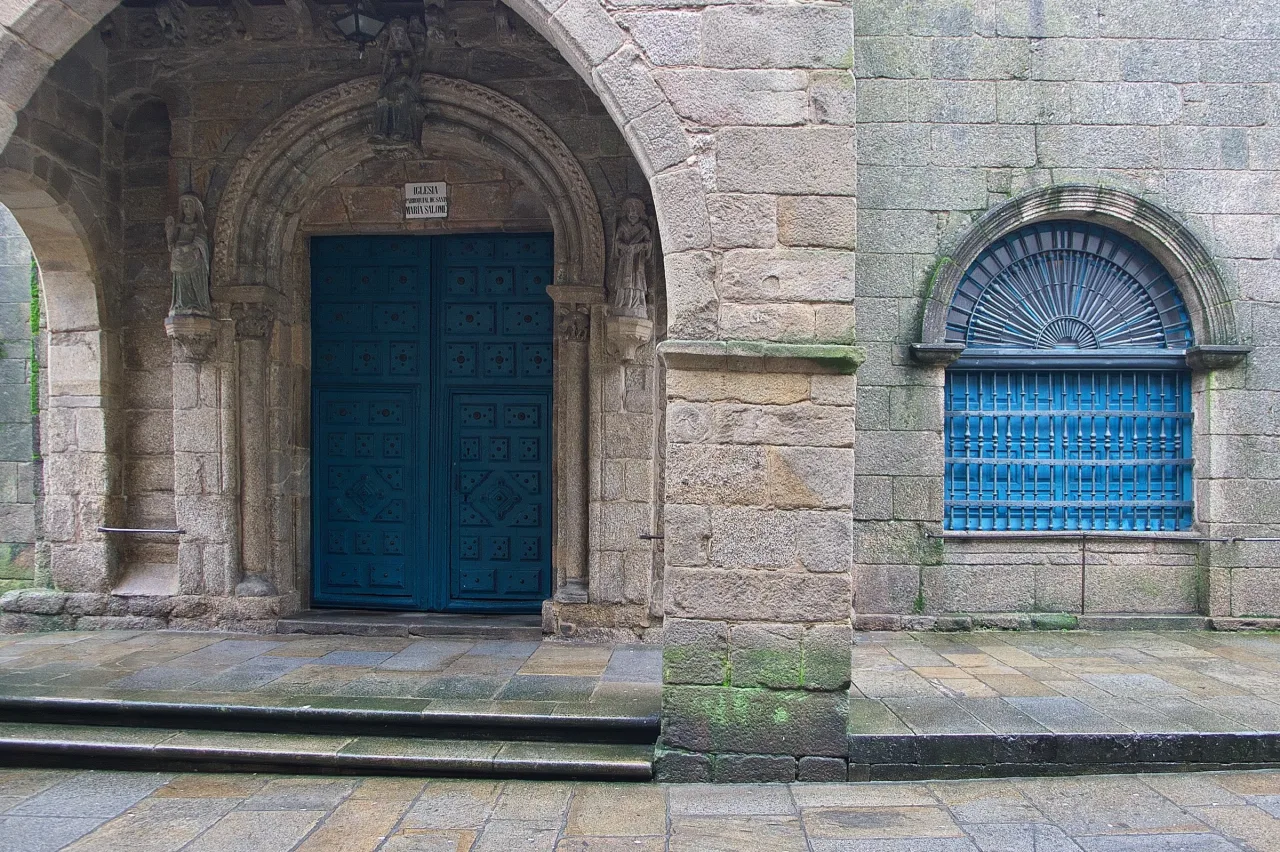
Bare granite and daylight. This is what a Galician church looked like before the Baroque arrived, and it is still a parish.
Read it from the west end. The inclination is severe enough that first-time visitors assume it is an optical trick, and it is not.
The only one left in Santiago, reached through the sacristy, with capitals connected to Master Mateo's workshop.
To the right of the main entrance, contemporary with the church.
Added three centuries after the church was built, to stop it falling into the river meadow. They are not decoration; they are the reason the building is still here.
The nave, the piers, and the font.
Add the cloister wing, the museum pieces and the walk around the exterior.
The walk out along the Sar, the church at leisure, and the walk back into the old town.
Walk out, not ride out. The twenty minutes downhill along the Sar are what make the church feel like a second place rather than a second monument.
It is a twenty-minute walk south of the old town along the Sar, or a short taxi ride. The church is part of the Cathedral of Santiago's ticketed visitor program; check the cathedral's booking system for current access and hours.
Not a devotional object; the structural puzzle of the building
Galician heritage sources · Cathedral of Santiago visitor programVisited as part of the church
Galician heritage sources · Cathedral of Santiago visitor programSource note Traditional attributions are presented as tradition, with documentation named where it exists.
Sar is not a shrine. Its place in Catholic Santiago is architectural and parochial.
The Cathedral of Santiago's visitor program, which includes this church among its ticketed visits, Galician heritage sources. The cause of the leaning piers is genuinely unsettled.
August 4, 2026
Use this for corrections, broken links, missing places, and planning ideas.