
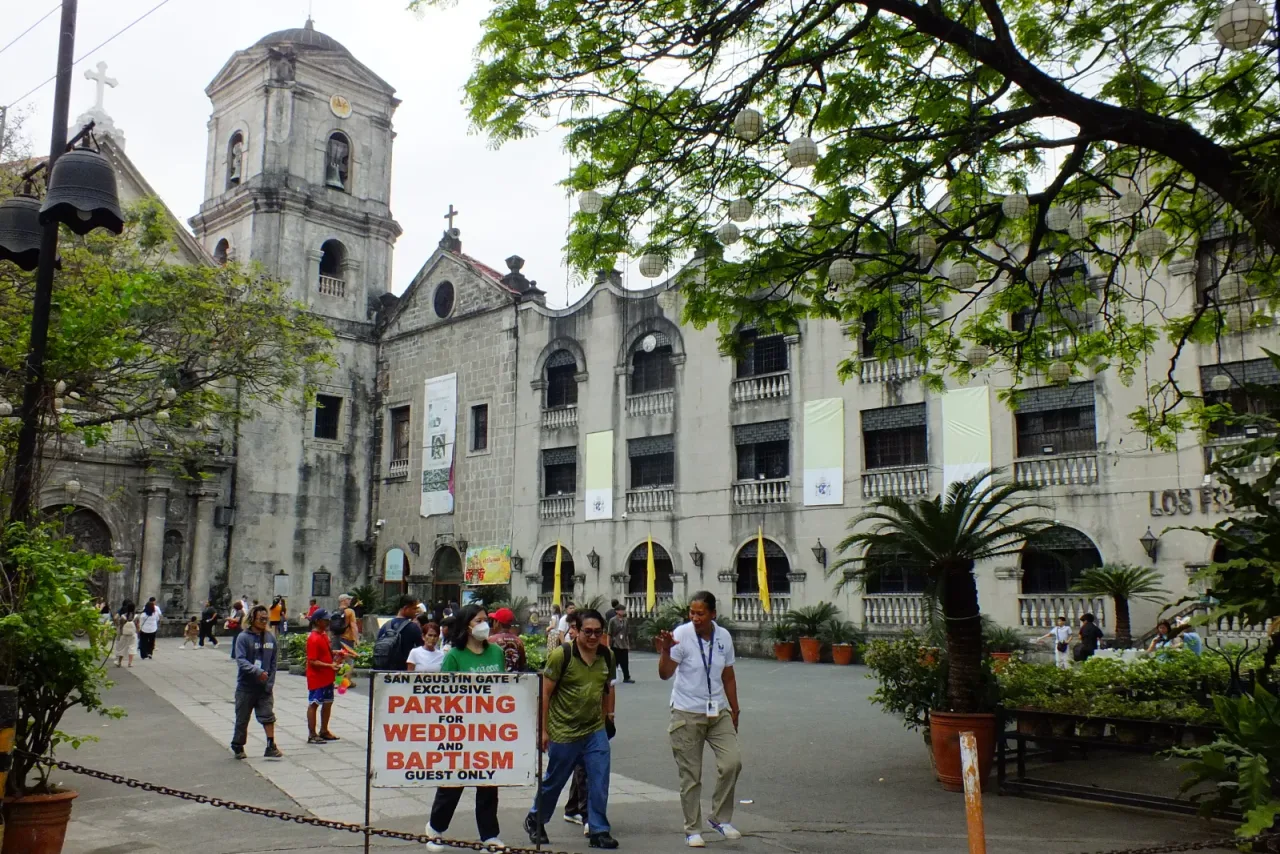
San Agustin Church
An Augustinian church completed in 1607, still used for Catholic worship and recognized by UNESCO for a Philippine Baroque shaped by local materials, conditions, and craftsmanship.
- Location
- Manila, Philippines 14.5889° N · 120.9754° E
- Type
- Augustinian church, archdiocesan shrine, and UNESCO World Heritage component
- Dedication
- The Immaculate Conception; archdiocesan shrine of Our Lady of Consolation and Cincture
Augustinian worship before a museum of architecture
Come first for the altar, the Augustinian life of the church, and Our Lady of Consolation and Cincture. Then let the building explain how Catholic architecture changed in the Philippines. The retablos, painted vaults, choir stalls, and massive structure belong to a sacred interior still ordered toward worship.
A Catholic church adapted to Philippine ground
The present stone church was completed in 1607 and is identified by the National Museum as the oldest standing stone church in the Philippines. It survived earthquakes, political change, war, and the destruction of much of Intramuros. That survival should not be narrated as European Baroque simply transplanted intact. UNESCO describes the Philippine Baroque churches as a fusion of European church design with local materials, decorative motifs, Chinese and Philippine craftsmanship, and adaptation to seismic and environmental conditions. San Agustin's continuing Augustinian worship and Marian devotion gave that architecture its purpose across the centuries.
The exterior is low and massive. Buttressed walls and cryptocollateral chapels answer an earthquake-prone landscape. Inside, high-Baroque retablos establish the liturgical focus while trompe-l'oeil painting reshapes the vault overhead. The choir loft preserves sixty-eight carved molave stalls and the Macao lectern. Read these in sequence: threshold, nave, altar, then choir. The tomb of Miguel Lopez de Legazpi belongs to the colonial history of the site but is not the Catholic reason to visit.
A Philippine Baroque made for worship and survival
Move from structure to image to prayer.
The massive exterior
Low proportions, buttresses, and the chapel system show adaptation to seismic conditions rather than a simple European copy.
The retablos and painted vault
High-Baroque altars and trompe-l'oeil painting order attention toward the sanctuary.
The choir
Sixty-eight carved molave stalls and the Macao lectern preserve the church's Augustinian choral and material history.
Spiritual Significance
San Agustin can hold several truths without flattening any of them. It belongs to Spanish colonial history and cannot be detached from colonial power. It also became distinctly Philippine through material, climate, workmanship, local appropriation, and centuries of Filipino Catholic worship. Its faith is neither reduced to architecture nor explained away as architecture's colonial afterlife.
Do Not Miss
-
The high-Baroque retablos
Approach them as altars within a worshiping church, not as isolated art objects.
-
The trompe-l'oeil interior
Notice how painting makes the vault appear architecturally richer than its surface.
-
The choir loft
The carved molave stalls and Macao lectern belong to the religious-order life of the church.
-
The structural system
Buttresses and cryptocollateral chapels show a Baroque adapted to Philippine seismic conditions.
- The contrast between the restrained facade and rich interior
- Local material and workmanship within a Catholic liturgical program
- The difference between church access and museum access
Visit Plans
-
Altar, vault, and Augustinian prayer
3 ordered stopsRead the living church before adding the museum.
- The nave and retablos
- The trompe-l'oeil vault
- Our Lady of Consolation and Cincture
How to Visit
Church worship and museum or cloister access may follow different hours, admission rules, photography policies, and closures. Check the current official source shortly before visiting. Join Mass or prayer where possible, then add the museum only if it is open and the day has room.
Church and museum access are not the same
Worship, museum entry, photography, and closures can follow separate rules.
Plan the visit
- Weddings, liturgies, and parish events can affect visiting.
- Confirm before crossing Intramuros specifically for the museum.
Map
The page follows the National Museum and UNESCO for status, date, structural features, and Philippine Baroque framing. It does not romanticize colonial power or reduce Filipino Catholic continuity to colonial imposition.
September 23, 2026
Photo credits
- Hero. Wide Awake! / Wikimedia Commons (CC BY 4.0). Source. CC BY 4.0.
- Church, monastery, and city. Fung360 / Wikimedia Commons (CC BY-SA 4.0). Source. CC BY-SA 4.0.