
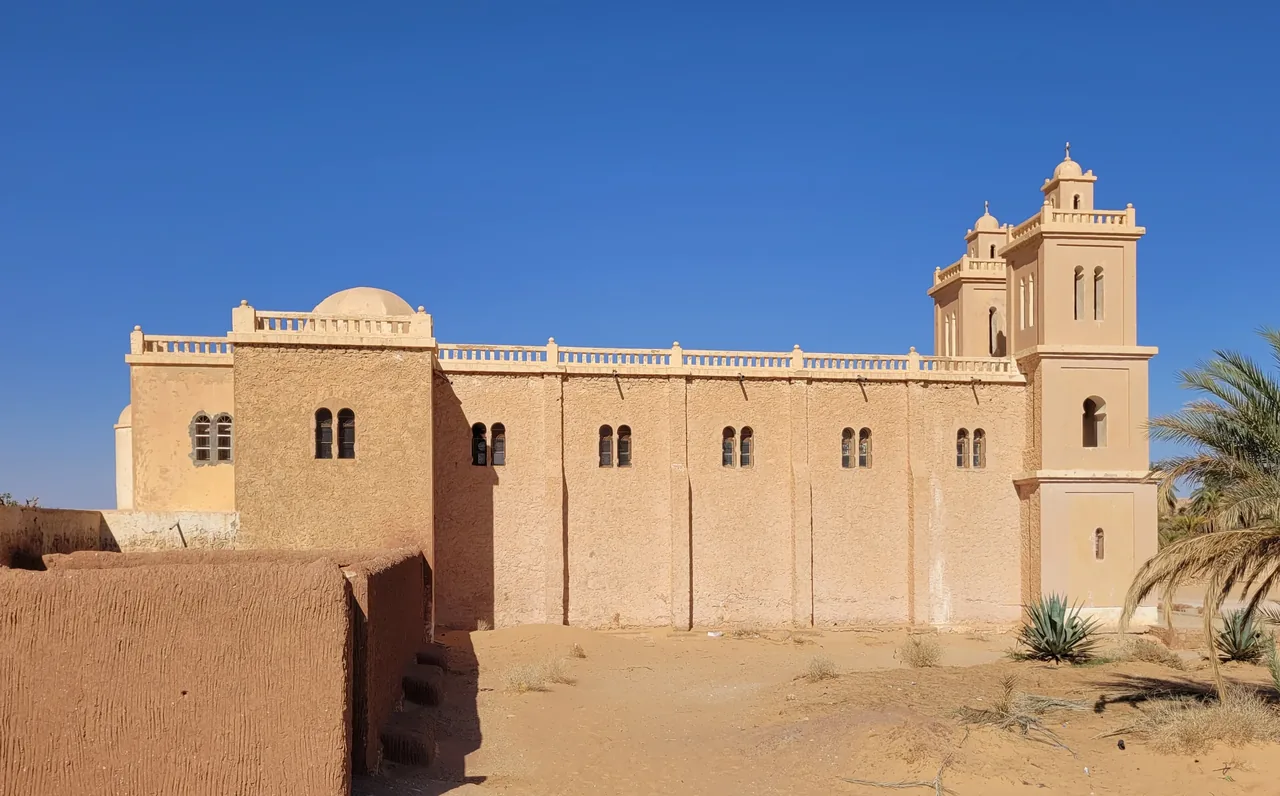
Church of Saint Joseph and the Tomb of Saint Charles de Foucauld, El Menia
The Saharan oasis church beside whose cemetery Saint Charles de Foucauld has been buried since 1929.
- Location
- El Menia, Algeria 30.5771° N · 2.8801° E
- Type
- Catholic parish church with the tomb of a canonised saint A modest Saharan church of the oasis, in the local building tradition
The grave in the oasis
Charles de Foucauld spent fifteen years in this desert wanting almost nothing except to be present, to be poor, to be a brother to the Tuareg among whom he lived, and to keep the Blessed Sacrament in a place where it had not been kept. He was killed at Tamanrasset in 1916. Since 1929 he has lain here. A Catholic comes to this grave to pray to a canonised saint, and to look at what a life stripped down to adoration and friendship actually cost.
From cavalry officer to hermit of the Sahara
Charles de Foucauld was a French officer and explorer before he was anything else, and by his own account a man who had lost his faith and found it again. He became a Trappist, then a hermit, then a priest, and settled first at Beni Abbes and later at Tamanrasset and the high hermitage of the Assekrem. He founded no order in his lifetime and made no converts he would have counted. What he did was stay, learn Tamahaq, compile its dictionary, keep the Eucharist, and be available. He was shot outside his hermitage on December 1, 1916. The Church canonised him in 2022. His spirituality is not a plan for dialogue but a way of prayer: the hidden life of Nazareth, adoration of the Blessed Sacrament, and a fraternity that followed from both rather than replacing them.
Charles de Foucauld was canonised by Pope Francis on May 15, 2022.
The Diocese of Laghouat-Ghardaia is the largest in Africa, covering more than two million square kilometers of the Algerian Sahara.
The diocese descends from the Apostolic Prefecture of the Sahara, created in 1868 under Cardinal Lavigerie.
The diocese describes the traces of Charles's presence at Beni Abbes, Tamanrasset and the Assekrem as making its territory a place of spiritual pilgrimage.
He wanted to be the least among them and to keep the Blessed Sacrament in the desert. He is buried in the desert still.
The Diocese of Laghouat-Ghardaia names this as a place of pilgrimage and not merely of tourism. It is a grave in a desert cemetery in a parish that serves a very small and largely migrant Catholic community. Silence suits it.
Do Not Miss
-
The grave
The reason the place exists for a pilgrim. The diocese presents it as a genuine pilgrimage destination.
-
Adoration
The Blessed Sacrament was the center of his desert life. It is the prayer that belongs here.
-
The silence
He chose it deliberately and for years. A visit that fills it misses him.
- That his was a life of adoration and hidden presence, not a program of interreligious relations
- That the diocese which keeps his grave is overwhelmingly a Church of migrants and students today
- That the Sahara he lived in is still difficult to reach, and that this was part of the point
Visit Plans
-
Prayer at the grave
3 ordered stopsA short visit ordered around the grave, the parish church beside it, and the silence Charles de Foucauld chose. Reaching El Menia is the long part; what happens here is brief and quiet.
- The church of Saint Joseph
- The grave in the cemetery beside it
- Time kept in silence, as he kept it
How to Visit
El Menia is deep in the Algerian Sahara, roughly a thousand kilometers south of Algiers, and is reached by long road journeys or internal flights to nearby Saharan towns. Travel in southern Algeria is subject to restrictions, and foreign visitors are often required to travel with authorised arrangements. Write to the diocese well in advance and check your own government's current travel advice for southern Algeria before planning anything.
- Prayer at the grave of Saint Charles de Foucauld
- Eucharistic adoration in the spirit of the hermit of the Sahara
- Intercession for the peoples of the Sahara among whom he lived
- The hidden life of Nazareth, which shaped everything he did here
The deep Sahara is not a casual destination.
El Menia lies about a thousand kilometers south of Algiers. Travel in southern Algeria is subject to permissions and escort requirements that change, and several governments advise against travel to parts of the Algerian south. The Catholic presence is very small. Contact the Diocese of Laghouat-Ghardaia before forming a plan, and consult current official travel advice for the region.
- What is here
- The grave of Saint Charles de Foucauld, in the cemetery beside the church of Saint Joseph, since 1929
- Diocese
- Laghouat-Ghardaia, the largest diocese in Africa
- Access
- Deep Sahara; long overland journeys and regional travel restrictions apply
- Before you go
- Contact the diocese and consult current official travel advice for southern Algeria
Current access
- Several governments advise against travel to parts of the Algerian south.
- Check your own government's current advice before forming any plan.
- The diocese, not an itinerary, is the right authority on whether and how to come.
Prayer and custody
- Eucharistic adoration and silence are the prayer that belongs here.
Relics, Tombs, Sacred Objects
Tomb and Burial
- Saint Charles de Foucauld is buried here. He was killed at Tamanrasset on December 1, 1916 and his body was brought to El Golea, now El Menia, in 1929.
Relics and Sacred Tradition
- The grave itself. The diocese presents it as a place of spiritual pilgrimage.
Sacred Objects
- The grave in the cemetery beside the church
- The church of Saint Joseph
Map
Hero image sourced from Wikimedia Commons (Bernard Gagnon, CC BY 4.0), as is the photograph of the tomb. Tomb location, date (1929), diocesan status and pilgrimage framing all from the Diocese of Laghouat-Ghardaia's own presentation page. Canonisation date confirmed independently. Access language deliberately defers to official travel advice rather than asserting it; southern Algeria carries regional restrictions distinct from the north. Beni Abbes, Tamanrasset and the Assekrem are named in the diocesan source; they are Foucauld's other Saharan places and lie far to the south.
September 17, 2026