
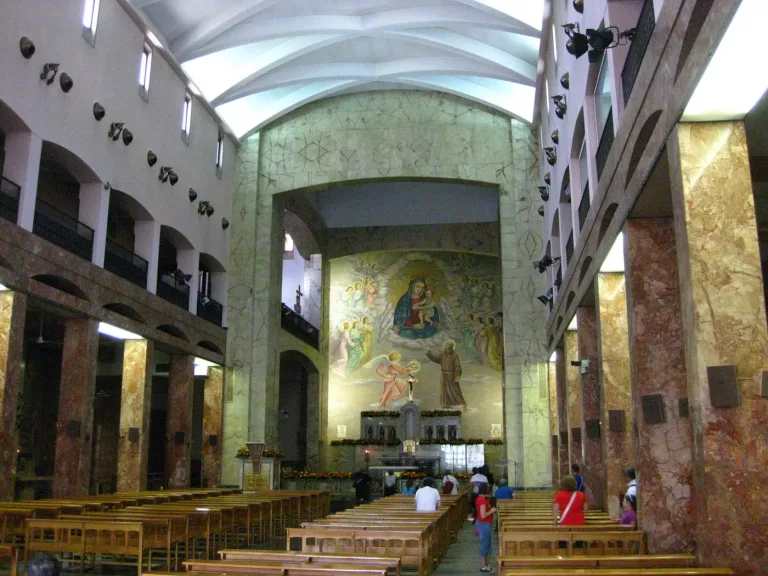
Sanctuary of Saint Pio, San Giovanni Rotondo
A sanctuary best understood through the sacrament of reconciliation and care for the sick: the friary where Padre Pio lived, the church where he prayed, and the tomb where pilgrims now ask his intercession.
- Location
- San Giovanni Rotondo, Italy 41.7065° N · 15.7277° E
- Type
- Catholic Capuchin sanctuary, friary, pilgrimage church, and saint tomb Historic friary church, mid-century sanctuary, and contemporary pilgrimage church
- Dedication
- Our Lady of Grace and Saint Pio of Pietrelcina
- Time Needed
- 2 hours to half a day
Begin where the friar actually lived
San Giovanni Rotondo can feel immense because devotion to Padre Pio outgrew the small friary.
The right order restores the person: begin with the older church, choir, and confessional ministry; continue to the tomb; then look toward the hospital he founded for suffering people.
A hidden friary becomes a world pilgrimage center
Padre Pio arrived at the Capuchin friary in 1916 and remained until his death in 1968. Pilgrims came for Mass and especially confession. The sanctuary expanded as crowds grew, and the newer Church of Saint Pio was built beside the historic complex. His body was exhumed in 2008 and later placed for public veneration in the crypt under Church and Capuchin oversight.
Three church spaces belong to one sanctuary. The small ancient church of Santa Maria delle Grazie is the church of Padre Pio’s ministry. The larger Santa Maria delle Grazie sanctuary was consecrated in 1959. The Church of Saint Pio, opened in 2004, has an upper church and a lower church used for veneration. The friary’s historic rooms and museum route have their own access arrangements.
The older church and friary should be visited before the monumental pilgrimage church
The tomb is documented; claims of complete incorruption are not made
The Casa Sollievo hospital keeps his practical work of mercy visible
Spiritual Significance
The place is not principally a theater of extraordinary phenomena. Padre Pio's daily work was priestly: Mass, confession, spiritual direction, prayer, obedience, and the hospital built for the sick.
Do Not Miss
-
The older friary church
Begin with the scale of Padre Pio's actual life before entering the spaces built for later crowds.
-
The confessionals and choir
Let the sacramental ministry interpret the extraordinary claims, not the other way around.
-
The tomb
Pray for reconciliation, endurance, and the sick; avoid sensational claims about the body's condition.
-
Casa Sollievo della Sofferenza
Recognize Padre Pio’s work of mercy from the sanctuary surroundings. Arrange any institutional visit through the hospital; patient areas are not a sightseeing stop.
- The contrast between the modest friary and the immense later pilgrimage church
- How Confession gives the sanctuary its deepest continuity
- The hospital as a work of mercy that outlived its founder
Visit Plans
-
Tomb and the Two Churches
Older church, friary context, tomb, and newer church.
-
Padre Pio in San Giovanni Rotondo
5 ordered stopsA sacrament-first path through friary, tomb, pilgrimage church, and hospital context.
- Begin in the older friary church.
- Visit the choir and confessional context.
- Pray at Saint Pio's tomb.
- Enter the newer pilgrimage church.
- End with Casa Sollievo and a prayer for the sick.
How to Visit
Ask the pilgrimages office which church currently holds the urn before deciding your sequence. Seasonal transfers take place between Santa Maria delle Grazie and the Church of Saint Pio; the sanctuary’s 2026 Lenten program announced one such transfer. Confirm Mass, Confession, languages, guided visits and access to historic rooms separately. Casa Sollievo is an operating hospital: its public pilgrim arrangements do not authorize entry into wards.
- Daily Mass and Confession according to current sanctuary schedules
- Prayer at Saint Pio's tomb
- Major pilgrim observances around September 23
Let the sanctuary set the day's rhythm.
Liturgy, Confession, access, reservations, and pilgrim routes vary by season and feast. Verify them at the official source.
Sacraments and pilgrimage access
- September feast crowds change access and movement.
- Allow enough time for the older friary before the newer pilgrimage church.
- Confirm the urn’s current placement before entering a crypt.
- The ancient church, 1959 sanctuary and 2004 pilgrimage church are distinct spaces within one complex.
- Ask the pilgrimages office about the choir, cell and museum route, mobility access and guided visits. Do not assume every historic room is open.
Relics, Tombs, Sacred Objects
Tomb and Burial
- Saint Pio of Pietrelcina
Relics and Sacred Tradition
- The body of Saint Pio, venerated under Capuchin custody within the sanctuary complex; confirm which church currently holds the urn
Sacred Objects
- The older friary church where Padre Pio celebrated Mass
- The choir and crucifix associated with the 1918 stigmata
- The confessionals associated with his long sacramental ministry
Connected Saints
Continue Your Pilgrimage
-
Catholic hospital
Casa Sollievo della Sofferenza
The hospital Padre Pio founded, opened in 1956 as a practical work for those who suffer.
-
Birthplace pilgrimage
Pietrelcina
Padre Pio's family and early priestly landscape, best treated as a separate day or onward journey.
-
Cave sanctuary of Saint Michael
Sanctuary of Saint Michael the Archangel, Monte Sant'Angelo
The cave sanctuary of Saint Michael, a pilgrimage since the early Middle Ages, higher up the Gargano. Many pilgrims to Saint Pio's tomb make both visits in one journey.

Map
The page uses the Vatican for Padre Pio's biography and canonization, the Capuchin sanctuary for current pilgrim access, and Opera Padre Pio for the hospital. The tomb is documented; complete-incorruption claims are not made.
August 1, 2026
Photo credits
- Hero. Chiesa di Santa Maria delle Grazie, interno (San Giovanni Rotondo). Lino M / Wikimedia Commons (CC BY-SA 2.0). Source. CC BY-SA 2.0.
- Saint Pio's Shrine. 71013 San Giovanni Rotondo, Province of Foggia, Italy - panoramio (6). Photo: Itto Ogami, CC BY 3.0, via Wikimedia Commons. Source. CC BY 3.0.