
- Location
- Damascus, Syria 33.5024° N · 36.3202° E
- Type
- Modern Franciscan Catholic shrine at a traditional conversion site A modern Franciscan memorial, begun in 1967 and inaugurated in 1971, at a traditional location of Paul's conversion
- Dedication
- The conversion of St. Paul
The road is certain, the place is traditional
Come here because the road to Damascus is certain in Acts and the exact point is not.
The memorial gives pilgrims a place to pray with Paul's encounter with the risen Christ, while keeping the geography in its proper category: a traditional localization, and not biblical precision. Its twentieth-century date is part of the story. It is a Catholic act of memorialization.
A traditional site, a modern memorial
In Acts 9, Saul was approaching Damascus when a light from heaven flashed around him. He fell to the ground and heard the voice of Jesus. He was led into Damascus blind. The event transformed the direction of his life and mission. Acts does not say that it happened at the location of the present memorial, and it does not describe a church standing there in apostolic times.
The traditional conversion site is in the Al-Tabbaleh area of Damascus. Franciscans of the Custody built a chapel at the traditional location in 1925. Pope Paul VI desired a new Memorial of St. Paul at the site. Construction began in 1967, and the present memorial was inaugurated in 1971. It is entrusted to the Custody of the Holy Land.
The Vatican's documentation for John Paul II's 2001 pilgrimage in the footsteps of the apostle names the Memorial of St. Paul as a destination, and John Paul II visited it on May 7, 2001. In his later reflection on the journey, he described the memorial in terms of God's call, and of Paul leaving his former security to move forward in response to that call.
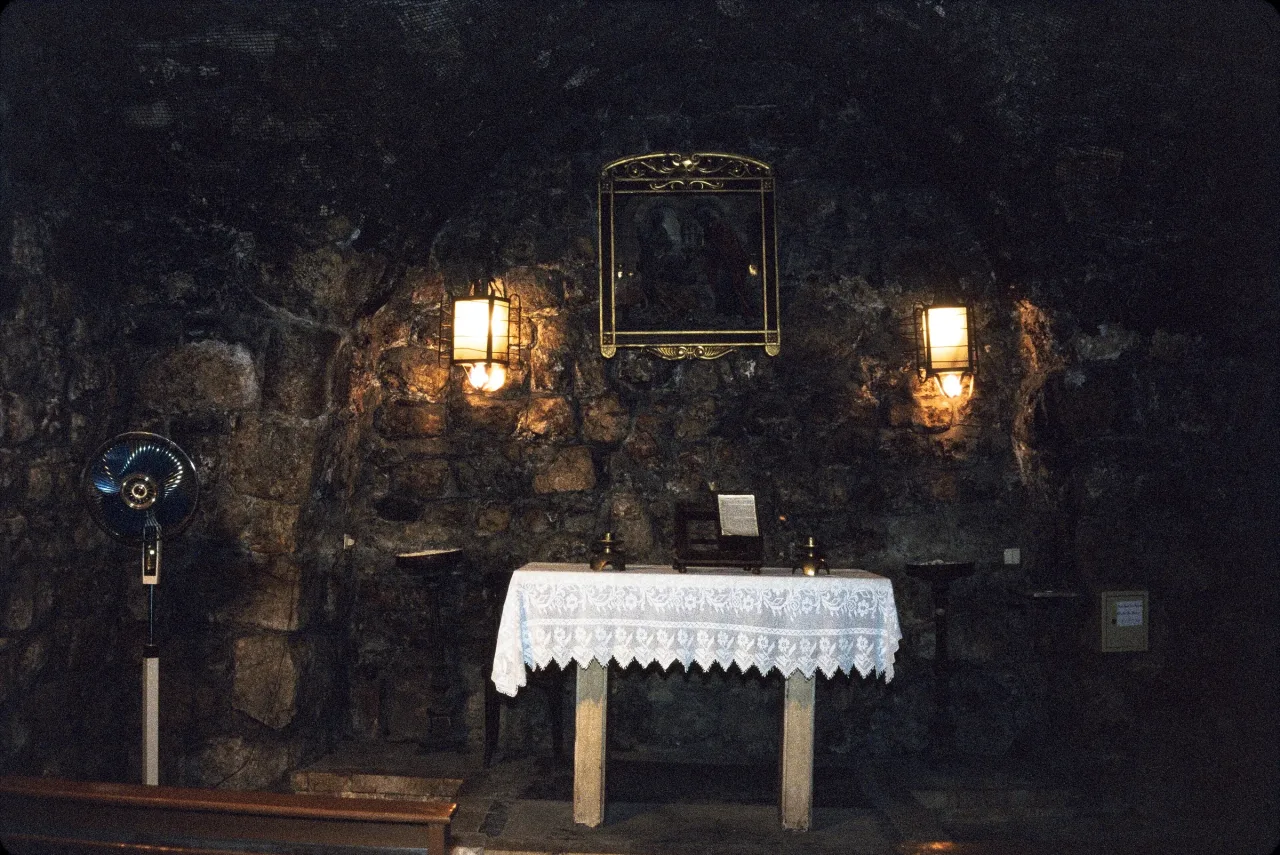
This is a modern shrine, not an archaeological church. Its character is deliberately that of a memorial. The principal stained-glass image inside shows Christ triumphant over death, and the shrine remains in Franciscan custody.
How to pray at the Memorial of St. Paul.
Read Acts 9:1-19, and let the geography stay traditional.
The light and the voice
Saul fell to the ground and heard the voice of Jesus. Pray with the encounter itself, and not with a picture of it.
Called out of security
John Paul II spoke of Paul leaving his former security to move forward in response to God's call. Ask what security you are being asked to leave.
Then the House of Ananias
The call is followed by reception, restored sight, and baptism. If you can, pray with both Damascus shrines as one Pauline sequence.
Spiritual Significance
The Memorial belongs with the House of Ananias in a Pauline sequence. Here the emphasis is encounter and call: Saul approaching Damascus. There the emphasis is reception into the Christian community, restored sight, baptism, and the words “Saul, my brother.” Neither surviving structure is apostolic.
Do Not Miss
-
The stained-glass window
The principal image in the memorial, showing Christ triumphant over death.
-
Acts 9:1-19
Bring the text. It gives the event and not its precise location.
- That this is a modern shrine and not an archaeological church.
- The shrine's deliberately memorial character.
- The stained glass, where the art of the memorial centers on Christ.
- The Franciscan custody of the place.
How to Visit
Verify current access with Franciscan and local Church sources, and consult current official travel guidance before planning any journey.
Continue Your Pilgrimage
Map
Vatican documentation for John Paul II's 2001 pilgrimage; Custody of the Holy Land; Acts 9:1-19.
September 18, 2026
Photo credits
- The principal stained-glass image. St Paul Damascus 2. Abojado / Wikimedia Commons (CC BY-SA 3.0). Source. CC BY-SA 3.0.