
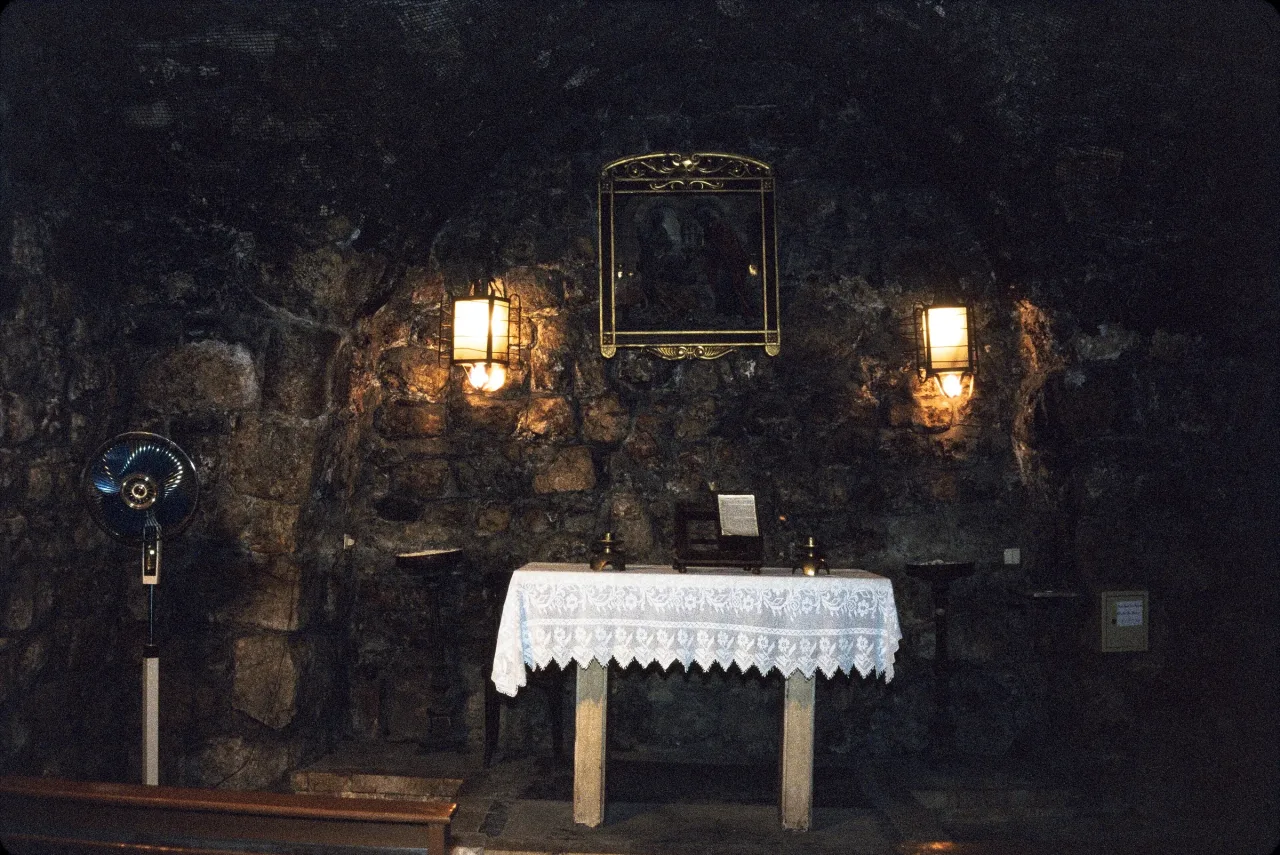
House of St. Ananias, Damascus
A traditional house site in Old Damascus, in the care of the Franciscans of the Custody of the Holy Land, that keeps the memory of Ananias receiving Saul.
- Location
- Damascus, Syria 33.5114° N · 36.3175° E
- Type
- Franciscan Catholic shrine and traditional house site An underground, crypt-like chapel of two rooms reached by a stair, rebuilt in 1867 and renovated in 1973
- Dedication
- St. Ananias of Damascus
Saul, my brother
Come here to stand with the man who obeyed the Lord, received a former persecutor, restored his sight, and stood at the threshold of his baptism.
The shrine is traditionally identified as the house of Ananias. Acts itself places Saul at the house of Judas on the street called Straight, which keeps the devotional tradition from becoming a false biblical claim.
What Acts says, and what the shrine keeps
Acts 9:10-19 tells us that Ananias was a disciple in Damascus. The Lord sent him to Saul, who was staying at the house of Judas on the street called Straight. Ananias laid hands on Saul, Saul regained his sight, and Saul was baptized. His words to the former persecutor were “Saul, my brother.”
Acts does not say that the house of Judas was Ananias's house. It does not say that the baptism took place in the surviving shrine, and it does not identify the surviving rooms. The Custody of the Holy Land describes the site as what is believed to have been the house of Ananias. That is a tradition, and it is kept here as one.
According to the Custody, archaeological work in 1921 uncovered remains associated with a Byzantine Church of the Holy Cross at the site, dated to the fifth or sixth century. The Custody obtained the return of the site to Christian use in 1820. The chapel was rebuilt in 1867 after destruction in 1860 and renovated in 1973. The shrine remains in Franciscan care, and the wider Franciscan presence in Damascus is a living pastoral ministry, not only the guardianship of a heritage site.
The traditional house is an underground, crypt-like space of two rooms reached by a stair, within the old walls of Damascus. Its scale is small and enclosed. The chapel has a later history of destruction, rebuilding, and renovation, so do not treat the rooms as first-century.
How to pray at the house of Ananias.
Read Acts 9:10-19 slowly.
Ananias's obedience
The Lord sent Ananias to the man who had persecuted the Church. Pray with his obedience, and ask for the courage to go where you are sent.
“Saul, my brother”
Ananias greets Saul as a brother. Ask for the grace to receive an enemy as a brother.
Sight and baptism
Saul regained his sight and was baptized. Pray for those who stand at the threshold of the faith, and for the people who are sent to them.
Spiritual Significance
The center of this place is Ananias's obedience and his words to the former persecutor. It is a place for thinking about Christian courage, about receiving an enemy as a brother, about baptism and conversion, and about the human intermediary in Paul's call.
Do Not Miss
-
The two-room chapel
An underground space reached by a stair, traditionally identified as the house of Ananias.
-
Acts 9:10-19
Bring the text. Acts places Saul at the house of Judas on the street called Straight.
- The intimate underground, two-room chapel.
- The sense of enclosure and scale.
- The later chapel history of destruction, rebuilding, and renovation.
- The site's place in Old Damascus and in the Pauline geography of the city.
How to Visit
Verify current shrine access with Franciscan and local Church sources, and consult current official travel guidance before planning any journey.
- A Franciscan shrine in the care of the Custody of the Holy Land, within a living Franciscan pastoral ministry in Damascus
Continue Your Pilgrimage
Map
Custody of the Holy Land; Acts 9:10-19; Holy See documentation on the Holy Land collection.
September 18, 2026
Photo credits
- Hero. Frank Kidner, Dumbarton Oaks / Wikimedia Commons (CC BY-SA 4.0). Source. CC BY-SA 4.0.