
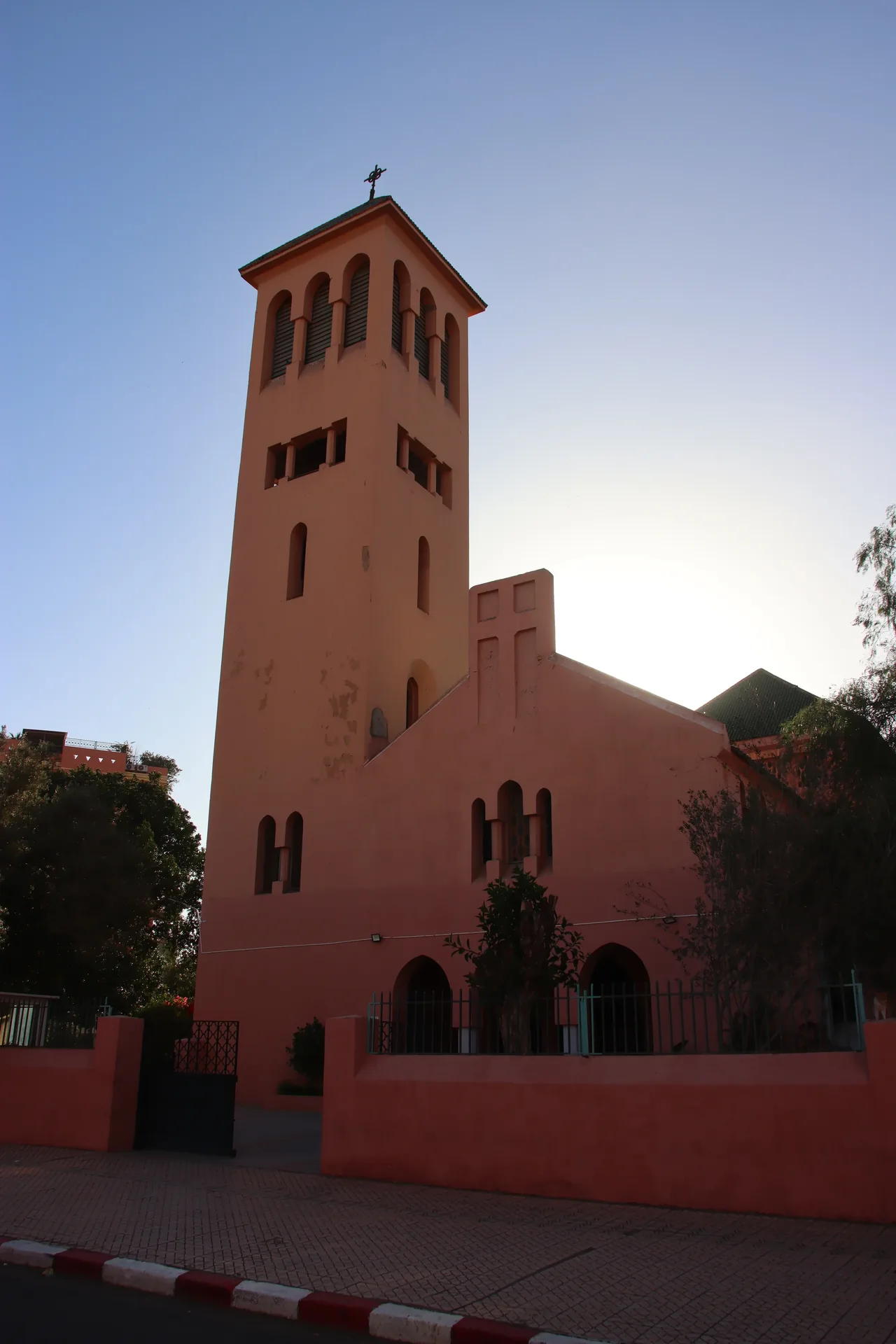
Church of the Holy Martyrs, Marrakech
A living Franciscan parish that is also the memorial of the first martyrs of the Franciscan order, and the far end of Saint Anthony's vocation.
- Location
- Marrakech, Morocco 31.6363° N · 8.0119° W
- Type
- Catholic parish church, Archdiocese of Rabat Built from 1928 in the Gueliz quarter; blessed in December by the Vicar Apostolic of Morocco
The blood at the beginning of the order
Francis sent five brothers to Morocco in 1219.
They went to the king of Marrakech to speak to him about Jesus, were expelled, came back, were imprisoned, came back again, and were killed on January 16, 1220. They are the first martyrs of the Franciscan order. Their story does not end there: when their relics reached Coimbra, a young Augustinian canon named Fernando saw them, left his order, became a Friar Minor, took the name Anthony, and set out for Morocco to do the same. Illness turned him back and a storm carried him to Italy. Anthony of Padua exists because five men died in this city.
Marrakech, Coimbra, Padua
The account the parish gives is plain: the five went to speak of Christ, were driven out, returned, were imprisoned and scourged, and on January 16, 1220 the king himself killed them. They were canonised and are kept as the protomartyrs of the order; the Archdiocese of Rabat names them as its patrons. Benedict XVI, teaching on Anthony of Padua, put the consequence in the Church's own words: the exposition of their relics at Coimbra in 1220 was the decisive turning point of Fernando's life, moving him to leave the Augustinian canons and to seek martyrdom in Morocco himself. The present church was built from 1928, in the colonial period, and the parish is careful to say it stands not far from the place of the martyrdom rather than on it. The Franciscans have served here since the mission was re-established in 1913, and three friars serve the parish now.
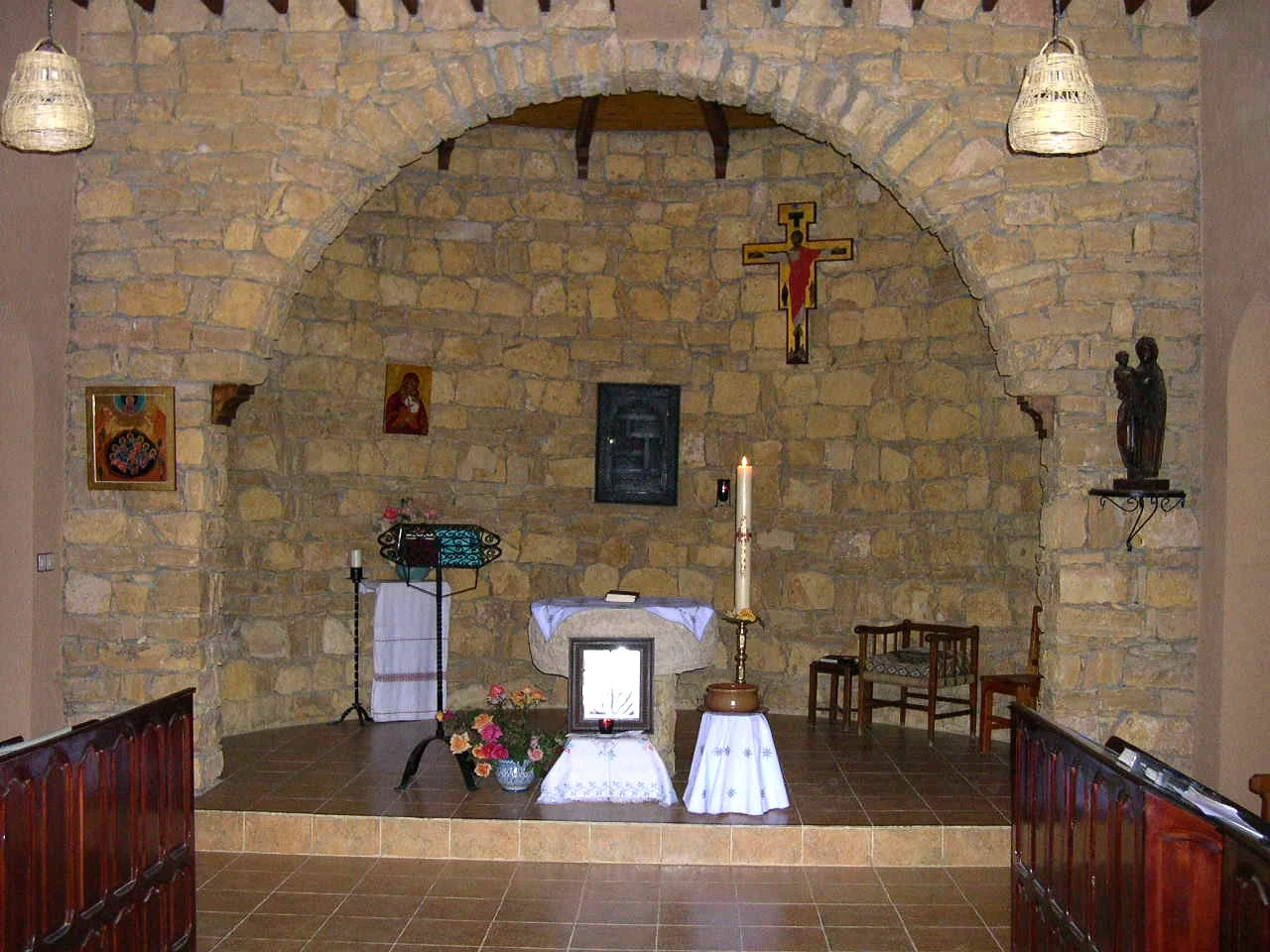
A church of the Gueliz quarter, built from 1928 and blessed by the Vicar Apostolic of Morocco. Inside, the altar mosaic carries the Arabic words Allah Mahabba, God is Love, from the First Letter of John, laid out in the shape of a cross. The baptistery holds seven paintings forming a baptismal catechesis. An icon of the Visitation hangs in the church; the parish describes it as an image of what it is for: carrying the greatest treasure of the faith out to meet another and to serve them.
The five protomartyrs are Berard of Carbio, Otho, Peter of San Geminiano, Adjutus and Accursius, killed on January 16, 1220.
The parish states that the church, built in 1928, stands not far from the place of their martyrdom. It does not claim the exact spot, and neither should a visitor.
The Franciscan martyrs are the patron saints of the Archdiocese of Rabat.
Blessed John of Prado, martyred in Morocco in 1631, has a chapel in the church.
The Franciscan mission in Marrakech was re-established on September 11, 1913 by Fr Apollinaire Colombie, to renew a Christian presence interrupted since 1790.
Five friars died here in 1220. When their relics reached Coimbra, a canon named Fernando left his order, took the name Anthony, and set out for Morocco himself.
This is the only church in the region and a genuinely working parish, with catechism, a choir, weddings and funerals, and a foreign and sub-Saharan African congregation. On the thirteenth of every month, except Saturdays and Sundays, a Mass of Saint Anthony of Padua is celebrated with the blessing of bread. That is not a tourist custom; it is the parish's own devotion, and it is the living end of the thread that runs back to 1220.
Do Not Miss
-
The Mass of Saint Anthony on the thirteenth
The blessing of bread, in the city whose martyrs made him a Franciscan.
-
The altar mosaic
Allah Mahabba, God is Love, in Arabic in the form of a cross.
-
The icon of the Visitation
The parish's own image of what it is doing here.
-
The chapel of Blessed John of Prado
A second Moroccan martyr, from 1631, kept in the same church.
- That the parish says near the place of martyrdom, not on it
- That the Franciscan martyrs are the patrons of the whole Archdiocese of Rabat
- That the congregation is largely foreign and sub-Saharan African
- That the Arabic on the altar is a confession of faith, not decoration
How to Visit
The church is on Rue de Imam Ali in Gueliz, a short taxi ride from the medina. Arrange the visit around Mass: weekdays at 19.00, Saturday at 18.30, Sunday at 10.30 in French and 12.30 in English. If you can be in Marrakech on the thirteenth of the month, go to the Saint Anthony Mass.
- Daily Mass, with Sunday Mass in French and in English
- The Mass of Saint Anthony of Padua on the thirteenth of each month, with the blessing of bread
- Veneration of the Franciscan protomartyrs
- The chapel of Our Lady, kept with flowers and candles by the faithful
A working parish with a monthly Saint Anthony Mass.
The parish publishes its own Mass times and keeps a special Mass of Saint Anthony of Padua on the thirteenth of each month, with the blessing of bread, except when the thirteenth falls on a Saturday or Sunday. Morocco does not restrict Catholic worship for foreign residents and visitors, and the church is openly a parish.
- Sunday Mass
- 10.30 in French, 12.30 in English
- Saturday
- 18.30
- Weekdays
- 19.00
- Saint Anthony
- Mass with the blessing of bread on the 13th of each month, except Saturdays and Sundays
- Address
- Rue de Imam Ali, Gueliz, Marrakech 40020
Current access
Prayer and custody
Relics, Tombs, Sacred Objects
Tomb and Burial
- The martyrs are not buried here. Their relics were carried to Coimbra in Portugal in 1220, where their exposition changed the life of the man who became Anthony of Padua.
Relics and Sacred Tradition
- The parish does not publish a relic claim. The church is a dedication and a memorial, not a reliquary shrine.
Sacred Objects
- The chapel of Blessed John of Prado, martyred in Morocco in 1631
- The altar mosaic reading Allah Mahabba, God is Love, in Arabic in the form of a cross
- An icon of the Visitation, which the parish describes as an image of its own life in a land of Islam
- Seven paintings by Q. Rieunier in the baptistery, forming a baptismal catechesis
Connected Saints
Continue Your Pilgrimage
Map
Hero image sourced from Wikimedia Commons (Draceane, CC BY-SA 4.0). The martyrdom-location limit ('not far from the place of their martyrdom') is the parish's own wording on its history page and is preserved exactly; a boilerplate line elsewhere on the same site says 'executed on the spot in the twelfth century', which is wrong on both century and location and is not used. Benedict XVI's General Audience of February 10, 2010 is the Church source for the Anthony bridge. The five martyrs' names follow the parish's French forms, anglicised.
September 17, 2026
Photo credits
- Hero. Draceane, CC BY-SA 4.0, via Wikimedia Commons. Source. CC BY-SA 4.0.