
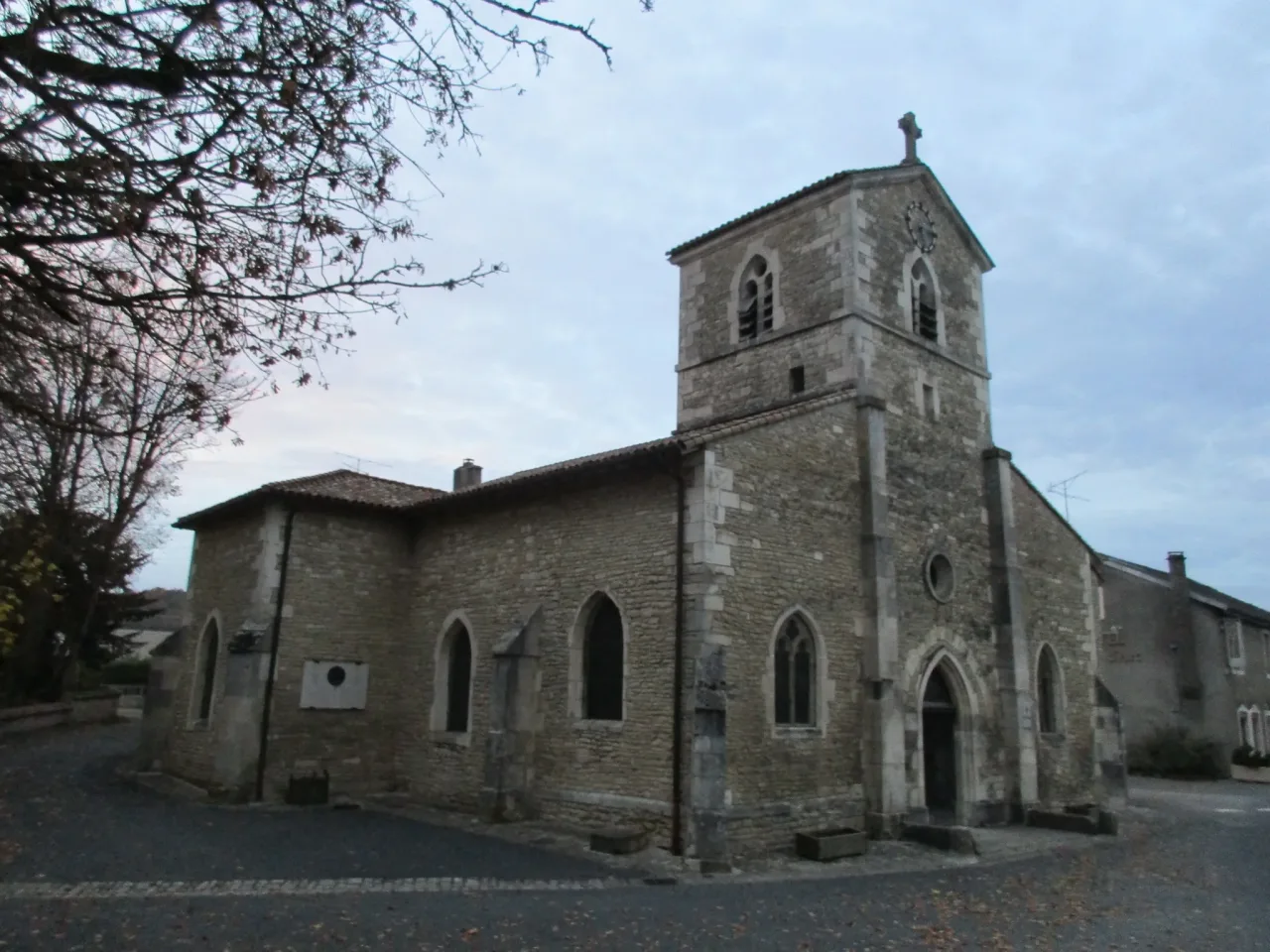
Église Saint-Remy, Domrémy-la-Pucelle
Saint-Remy is the parish church of Domrémy-la-Pucelle. Joan of Arc was baptized here as an infant, went to Mass here as a girl, and knew this building better than any other. It stands a two minute walk from the house where she was born and has been altered many times since.
- Location
- Domrémy-la-Pucelle, France 48.4423° N · 5.6749° E
- Type
- Parish Church A small village church of the Meuse valley carrying work of several periods, with a squat western tower, lancet windows and a nave altered and reordered across the centuries since Joan's lifetime
- Dedication
- Saint Remigius of Reims, the bishop who baptized Clovis
The Parish Before the Mission
Everything public about Joan of Arc began somewhere private and sacramental, and this is where. She was made a Christian in this parish, and the sacramental life she kept up under interrogation at Rouen, the confession and Communion she asked for and was refused, started in this room. Coming here first puts the rest of her story in the right order. She was not a soldier who happened to be devout. She was a baptized village Catholic who was sent.
Baptized at Domrémy
Joan was baptized in this parish as an infant, around 1412. The exact day is not recorded, and the godparents named later in the rehabilitation testimony are the closest thing to a contemporary account of the event. She grew up going to this church. Witnesses at the 1456 proceedings remembered a girl who went to confession often, who knelt when the bells rang, and whom some of the other children teased for praying too much. She named Saint Michael, Saint Catherine and Saint Margaret when she was asked at Rouen who spoke to her, and those three were figures a Lorraine village would have known from its own altars and images rather than from a theologian's library. The dedication of the church is to Saint Remigius, the bishop who baptized Clovis at Reims. Joan would return to Reims seventeen years later for a coronation.
A small stone church with a heavy western tower and a nave that has been rebuilt and reordered more than once. Work of several centuries sits side by side, and the interior arrangement is not the one Joan knew. The building is nonetheless continuous with the church of her baptism rather than a later replacement on the site.
Spiritual Significance
The church is plain, cool and usually empty. It is a working parish rather than a shrine, and it has not been dressed up. That plainness is the most valuable thing about it. Whatever a visitor brings to Joan of Arc, this room resists it and offers instead the ordinary means by which a Christian is made.
Do Not Miss
-
The font
Shown as the font of Joan's baptism. That this was her parish is secure. Whether this is the very font is a narrower claim we leave open.
-
The sixteenth-century retables
An inscription in the church dates the altarpieces of the Blessed Virgin and Saint Nicholas to the sixteenth century, when Joan's great-nephew Claude du Lys was curé here.
-
The dedication
Saint Remigius baptized Clovis at Reims. Joan was baptized in a church named for him and went to Reims for a coronation.
-
The plainness
Nothing here is staged. It is a village parish that happens to have baptized a saint, and it still behaves like a village parish.
-
The walk to the house
Two minutes. The distance between her baptism and her cradle is the size of the whole world she knew until she was about seventeen.
How to Visit
Come from the birthplace, which is two minutes away, and sit down before looking at anything. The church is small enough to exhaust visually in five minutes and worth twenty. Bois-Chenu is above the village and belongs later in the day.
- Mass in the ordinary rhythm of a small rural parish, not daily
- Diocesan Johannine pilgrimage liturgies at the end of May
- Private prayer through the day when the church is open
A working rural parish, usually open by day.
- Where
- Domrémy-la-Pucelle, 88630, Vosges
- Diocese
- Diocese of Saint-Dié
- Time needed
- Twenty minutes, longer if you stay to pray
- Mass
- Not daily. A rural parish shares a priest with neighboring villages
- Before you go
- Confirm Mass times with the diocese. Johannine pilgrimage liturgies fall at the end of May
Visiting
- The churchyard and the outside of the building can be walked at any hour, and the birthplace stands two minutes away.
Additional schedule notes
Liturgy
Mass here is occasional rather than daily. The end of May, around Joan's feast on May 30, is when the diocesan pilgrimage brings the parish and Bois-Chenu together.
- The diocesan Johannine pilgrimage joins this parish church to the basilica at Bois-Chenu on the hill above.
Confirm with the Diocese of Saint-Dié rather than assuming a Sunday Mass in the village itself.
Relics, Tombs, Sacred Objects
Tomb and Burial
- No saint is buried here. Joan was executed at Rouen in 1431 and no remains survive.
Relics and Sacred Tradition
- The church holds no relic of Joan of Arc. No authenticated bodily relic of hers is known to survive anywhere, and the devotional interest of this church is its continuity as her parish rather than any object.
Sacred Objects
- The baptismal font, shown to pilgrims as the place of her baptism. The identification of this parish is secure; the identification of this particular font is not.
- Retables of the altars of the Blessed Virgin and Saint Nicholas, recorded in the church as sixteenth-century work from the time when Claude du Lys, a great-nephew of Joan, was curé here.
- The fabric of the building itself, which preserves earlier material inside later rebuilding.
The rest of the Domrémy geography


Map
That Joan was baptized in this parish is secure; the exact date is not, and the record does not supply one. The building has been altered repeatedly since the fifteenth century and preserves earlier material within later work. That narrower claim needs primary or heritage evidence, and the broader claim, that this is the church in which she was baptized, does not depend on it.
September 2, 2026
Photo credits
- Hero. Photo: Arnaud 25, CC BY-SA 4.0, via Wikimedia Commons. Source. CC BY-SA 4.0.
- The Church Dates Its Own Furniture. Photo: Arnaud 25, CC BY-SA 4.0, via Wikimedia Commons. Source. CC BY-SA 4.0.