
The Holy Nail (Sacro Chiodo)
Passion relic, traditional venerationShown annually in the rite of the Nivola
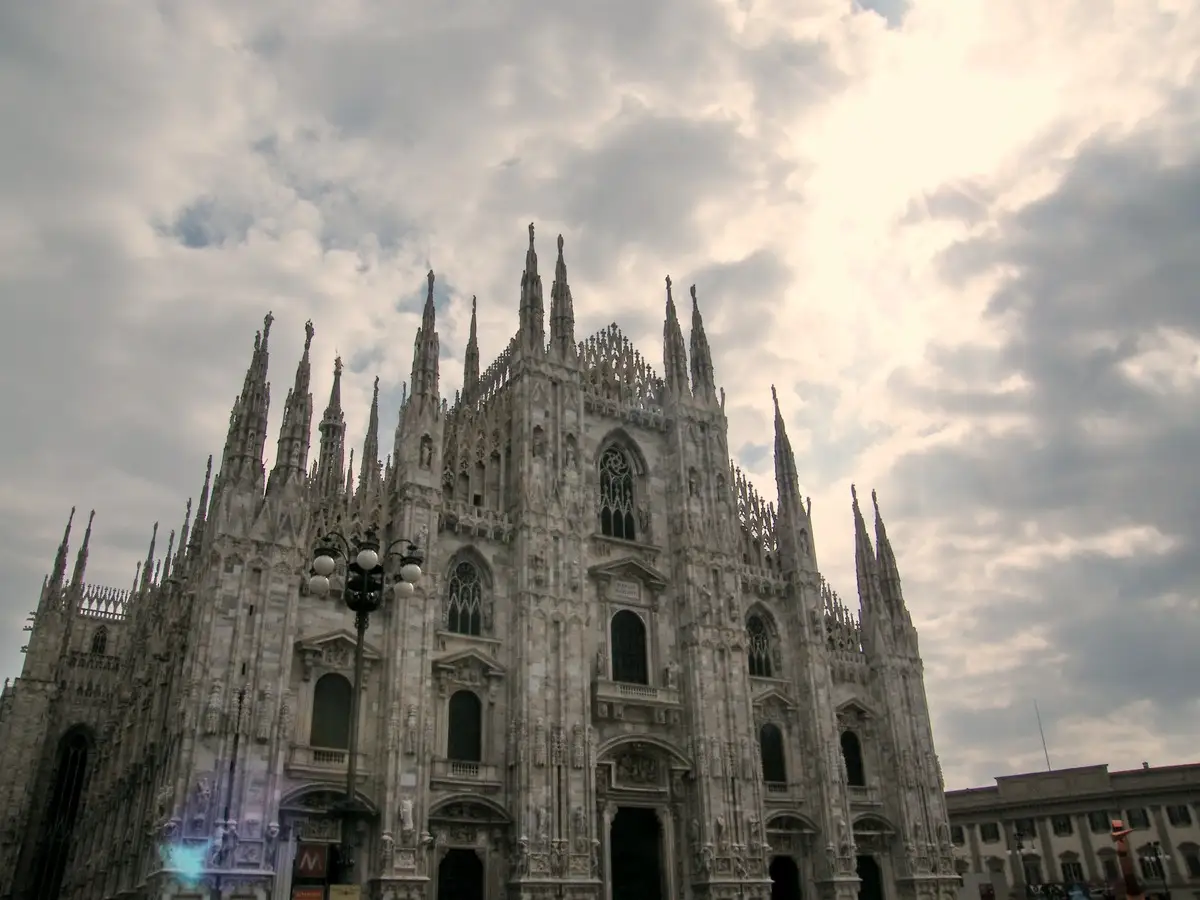
Duomo di MilanoMilan Cathedral is the vast Gothic cathedral of the Archdiocese of Milan, dedicated to Saint Mary of the Nativity and known for its marble spires, Madonnina, Holy Nail devotion, and crypt of Saint Charles Borromeo.
The Duomo is famous for its marble pinnacles and rooftop, but it is first a cathedral: dedicated to Santa Maria Nascente, Mary of the Nativity, and the seat of the ancient Ambrosian church of Milan. Its devotional weight is real. The Holy Nail, venerated as a relic of the Passion, is set high above the apse, and Saint Charles Borromeo lies in the crypt below. Begin inside, with the nave, before climbing to read the spires up close.
Construction began in 1386 and continued across centuries of Milanese life. The cathedral became the city's sacred center, shaped by Gothic ambition, reforming archbishops, and the long patience of marble. It remains the seat of the Archbishop of Milan and the heart of the Ambrosian liturgy.
The exterior is famous for lace-like marble, a forest of spires and statues, and the rooftop terraces crowned by the gilded Madonnina. Inside, the nave is darker and more solemn, its great columns drawing the eye toward the altar and the apse.
Read the cathedral before the rooftop. Four things carry its meaning.
The vast marble nave is the cathedral itself; the rooftop is a later wonder, not the point.
Beneath the choir, the scurolo holds the tomb of Saint Charles Borromeo, reforming archbishop of Milan.
A red light high in the apse marks the Sacro Chiodo, venerated as a nail of the Passion.
The gilded Virgin crowns the highest spire; the terraces let you read the saints and pinnacles up close.
The cathedral is dedicated to Santa Maria Nascente, Saint Mary of the Nativity, and is the seat of the Archbishop of Milan.
The Holy Nail is shown in the annual rite of the Nivola rather than as an ordinary display object.
The Duomo is not only a landmark or a panorama. Its Catholic heart is Marian, Ambrosian, and Passion-centered, with the Holy Nail above the apse and the tomb of Saint Charles giving the visit real devotional weight.
Enter the cathedral first. The immense marble nave and the colored light of its windows are the heart of the Duomo, easily skipped by visitors who rush to the lift.
Below the choir lies the tomb of Saint Charles Borromeo, the reforming archbishop of Milan, in a richly decorated underground chapel. A place for prayer, not only sightseeing.
High in the apse, a small red light marks the Sacro Chiodo, traditionally venerated in Milan as a nail of the Passion. It is not handled like an ordinary display object; it is brought down once a year in the rite of the Nivola.
Some of the largest stained-glass windows in the world fill the apse and aisles, and the towering nave columns carry the eye upward toward the altar.
Climb to walk among the marble spires and statues, with the gilded Madonnina at the summit watching over the city. Read it as sacred-city iconography, not just a viewpoint.
Beneath the cathedral, when ticketing allows, lie the remains of the early baptistery of Santa Tecla, where Milanese Christianity took root.
Begin inside, with the nave, the stained glass, and the crypt of Saint Charles, before considering the roof.
Add the rooftop terraces, the cathedral museum, and the archaeological area beneath the square, after time in the cathedral.
Plan around the Ambrosian liturgy. Begin with Mass or prayer, then the crypt of Saint Charles and the Marian focus of the cathedral.
Begin inside the cathedral before going to the rooftops. Visit the crypt of Saint Charles if accessible, notice the stained glass and altar, then use the rooftop terraces to read the spires and saints up close. Check official ticketing and liturgy schedules before you go.
Visiting
Good to know
As an active cathedral, modest dress is required; shoulders and knees should be covered.
Rooftop access depends on weather and can close in poor conditions.
Shown annually in the rite of the Nivola
Duomo di MilanoPublic veneration in the crypt
Archdiocese of MilanDevotional landmark
Duomo di MilanoSource note Traditional attributions are presented as tradition, with documentation named where it exists.
Use this for corrections, broken links, missing places, and planning ideas.